











 Secure payments
Standard refund policy
Trade Assurance
Secure payments
Standard refund policy
Trade Assurance
| Product Type | Memory Module |
|---|---|
| Memory Capacity | 32 GB |
| Memory Technology | DDR4 |
| Product Voltage | 1.2V |
| RAM Speed | 2666MHz |
| RAM Standard | DDR4-2666/PC4-21300 |
| Error Identifying | ECC |
| Signal Type | Unbuffered |
| Column Access Strobe (CAS) | CL19 |
| Rank | Dual Rank x8 |
| Quantity of Pins | 288-pin |
| RAM Genre | UDIMM |
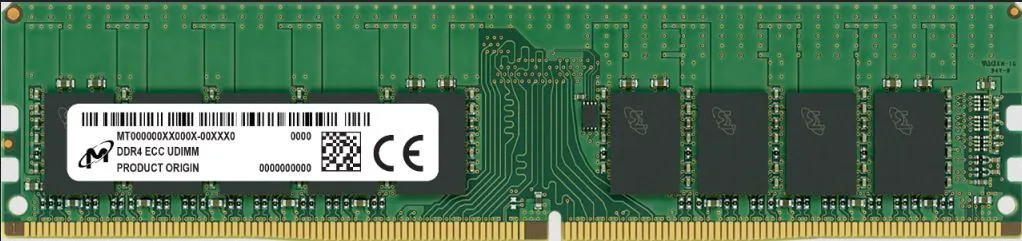
This unbuffered ECC UDIMM is best suited for entry-level servers and professional workstations running memory-intensive workloads like virtualization, in-memory databases, or critical data analysis. Its dual-rank x8 organization improves interleaving for lower latency, while integrated ECC at a standard 1.2 V ensures data integrity without sacrificing energy efficiency.
1. ECC error correction safeguards transactional integrity by detecting and rectifying single-bit faults in real time, essential for preventing silent data corruption in always-on enterprise servers.
2. 32 GB capacity per stick doubles the memory footprint of a typical dual-slot server node, letting virtualization hosts pack more tenants and larger database caches without expanding hardware.
3. 2666 MHz speed provides the steady throughput needed to feed modern multi-core Xeon processors, keeping data pipelines full during concurrent analytics and high-frequency trading jobs.
4. Dual rank x8 organization interleaves access across internal banks, sustaining full channel saturation and consistent latency even under heavy multi-VM consolidation.
5. 1.2 V low operating voltage trims datacenter power draw and waste heat at scale, directly improving power usage effectiveness for dense rack deployments.
When you operate a virtualized cluster hosting business-critical applications, silent data corruption is your worst enemy. The Micron MTA18AS4FG72AZ-2G6B1R is a 32GB DDR4-2666 ECC UDIMM engineered specifically for entry-level servers and workstations where data integrity cannot be compromised, yet registered buffering is neither required nor supported. Its unbuffered ECC design allows the CPU to detect and correct single-bit errors in real time, preventing a flipped bit in a hypervisor’s memory space from cascading into an entire node failure during live migration.
Paired with its dual-rank x8 organization, this module enables rank interleaving that improves sustained bandwidth for memory-intensive workloads. In an in-memory database like Redis or a transactional cache, that means faster key retrieval under high concurrency without stalling the pipeline. The 32GB capacity on a single stick also maximizes the limited DIMM slots of micro-ATX server boards, giving you the density to run more virtual machines or larger dataset allocations without sacrificing error correction. For the IT manager overseeing a 24/7 small-office virtualization host or a developer compiling large codebases on a workstation, this memory transforms stability from a hope into a guarantee, directly reducing unplanned downtime and data validation overhead.
General Virtualization
Deploy this 32GB ECC UDIMM in pairs or quads across all memory channels to maximize capacity while preserving data integrity. A typical dual-socket virtualization host benefits from six to eight identical modules (192–256 GB total), allowing dozens of VMs to run comfortably with memory overcommit protection. Always populate symmetric slots to maintain NUMA balance and avoid performance cliffs under mixed workloads.
In-Memory Database
In-memory databases demand low latency and absolute reliability, making ECC non‑negotiable. Install four to six of these dual‑rank x8 modules for 128–192 GB capacity; the 2666 MHz speed and CL19 latency provide a stable foundation for Redis, SAP HANA, or Memcached instances. Avoid mixing different ranks or speeds, and configure the BIOS for maximum memory throughput to keep query response times predictable.
High‑Performance Computing
For HPC nodes where memory bandwidth directly governs performance, populate every available memory channel with one 32GB DIMM — for example, eight modules in an octa‑channel platform to achieve 256 GB at peak bandwidth. The unbuffered ECC design reduces latency compared to registered DIMMs, which benefits tightly coupled parallel codes. Match this with a balanced CPU memory controller configuration and enable interleaving to avoid hot‑spot channels during large‑matrix computations.
Rigorously tested; compatible with Dell PowerEdge T140, HPE ProLiant ML30 Gen10, and Lenovo ThinkSystem ST50.
Q: Can I mix this MTA18ASF4G72AZ-2G6B1R with other memory modules of different brands or speeds?
A: Mixing non-identical modules on a server platform is not recommended. ECC UDIMMs should be matched by part number, rank, and speed to maintain signal integrity and avoid memory errors in mission-critical environments.
Q: Is this memory compatible with my Intel Xeon E-2300 series platform?
A: This 32GB DDR4-2666 ECC UDIMM is validated for Intel Xeon E-2300/E-2200 and select AMD Ryzen PRO platforms that support unbuffered ECC. Always confirm board-level QVL for specific 288-pin DDR4 ECC compatibility.
Q: What is the recommended DIMM population order for optimal performance?
A: Populate identical modules starting with the farthest slot from the CPU per channel, typically the blue slots first on server boards. Follow the motherboard’s memory population guide to enable dual-channel symmetric mode.
Q: Does this module support overclocking or XMP profiles?
A: No. This is a JEDEC-compliant DDR4-2666 ECC UDIMM operating at PC4-21300 standards. It does not carry XMP profiles and is not designed for overclocking; stability and data integrity are prioritized.
Q: What warranty and typical failure rate can I expect?
A: This module includes a one-year warranty. ECC UDIMMs built with Micron qualified components demonstrate very low AFR, typically under 0.2% annually under standard server operating conditions.