











 Secure payments
Standard refund policy
Trade Assurance
Secure payments
Standard refund policy
Trade Assurance
| Product Type | Memory Module |
|---|---|
| Memory Capacity | 32 GB |
| Memory Technology | DDR4 |
| Product Voltage | 1.2V |
| RAM Speed | 2666MHz |
| RAM Standard | DDR4-2666/PC4-21300 |
| Error Identifying | ECC |
| Signal Type | Unbuffered |
| Column Access Strobe (CAS) | CL19 |
| Rank | Dual Rank x8 |
| Quantity of Pins | 288-pin |
| RAM Genre | UDIMM |
This unbuffered ECC UDIMM is engineered for entry-level servers and professional workstations, where the combination of DDR4-2666 speed and dual-rank x8 organization optimizes memory interleaving for virtualized environments and memory-intensive databases. Its integrated ECC and unregistered signal path deliver critical data integrity and stable operation under continuous load without the added latency of a register.
1. Built-in error correction safeguards transactional data, eliminating silent data corruption in always-on server environments that demand uncompromised stability.
2. The high per-module capacity maximizes memory density per channel, enabling heavier virtual machine consolidation without resorting to costly, power-hungry registered alternatives.
3. Dual-rank organization leverages bank interleaving to boost sustained bandwidth under concurrent workloads, a direct benefit for database queries and containerized microservices.
4. The unbuffered signal path reduces access latency compared to buffered memory, giving latency-sensitive edge servers and small-footprint virtualization hosts a responsive performance edge.
5. A mainstream 2666 MT/s transfer rate aligns with widespread server processors, delivering reliable throughput for multi-threaded applications while keeping thermal and power budgets in check.
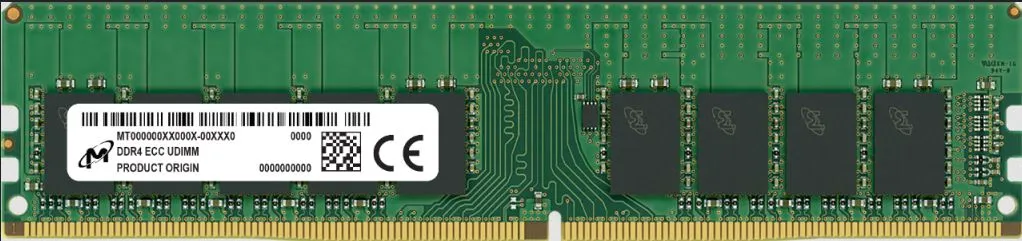
When you are running a virtualization cluster or an in-memory database on a small business server or workstation, every bit of data integrity matters. The Micron MTA18ASF4G72AZ-2G6B1ZI is a 32GB DDR4-2666 ECC unbuffered UDIMM, purpose-built to protect your critical workloads from silent data corruption. Its error-correcting code (ECC) continuously detects and corrects single-bit memory errors caused by cosmic radiation or electrical noise, preventing random crashes in a virtualized environment where multiple guest machines share physical resources. Without ECC, a flipped bit could quietly corrupt your database index or bring down a financial transaction log overnight.
The dual-rank x8 organization directly impacts real-world throughput: while one rank completes a read cycle, the controller can already initiate a command to the other rank, meaning faster data access and reduced latency under the sustained mixed read/write patterns typical of a database engine like Redis or MySQL. Paired with a 1.2V operating voltage, this module also lowers power draw and thermal output in always-on servers, helping you keep energy costs and cooling requirements in check across a 24/7 deployment. Together, these features mean you can consolidate more virtual machines or handle larger datasets with uncompromised stability, protecting both your uptime and your data.
This is a server-class DDR4-2666 ECC Unbuffered DIMM (288-pin UDIMM), designed for entry-level servers and workstations that require data integrity without registered buffering. Its 32GB capacity and dual-rank x8 organization suit capacity- and reliability-sensitive workloads. Below is capacity planning guidance for typical server scenarios.
General Virtualization
A hypervisor host benefits from ECC protection and balanced capacity. Start with two 32GB modules (64GB total) in dual-channel mode to support a moderate number of VMs. Scale to four identical DIMMs (128GB) when hosting memory-intensive applications or increasing VM density, ensuring all memory channels are populated for optimal bandwidth.
In-Memory Database
In-memory platforms like Redis or SAP HANA demand large, fault-tolerant memory sets. Use four 32GB ECC UDIMMs (128GB) to maximize capacity and dual-channel bandwidth while maintaining the low latency of dual-rank x8 construction. Avoid mixing capacities; identical modules guarantee consistent database response times and prevent rank imbalance.
High-Performance Computing
HPC workloads require maximum sustained bandwidth and compute reliability. Fully populate all memory channels with identical 32GB DIMMs — on a typical dual-channel platform, a 2×32GB or 4×32GB configuration is advised. The ECC feature prevents silent data corruption during long-running simulations, and dual-rank modules improve memory-level parallelism for compute-bound tasks.
Rigorously tested for server compatibility, works with Dell PowerEdge R240, HPE ProLiant DL20 Gen10, Lenovo ThinkSystem ST50 V2, and more.
Q: Can I mix this MTA18ASF4G72AZ-2G6B1ZI with other memory modules of different brands or speeds in my server?
A: Mixing modules is not recommended. Even minor differences in rank, timings, or ECC implementation can cause instability. For reliable operation, install identical Micron ECC UDIMMs with matching part numbers.
Q: Is this memory compatible with my server? Which Intel or AMD platforms are supported?
A: This DDR4-2666 ECC UDIMM is compatible with entry-level servers using Intel Xeon E-2100/E-2200 series or AMD AM4 platforms with Ryzen PRO processors. Verify your motherboard supports 32GB ECC unbuffered modules.
Q: What is the recommended DIMM population order for optimal performance on a server motherboard?
A: Follow your server motherboard manual. Typically, populate identical modules in matched sets starting with the primary memory channels (e.g., slots A1 and B1). This enables dual-channel mode and balanced memory interleaving.
Q: Does this module support overclocking or XMP profiles?
A: No. This is a JEDEC-compliant server memory module running at standard DDR4-2666 (PC4-21300) with fixed CL19 timings. Overclocking and XMP are not supported to ensure strict data integrity.
Q: What warranty and typical failure rate can I expect for this server memory?
A: This module includes a one-year warranty. As enterprise-grade Micron ECC memory built with stringent testing, it demonstrates an extremely low annualized failure rate (AFR) under specified operating conditions.