











 Secure payments
Standard refund policy
Trade Assurance
Secure payments
Standard refund policy
Trade Assurance
| Product Type | Memory Module |
|---|---|
| Memory Capacity | 32 GB |
| Memory Technology | DDR4 |
| Product Voltage | 1.2V |
| RAM Speed | 2933MHz |
| RAM Standard | DDR4-2933/PC4-23400 |
| Error Identifying | ECC |
| Signal Type | Registered |
| Column Access Strobe (CAS) | CL21 |
| Rank | Dual Rank x4 |
| Quantity of Pins | 288-pin |
| RAM Genre | RDIMM |
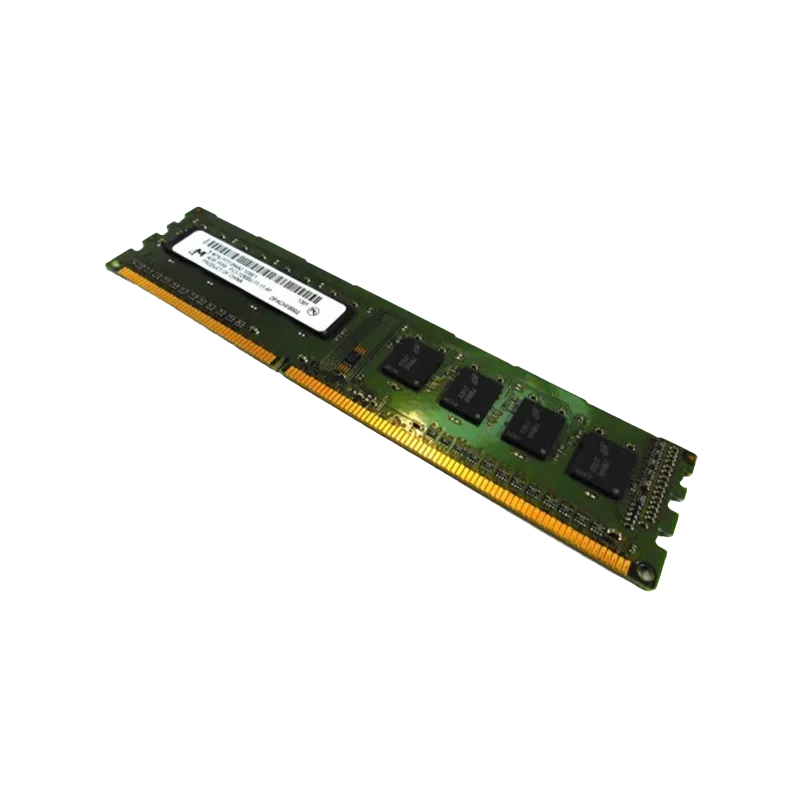
This DDR4-2933 Registered ECC module, with a Dual Rank x4 configuration and 1.2V operating voltage, is engineered for server platforms demanding robust data integrity in memory-intensive workloads such as virtualization and in-memory databases. Its registered signal type and ECC ensure stable, error-correcting operation across high-density deployments, while the 32GB capacity and CL21 latency balance capacity and responsive access in multi-DIMM configurations.
1. ECC error correction detects and corrects single-bit memory faults in real time, preserving transactional integrity for databases and financial processing where data accuracy is non-negotiable.
2. Registered signal buffering stabilizes command and address lines across fully populated server nodes, enabling massive memory scaling without sacrificing electrical reliability.
3. 32-gigabyte capacity per module increases workload consolidation density, allowing more virtual machines per physical host and reducing data center footprint.
4. 2933 MT/s throughput elevates memory bandwidth for in-memory analytics and high-frequency trading applications, cutting response latency under sustained enterprise loads.
5. Dual-rank x4 organization interleaves memory accesses across ranks, keeping the memory controller pipeline saturated and consistent under heavy multi‑tenant virtualization.
The Micron MTA36ASF4G72PZ-2G9E2TG is a server-class registered DIMM (RDIMM) engineered for the data center, where its four defining characteristics turn into tangible business resilience. ECC error correction continuously scrubs single-bit upsets caused by background radiation, shielding your transactional databases from silent data corruption that could otherwise cascade into financial misreporting or inventory mismatches. The registered buffer preserves clean signal integrity across fully populated memory channels, giving large virtualization clusters the headroom to scale to terabyte-level footprints without random reboots or memory training failures during peak load. Its dual-rank x4 organization multiplies bank-level parallelism—when your in-memory analytics engine, such as Redis or SAP HANA, scans massive columnar datasets, the increased interleaving sustains higher bandwidth and keeps query response times predictable even under concurrent user spikes. Finally, the 2933 MT/s transfer rate, combined with a low 1.2V operating voltage, feeds throughput-hungry VMs while curbing thermal stress in dense rack deployments. This RDIMM transforms memory from a simple capacity number into a reliability foundation for always-on, data-heavy enterprise services.
General Virtualization
For a standard hypervisor hosting multiple VMs, populate channels symmetrically to maximize bandwidth. Deploy six or eight identical 32GB RDIMMs across the server’s memory channels (e.g., 6 x 32GB for 192GB total) to balance capacity and memory interleaving, ensuring stable ECC protection for mixed workloads without overcommitting RAM.
In-Memory Database
In-memory databases demand both high capacity and low latency. Use a fully balanced configuration with at least 12 x 32GB RDIMMs per socket (384GB) to keep entire datasets in RAM. Dual-rank x4 modules deliver strong signal integrity, and populating all channels evenly sustains the high throughput needed for real-time analytics.
High-Performance Computing
HPC clusters benefit from maximum memory bandwidth per node. Install one 32GB RDIMM per channel across all available channels (typically 8 or 16 modules), exploiting the 2933MT/s speed and dual-rank design to feed compute-bound simulations. Avoid mixing ranks or leaving channels empty, as unbalanced configs degrade parallel performance in tightly coupled MPI jobs.
Proven compatible with Dell PowerEdge R740, HPE ProLiant DL380 Gen10, and Lenovo ThinkSystem SR650.
Q: Can I mix this MTA36ASF4G72PZ-2G9E2TG with other memory modules of different brands or speeds?
A: Mixing is strongly discouraged. Registered ECC modules require identical part numbers, ranks, and timings for stability. Dissimilar modules may cause POST failures or silent data corruption in server environments.
Q: Is this memory compatible with my system?
A: It is compatible with Intel Xeon Scalable and AMD EPYC platforms supporting DDR4-2933 Registered ECC DIMMs. Verify your server or motherboard’s qualified vendor list (QVL) for this specific 32 GB dual-rank x4 module.
Q: What is the recommended DIMM population order for optimal performance?
A: Populate identical DIMMs symmetrically across memory channels per your server’s manual. For dual-rank x4 modules, start with the slots furthest from the CPU on each channel to balance interleaving and maximize throughput.
Q: Does this module support overclocking or XMP profiles?
A: No. This is a JEDEC-compliant DDR4-2933 Registered ECC DIMM designed for mission-critical stability. It does not support XMP or overclocking; strict CL21 timings and 1.2 V ensure data integrity, not tunable performance.
Q: What warranty and typical failure rate can I expect?
A: This module carries a one-year warranty. Server-grade memory like this typically exhibits extremely low annualized failure rates (AFR) due to rigorous screening and ECC protection, ensuring high reliability in 24/7 operation.