











 Secure payments
Standard refund policy
Trade Assurance
Secure payments
Standard refund policy
Trade Assurance
| Product Type | Memory Module |
|---|---|
| Memory Capacity | 32 GB |
| Memory Technology | DDR4 |
| Product Voltage | 1.2V |
| RAM Speed | 2933MHz |
| RAM Standard | DDR4-2933/PC4-23400 |
| Error Identifying | ECC |
| Signal Type | Registered |
| Column Access Strobe (CAS) | CL21 |
| Rank | Dual Rank x4 |
| Quantity of Pins | 288-pin |
| RAM Genre | RDIMM |
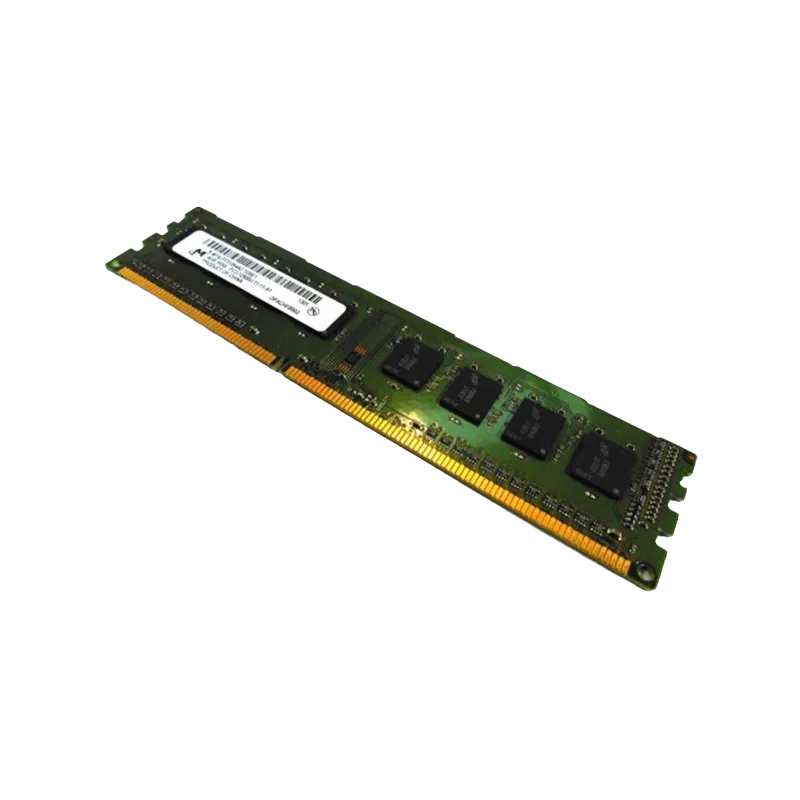
This 32GB DDR4-2933 RDIMM with ECC and registered signal type delivers exceptional data integrity and stability for server platforms running virtualization or in-memory databases. Its Dual Rank x4 organization optimizes memory bandwidth under heavy loads, while the 1.2V operating voltage and CL21 latency strike an efficient balance between performance and power in dense multi-DIMM configurations.
1. ECC protection detects and corrects single-bit errors in real time, preserving data integrity for mission-critical virtualization and database workloads.
2. Registered signal buffering stabilizes high-capacity memory channels, allowing dense server configurations to scale without compromising signal quality.
3. A 32-gigabyte module capacity raises the memory ceiling per server node, directly expanding the number of virtual machines or containers that can coexist under heavy consolidation.
4. The twenty-nine-thirty-three data rate increases memory bandwidth to feed multi-core server CPUs, reducing latency in throughput-sensitive analytics and AI inference pipelines.
5. Dual-rank x4 organization leverages bank interleaving to sustain higher utilization of the memory bus, which prevents bottlenecks when multiple VMs access memory simultaneously.
The Micron MTA36ASF4G72PZ-2G9E2VI is a 32GB DDR4-2933 registered RDIMM built for enterprise servers. Its four key characteristics solve real-world data-center challenges. ECC actively corrects single-bit errors, preventing silent data corruption that could crash your hypervisor or quietly compromise financial records in a database. The registered buffer maintains signal integrity under heavy loads, letting you fully populate all memory channels with high-density DIMMs for dense virtualization hosts without stability concerns. The dual-rank x4 organization boosts sustained bandwidth through rank interleaving, directly accelerating memory-hungry in-memory workloads. Finally, 2933MT/s at a low 1.2V balances strong throughput with energy efficiency, helping you manage power budgets at scale. In a VMware cluster running dozens of virtual machines, ECC and the registered design ensure that a memory error in one guest never corrupts another, while dual rank keeps the hypervisor responsive under mixed loads. For an in-memory database like Redis or SAP HANA, ECC guards against bit flips that could invalidate transactional integrity, and the dual-rank bandwidth speeds key lookups and real-time analytics. This module translates directly into fewer outages, faster queries, and a measurably lower total cost of ownership.
General Virtualization
When consolidating multiple VMs on a dual-socket server, balanced capacity and memory bandwidth are essential. Populating one 32 GB registered ECC module per memory channel (commonly 6 or 8 channels per CPU) delivers optimal interleaving and avoids performance penalties, yielding 384–512 GB total while keeping memory fully populated for future scaling. Always install identical RDIMMs in each channel to maintain lockstep operation.
In-Memory Database
In-memory databases such as SAP HANA or Redis demand maximum capacity and data integrity. Fill all available memory channels with two 32 GB RDIMMs per channel (2DPC), even if this drops the speed slightly below 2933 MT/s, to achieve terabyte-scale footprints per node. Distribute modules symmetrically across NUMA nodes to avoid remote memory access and ensure predictable low-latency response.
High-Performance Computing (HPC)
HPC workloads favor bandwidth over extreme capacity, so a one-DIMM-per-channel (1DPC) configuration is ideal. Install one 32 GB module in every channel to sustain the full 2933 MT/s frequency and maximize throughput for memory-bound simulations. This typically provides 192–256 GB per dual-socket node, sufficient for most scientific computing tasks while keeping memory latency uniform.
Strictly tested server memory, compatible with Dell PowerEdge R760, HPE ProLiant DL380 Gen10, Lenovo ThinkSystem SR650.
Q: Can I mix this MTA36ASF4G72PZ-2G9E2VI with other memory modules of different brands or speeds?
A: Mixing RDIMMs of different brands or speeds is not recommended. The system defaults to the lowest speed and may face stability issues. For mission-critical servers, always use identical modules to guarantee ECC and registered signaling integrity.
Q: Is this memory compatible with my system?
A: This DDR4-2933 ECC RDIMM is designed for server platforms such as Intel Xeon Scalable and AMD EPYC. Verify your motherboard’s QVL or chipset support for registered memory and the specific 2933MT/s speed before purchasing.
Q: What is the recommended DIMM population order for optimal performance?
A: Consult your server board’s manual for balanced memory channel configuration. Typically, populate identical DIMMs across all memory channels, filling the first slot of each channel first to maximize bandwidth and maintain interleaving.
Q: Does this module support overclocking or XMP profiles?
A: No. This server RDIMM adheres strictly to JEDEC standards for reliability. It does not support XMP or overclocking; it operates at fixed 2933MT/s with ECC enabled to ensure data integrity under 24/7 workloads.
Q: What warranty and typical failure rate can I expect?
A: This module includes a 1-year warranty. Server-grade RDIMMs exhibit very low failure rates, typically under 0.1% annually when operated within specified conditions, offering high reliability for enterprise environments.