











 Secure payments
Standard refund policy
Trade Assurance
Secure payments
Standard refund policy
Trade Assurance
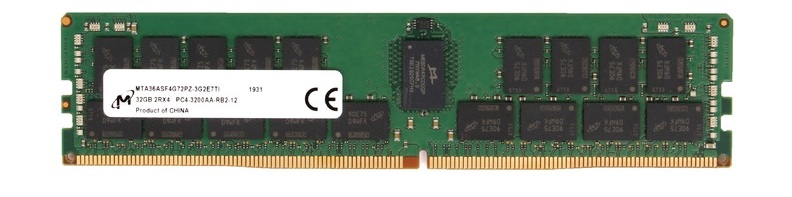
| Product Type | Memory Module |
|---|---|
| Memory Capacity | 32 GB |
| Memory Technology | DDR4 |
| Product Voltage | 1.2 V |
| RAM Speed | 3200 MHz |
| RAM Standard | DDR4-3200/PC4-25600 |
| Error Identifying | ECC |
| Signal Type | Registered |
| Column Access Strobe (CAS) | CL22 |
| Rank | Dual Rank x4 |
| Quantity of Pins | 288-pin |
| RAM Genre | RDIMM |
This RDIMM with ECC and a registered signal type is purpose-built for server platforms, ensuring heightened data integrity in virtualized environments and memory-intensive database workloads. Its dual-rank x4 organization boosts memory bandwidth via rank interleaving while the 1.2 V DDR4-3200 specification delivers a balance of energy efficiency and reliable throughput.
1. ECC protection detects and corrects single-bit memory errors in real time, safeguarding financial transactions and database queries from silent data corruption.
2. Registered signal buffering stabilizes command and address lines across high-density server banks, enabling smooth scaling to multi-terabyte memory configurations without signal degradation.
3. 32 GB capacity per module boosts virtualization density, allowing more virtual machines per host while leaving headroom for memory-intensive in-memory databases.
4. 3200 MHz transfer rate doubles peak bandwidth over previous-gen speeds, accelerating parallel analytics workloads and reducing latency in high-frequency trading platforms.
5. Dual Rank x4 organization interleaves memory accesses across internal banks, sustaining throughput under heavy consolidation and keeping response times predictable for latency-sensitive services.
Built specifically for server environments, the MTA36ASF4G72PZ-3G2J3R is a 32GB DDR4-3200 registered DIMM with ECC, designed to eliminate the real-world risks that keep IT operators awake at night. Its ECC engine continuously corrects single-bit errors right at the hardware level. In an in-memory database like SAP HANA, a single uncorrected bit flip can silently corrupt financial records or crash an entire transactional workload; ECC turns a silent threat into a non-event, preserving data integrity around the clock. The registered architecture buffers command and address signals, which becomes critical when a virtualized host is fully populated with modules to maximize VM density. Without it, signal degradation across multiple ranks could cause intermittent errors or outright boot failures, but with registered buffering you maintain rock-solid stability across all sockets. The 32GB capacity per stick, built on a dual-rank x4 design, enables aggressive consolidation in hypervisor clusters while leveraging rank interleaving to overlap data bursts. This means faster data access and higher sustained bandwidth for latency-sensitive tasks such as a Redis cache layer handling millions of simultaneous queries. At 3200MT/s, the module feeds modern server CPUs the throughput they demand, letting your virtualized infrastructure and real-time analytics engines scale without memory bottlenecks, unplanned downtime, or compromised data.
Server Memory Identified: 32GB DDR4-3200 ECC Registered RDIMM
This module’s ECC and registered design is built for enterprise-grade reliability, making it ideal for servers and workstations where data integrity and sustained uptime are critical.
General Virtualization
For moderate consolidation of virtual machines (e.g., 10–15 VMs running web services, light databases, or domain controllers), populate all available memory channels with identical 32GB RDIMMs to reach 128GB–256GB. Using balanced multi-channel configurations prevents memory bandwidth bottlenecks; a dual-socket server with 8 DIMMs per CPU (16 x 32GB) delivers a dense 512GB pool, allowing generous memory overcommit while preserving NUMA locality.
In-Memory Database
In-memory platforms like Redis or SAP HANA demand both capacity and low latency. Deploy these modules in a symmetric layout—six or eight DIMMs per socket—to achieve 192GB–256GB per node while maintaining 1 DIMM per channel (1DPC) for maximum 3200 MT/s speed. Dual-rank x4 RDIMMs offer high bank-level parallelism, which accelerates random access: configure at least 384GB across a two-socket server to hold entire datasets in RAM without swapping.
High-Performance Computing
HPC workloads benefit from balanced bandwidth and capacity. Install 32GB RDIMMs across all eight memory channels per CPU (8 x 32GB = 256GB per socket) to saturate the memory bus. Configure clusters with uniform DIMM sizes for inter-node consistency. For memory-bandwidth-bound simulations, prioritize filling all channels over maximum capacity per DIMM—eight 32GB RDIMMs at 1DPC yield roughly 204 GB/s per socket, ideal for CFD or molecular dynamics.
Rigorously tested for compatibility with Dell PowerEdge R760, HPE ProLiant DL380 Gen11, Lenovo ThinkSystem SR650, and Cisco UCS C220 M6.
Q: Can I mix this MTA36ASF4G72PZ-3G2J3R with other memory modules of different brands or speeds?
A: Mixing modules from different brands or speeds may cause instability and signal interference. For reliable 24/7 server operation, we strongly recommend using identical Micron RDIMMs with the same part number.
Q: Is this MTA36ASF4G72PZ-3G2J3R compatible with my Intel Xeon or AMD EPYC server platform?
A: This 32GB DDR4-3200 RDIMM is compatible with servers that support ECC Registered DDR4 memory. Please verify your motherboard supports PC4-25600 and check the vendor’s qualified vendor list (QVL).
Q: What is the recommended DIMM population order for optimal performance on a server?
A: Follow your server motherboard’s population guide. Typically, populate identical DIMMs in each channel’s first available slot, often the blue or white slots, to evenly distribute memory load and maximize multi-channel bandwidth.
Q: Does this module support overclocking or XMP profiles?
A: No, this JEDEC-compliant server RDIMM prioritizes stability and data integrity over overclocking. It does not support XMP profiles and runs only at standard DDR4-3200 speeds for mission-critical reliability.
Q: What warranty and typical failure rate can I expect?
A: This module is covered by a 1-year warranty. For enterprise-grade Micron memory, the annualized failure rate is typically below 0.5%, ensuring exceptional reliability for demanding server environments.