











 Secure payments
Standard refund policy
Trade Assurance
Secure payments
Standard refund policy
Trade Assurance
| Product Type | Memory Module |
|---|---|
| Memory Capacity | 32 GB |
| Memory Technology | DDR4 |
| Product Voltage | 1.2V |
| RAM Speed | 3200MHz |
| RAM Standard | DDR4-3200/PC4-25600 |
| Error Identifying | ECC |
| Signal Type | Registered |
| Column Access Strobe (CAS) | CL22 |
| Rank | Dual Rank x8 |
| Quantity of Pins | 288-pin |
| RAM Genre | RDIMM |
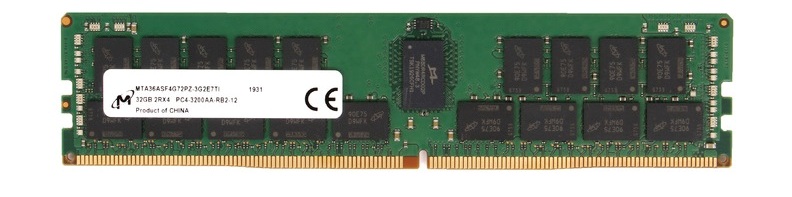
This registered ECC DDR4-3200 RDIMM with dual-rank x8 organization is purpose-built for server platforms handling virtualization, in-memory databases, or mission-critical workloads where data integrity and uptime are paramount. The combination of 1.2V low-power operation, CL22 latency, and registered signal buffering ensures stable signal integrity across densely populated memory channels, while ECC actively corrects single-bit errors to prevent silent data corruption.
1. ECC safeguards every data bit against spontaneous corruption, preserving the integrity of financial ledgers and long-running simulations without interruption.
2. Registered clocking stabilizes command signals across multiple channels, enabling the high memory capacity density vital for large-scale virtualized clusters.
3. Dual Rank x8 layout interleaves accesses to keep the memory pipeline continuously fed, reducing latency under the concurrent demands of containerized microservices.
4. Generous per-module density lets IT architects quadruple node memory within the same footprint, supporting bigger in-memory databases without sacrificing redundancy.
5. High-throughput frequency feeds modern many-core CPUs with rapid data streams, cutting response time for real-time analytics and high-frequency transactional workloads.
Based on the RDIMM designation, ECC support, and registered signal type, this is unequivocally a server-grade memory module designed for data centers and enterprise workstations where stability and data integrity outweigh raw consumer speed. Its four key characteristics directly address the critical pain points of IT infrastructure.
Consider a dense virtualization cluster running dozens of VMs. Here, ECC memory is non-negotiable; it actively corrects single-bit errors induced by background radiation, preventing silent data corruption that could destabilize hypervisors or silently alter a financial database record. Meanwhile, the registered buffer stabilizes the electrical load across multiple DIMMs on the same channel, allowing you to populate all 24 slots on a board like a 32 GB module without signal degradation—this directly enables the terabyte-scale memory pools needed for seamless live migration and VM sprawl. In an in-memory database such as Redis or SAP HANA, the dual-rank architecture becomes vital. It interleaves memory banks to deliver higher sustained bandwidth when the CPU is bombarded with concurrent queries, dramatically reducing micro-latency during peak transaction bursts. Finally, the 3200MT/s speed provides a 25.6 GB/s throughput ceiling, ensuring your data-hungry analytics workloads are never starved by a memory bottleneck, turning raw capacity into actionable, reliable performance that safeguards your uptime SLAs.
General Virtualization
For a 32GB RDIMM, populate two modules per server for a total of 64GB to comfortably run 10–15 general-purpose VMs. This registered ECC memory ensures data integrity under sustained multi-tenant workloads, making it ideal for hypervisors like VMware ESXi or Proxmox.
In-Memory Database
Deploy six to eight of these 32GB RDIMMs (192–256GB total) to keep entire datasets resident in RAM for Redis, SAP HANA, or Memcached. The dual-rank x8 organization and CL22 latency deliver the low-latency, high-throughput access that in-memory engines demand, while ECC guards against silent data corruption.
High-Performance Computing
Populate all available DIMM slots in a balanced configuration, typically eight modules per node (256GB), to sustain memory-bandwidth-bound simulations and fluid dynamics codes. Registered DIMMs at 3200MHz maintain stable signal integrity across many ranks, allowing dense configurations without downclocking under heavy parallel job loads.
Fully tested server memory, compatible with Dell PowerEdge R750, HPE ProLiant DL380 Gen10+, Lenovo ThinkSystem SR650 V2, etc.
Q: Can I mix this MTA18ASF4G72PDZ-3G2B2TI with other memory modules of different brands or speeds?
A: Mixing RDIMMs of different brands or speeds is not recommended. It may force all modules to the lowest common speed and can cause signal integrity issues, risking system instability.
Q: Is this memory compatible with my Intel or AMD server platform?
A: This DDR4-3200 Registered ECC module is compatible with platforms supporting RDIMMs, such as Intel Xeon Scalable (1st/2nd Gen) and AMD EPYC 7002/7003 series. Verify your motherboard’s qualified vendor list.
Q: What is the recommended DIMM population order for optimal performance?
A: Always follow your server board’s memory population guide. Typically populate identical RDIMMs in matching slots per channel first, balancing across CPU memory controllers to maintain optimal interleaving and bandwidth.
Q: Does this module support overclocking or XMP profiles?
A: No. As an enterprise Registered ECC DIMM, it adheres strictly to JEDEC DDR4-3200 standards (PC4-25600) at 1.2V. It does not support overclocking or XMP, prioritizing data integrity and stability.
Q: What warranty and typical failure rate can I expect?
A: This module comes with a 1-year warranty. As a high-quality enterprise component, its annualized failure rate is very low under specified operating conditions, ensuring reliable 24/7 operation.