











 Secure payments
Standard refund policy
Trade Assurance
Secure payments
Standard refund policy
Trade Assurance
| Product Type | Memory Module |
|---|---|
| Memory Capacity | 32 GB |
| Memory Technology | DDR4 |
| Product Voltage | 1.2V |
| RAM Speed | 3200MHz |
| RAM Standard | DDR4-3200/PC4-25600 |
| Error Identifying | ECC |
| Signal Type | Registered |
| Column Access Strobe (CAS) | CL22 |
| Rank | Dual Rank |
| Quantity of Pins | 288-pin |
| RAM Genre | RDIMM |
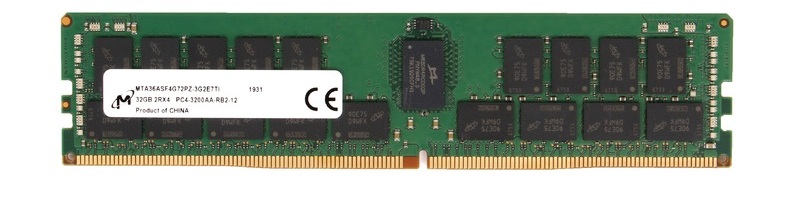
This 32GB DDR4-3200 Registered ECC RDIMM is engineered for server platforms where data integrity and uptime are critical, making it ideal for virtualization clusters and in-memory databases. Its dual-rank architecture improves interleaving efficiency and memory bandwidth under heavy multi-DIMM loads, while the CL22 latency ensures stable, predictable access timing at 1.2V.
1. ECC memory detects and corrects single-bit errors in real time, safeguarding transactional databases and financial systems from silent data corruption that could otherwise cascade into critical failures.
2. Registered signal buffering stabilizes high-capacity memory channels by reducing electrical load on the CPU’s memory controller, enabling dense server configurations to scale without sacrificing signal integrity.
3. Dual Rank interleaving allows the memory controller to access one rank while the other refreshes, dramatically boosting sustained throughput for virtualized workloads running multiple concurrent VMs.
4. A 32-gigabyte module doubles the memory footprint per DIMM slot, maximizing virtualization density and allowing more containers or tenants per physical host in consolidated data centers.
5. The 3200 megahertz transfer speed elevates per-channel bandwidth, reducing latency spikes during peak loads in in-memory analytics and high-frequency trading platforms that demand rapid data access.
In the data center, the MTA18ASF4G72PDZ-3G2E1TI RDIMM is built to eliminate the stability and integrity risks that keep IT managers awake at night. Four characteristics make it a decisive upgrade. ECC actively corrects memory errors—for an in-memory database processing thousands of financial transactions per second, this means silent bit-flips never cascade into corrupted records or compliance violations. Registered buffering stabilizes command and address signals when multiple DIMMs populate the same channel, so a virtualized VMware or Hyper-V cluster can confidently run dense VM fleets without signal degradation under heavy load. Dual-rank interleaving then amplifies effective bandwidth, driving noticeably lower latency for real-time analytics engines that sift through massive datasets. Finally, 3200MT/s performance at 1.2V balances high throughput with energy efficiency, directly reducing power bills and cooling strain across a fully populated server. This module does not just fill a slot—it underwrites accuracy, scale, and responsive performance for mission-critical workloads.
General Virtualization
Start with four 32GB RDIMMs (128 GB) distributed across memory channels, which provides sufficient headroom for dozens of virtual machines. This registered dual-rank configuration ensures stable, high-bandwidth performance, and ECC corrects memory errors common in densely consolidated 24/7 environments.
In-Memory Database
To hold entire datasets in RAM, fill all available channels—each with one 32GB RDIMM—yielding 256 GB to 512 GB per server (e.g., 8–16 modules). Running one dual-rank DIMM per channel maintains the full DDR4-3200 speed and improves access parallelism, while registered ECC prevents data corruption during intense transactional workloads.
High Performance Computing
Install a single 32GB module per memory channel (often 8 channels per dual-socket node) to maximize bandwidth for simulation and modeling. The dual-rank design increases row-buffer hit rates, and ECC Registered memory eliminates soft errors over multi-day compute runs, ensuring result accuracy.
Thoroughly tested server RDIMM, compatible with Dell PowerEdge R760, HPE ProLiant DL380 Gen11, Lenovo ThinkSystem SR650 V3.
Q: Can I mix this MTA18ASF4G72PDZ-3G2E1TI with other memory modules of different brands or speeds?
A: Mixing modules is not recommended for this registered ECC memory. It can cause instability, signal integrity issues, and may force all DIMMs to the lowest common speed, undermining server reliability.
Q: Is this memory compatible with my system?
A: This RDIMM is designed for servers using Intel Xeon Scalable or AMD EPYC platforms with DDR4-3200 support. Verify your motherboard's Qualified Vendor List (QVL) for ECC Registered memory compatibility before purchase.
Q: What is the recommended DIMM population order for optimal performance?
A: Follow your server board's population guide. Typically, populate identical DIMMs per channel starting with slots farthest from the CPU, filling blue slots first to balance loads and maintain dual-rank performance.
Q: Does this module support overclocking or XMP profiles?
A: No. This is a JEDEC-compliant DDR4-3200 server DIMM. ECC Registered memory prioritizes data integrity over speed, and does not support overclocking or XMP; it runs at standard timings (CL22) for stability.
Q: What warranty and typical failure rate can I expect?
A: It includes a one-year warranty. As enterprise-grade RDIMM, it has an extremely low annualized failure rate (AFR) under specification, typically below 0.5% in properly cooled and managed server environments.