











 Secure payments
Standard refund policy
Trade Assurance
Secure payments
Standard refund policy
Trade Assurance
| Product Type | Memory Module |
|---|---|
| Memory Capacity | 32 GB |
| Memory Technology | DDR4 |
| Product Voltage | 1.2V |
| RAM Speed | 3200MHz |
| RAM Standard | DDR4-3200/PC4-25600 |
| Error Identifying | ECC |
| Signal Type | Unbuffered |
| Column Access Strobe (CAS) | CL22 |
| Rank | Dual Rank x8 |
| Quantity of Pins | 288-pin |
| RAM Genre | UDIMM |
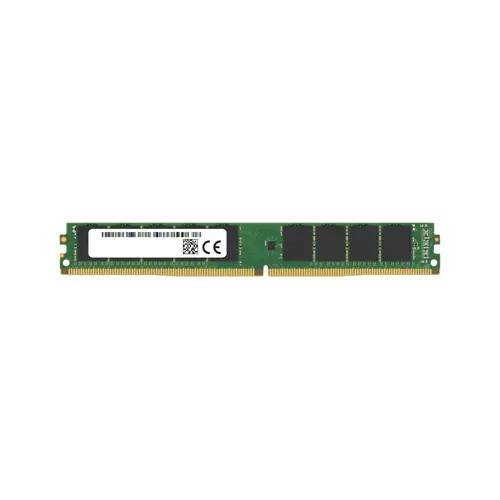
This 32GB DDR4-3200 UDIMM with ECC is purpose-built for entry-level servers and workstations using platforms like AMD Ryzen Pro or Intel Xeon E-series, where unbuffered memory with error correction is required to ensure data integrity for mission-critical applications such as financial modeling and local virtualization. The dual-rank x8 organization maximizes memory bandwidth at the standard 1.2V, pairing 3200MHz speed with CL22 latency to deliver reliable, sustained throughput under continuous load without the added latency of a register buffer.
1. ECC protection detects and corrects single-bit errors in real time, safeguarding transactional data integrity for always-on enterprise applications.
2. A 32-gigabyte capacity allows dense virtualization footprints, letting a single server host more VMs without swapping to slower storage.
3. High-speed 3200 MT/s throughput accelerates in-memory databases and real-time analytics, reducing query latency under heavy concurrent loads.
4. Dual-rank organization interleaves memory accesses across two rank groups, boosting effective bandwidth for workloads that thrive on parallel data streams.
5. An unbuffered design delivers lower access latency compared to registered memory, benefiting latency-sensitive edge server tasks and microservices.
Based on the UDIMM form factor with ECC, this is a server-grade memory module purpose-built for entry-level servers and workstations using platforms like Intel Xeon E or AMD Ryzen Pro. Its specifications translate directly into tangible gains for IT professionals and data-driven businesses.
The most critical feature is ECC error correction: in a virtualization cluster running multiple VMs, a single bit-flip in system memory can corrupt a database transaction or crash a hypervisor. ECC automatically detects and corrects single-bit errors, preserving data integrity and preventing hours of unscheduled downtime. The 32GB capacity at Dual Rank x8 organization is equally crucial. When deployed in a memory database like Redis or an in-memory analytics engine, dual rank efficiently interleaves memory accesses to deliver higher sustained bandwidth—reducing latency spikes under heavy concurrent queries. Meanwhile, the 3200MHz speed and standard 1.2V DDR4-3200 operation provide a responsive thermal envelope; lower voltage means less heat in dense 1U chassis, allowing you to populate all four DIMM slots without throttling. For a growing SMB running both a domain controller and a lightweight virtualized ERP system on a single server, this module delivers the uncompromising stability and throughput that unbuffered ECC memory alone can offer—a direct safeguard for your business continuity.
This 32 GB DDR4‑3200 ECC Unbuffered DIMM is server‑class memory, ideal for error‑sensitive workloads. Use the following guidelines for capacity planning.
General Virtualization
Populate all memory channels symmetrically to sustain balanced throughput. Begin with four identical 32 GB modules (128 GB total) per socket, which comfortably hosts two to three dozen light VMs. Scale by adding matched sets—eight modules (256 GB) per socket when VM density grows—always keeping one DIMM per channel to preserve the rated 3200 MT/s speed.
In‑Memory Database
Large in‑memory datasets demand maximum capacity and data integrity. Fully populate the platform with these 32 GB ECC UDIMMs, aiming for at least 256 GB on a dual‑socket node. Install one DIMM per channel to maintain low latency and full bandwidth; if more capacity is needed, add a second DIMM per channel while accepting a slight speed reduction. ECC is mandatory to guard against in‑memory bit errors.
High‑Performance Computing
HPC codes rely on robust bandwidth and computational accuracy. Install one 32 GB module per memory channel (e.g., 6 or 8 per CPU) to deliver the full 3200 MT/s data rate. The dual‑rank x8 construction boosts thread‑level parallelism, and ECC ensures result fidelity during days‑long simulations. A dual‑socket configuration with 12 modules (384 GB) handles most compute‑intensive research jobs with ease.
Rigorously tested for servers: Dell PowerEdge R760, HPE ProLiant DL380 Gen11, Lenovo ThinkSystem SR650 V3.
Q: Can I mix this MTA18ADF4G72AZ-3G2B3 with other memory modules of different brands or speeds?
A: Mixing is strongly discouraged for ECC UDIMMs. Different brands, speeds, or ranks may cause instability, prevent ECC from functioning, and lead to system errors. Always use identical modules for validated reliability.
Q: Is this memory compatible with my system?
A: This 32GB DDR4 ECC UDIMM is built for server/workstation platforms. It requires a motherboard with DDR4 ECC Unbuffered support, such as Intel Xeon E with C256/C246 chipsets or AMD AM4 with Ryzen PRO and ECC-enabled BIOS. Confirm via the board’s QVL.
Q: What is the recommended DIMM population order for optimal performance?
A: Follow your motherboard manual. Typically, populate the primary slot of each memory channel first (e.g., DIMM_A1 and DIMM_B1). Add the second module per channel only after the first set, ensuring dual-channel and balanced ECC operation.
Q: Does this module support overclocking or XMP profiles?
A: No. This is a JEDEC-compliant ECC UDIMM operating at the standard 3200MT/s. It does not support XMP or overclocking—data integrity and stability are critical for server memory, making non‑standard speeds unsuitable.
Q: What warranty and typical failure rate can I expect?
A: It comes with a 1-year warranty. As a Micron server-grade module, it provides exceptional reliability with an annualized failure rate (AFR) typically well under 0.5% under normal operating conditions.