











 Secure payments
Standard refund policy
Trade Assurance
Secure payments
Standard refund policy
Trade Assurance
| Product Type | Memory Module |
|---|---|
| Memory Capacity | 32 GB |
| Memory Technology | DDR4 |
| Product Voltage | 1.2V |
| RAM Speed | 3200MHz |
| RAM Standard | DDR4-3200/PC4-25600 |
| Error Identifying | ECC |
| Signal Type | Registered |
| Column Access Strobe (CAS) | CL22 |
| Rank | Single Rank x4 |
| Quantity of Pins | 288-pin |
| RAM Genre | RDIMM |
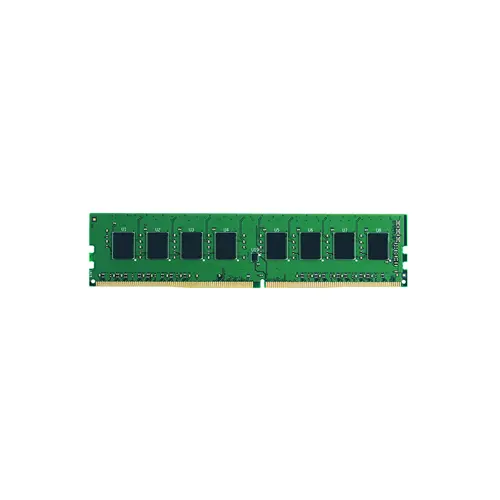
Designed for server-class platforms, this 32GB DDR4-3200 RDIMM leverages ECC and registered signal buffering to ensure data integrity and stable operation under heavy virtualization and in-memory database workloads. Its single-rank x4 configuration minimizes electrical loading on the memory bus, enabling lower latency at CL22 and higher sustained throughput in dense multi-DIMM deployments.
1. ECC error correction actively detects and fixes single-bit memory errors, preserving data integrity for financial transactions and virtualized workloads where even silent corruption is unacceptable.
2. Registered buffering strengthens signal integrity across densely populated memory channels, enabling large-scale server deployments to maintain stable operation under heavy access loads.
3. Generous capacity per module frees up DIMM slots for future expansion while satisfying the memory demands of high-density virtualization and in-memory database clusters.
4. High-throughput memory bandwidth eliminates data bottlenecks in multi-core server CPUs, accelerating real-time analytics and simultaneous containerized services.
5. Energy-efficient operation at reduced voltage lowers datacenter power draw and heat dissipation, directly improving total cost of ownership in always-on hyperscale environments.
When deploying a mission‑critical virtualization cluster or an in‑memory database, the MTA18ASF4G72PZ‑3G2 32 GB DDR4‑3200 RDIMM is not simply a capacity upgrade—it is an insurance policy for your data and uptime. Its ECC technology actively detects and corrects single‑bit memory errors, a silent threat that can corrupt financial transactions or crash a hypervisor hosting dozens of virtual machines. Registered signaling with a buffer chip stabilizes the electrical load on the memory bus, allowing a server to run four or eight of these modules simultaneously without signal degradation, which is essential when you are scaling to 256 GB or more for dense virtual desktop infrastructure. The single‑rank x4 organization delivers consistent, predictable bandwidth under heavy concurrent access—exactly what an in‑memory database like Redis or SAP HANA needs to sustain low‑latency responses as dataset sizes grow. At 1.2 V, this module also reduces power draw and thermal stress across a fleet of 1U rack servers, shrinking cooling costs while preserving long‑term reliability. In each scenario, from keeping a SQL Server failover cluster alive through a bit flip to ensuring a 50‑VM host remains responsive under peak load, this memory turns technical specifications into tangible business resilience.
General Virtualization
Install one 32GB RDIMM per memory channel to preserve full 3200MT/s speed while supplying generous capacity for virtual machines. In a dual-socket server with eight channels per CPU, eight modules provide 256 GB, ideal for moderate consolidation ratios. Leave half the slots empty for seamless future scaling without sacrificing balanced performance.
In-Memory Database
Maximize capacity by fully populating all channels with identical 32GB single-rank x4 RDIMMs, maintaining consistent CL22 latency and ECC protection. A dual-processor platform can reach 512 GB or more, enabling large in-memory datasets with reliable data integrity. Enable memory interleaving and align the configuration with NUMA boundaries for predictable low-latency access.
High-Performance Computing
For bandwidth-sensitive workloads, deploy one 32GB RDIMM per channel to sustain the rated 3200MT/s speed across all eight channels. This yields 256 GB of high-bandwidth capacity per socket, sufficient for most parallel jobs. If greater capacity is required, add a second identical module per channel while expecting a minor frequency trade-off, and ensure adequate cooling for densely packed 288-pin registered DIMMs.
Rigorously tested server memory, compatible with Dell PowerEdge R760, HPE ProLiant DL380 Gen11, Lenovo ThinkSystem SR650 V3.
Q: Can I mix this MTA18ASF4G72PZ-3G2 with other memory modules of different brands or speeds?
A: Mixing is not recommended. RDIMMs should be identical in speed, rank, and timings per channel for signal integrity. Mismatched modules may cause POST failures or instability on server platforms.
Q: Is this memory compatible with my system?
A: This 32GB DDR4-3200 RDIMM is compatible with Intel Xeon Scalable (2nd Gen and newer) or AMD EPYC 7002/7003 series platforms. Please verify your server’s memory QVL or chipset support for Registered ECC modules.
Q: What is the recommended DIMM population order for optimal performance?
A: Always populate channels symmetrically, starting with the furthest slot per channel. Consult your server board’s manual; typically, install identical DIMMs in 1 DIMM per channel (1DPC) for maximum bandwidth and balanced memory interleaving.
Q: Does this module support overclocking or XMP profiles?
A: No. This is a JEDEC-standard RDIMM with fixed CL22 timings. Server memory does not support overclocking or XMP; it operates strictly at specified JEDEC speeds for stability and data integrity in enterprise environments.
Q: What warranty and typical failure rate can I expect?
A: This module includes a 1-year warranty. Typical annualized failure rate (AFR) for enterprise-grade RDIMMs is below 0.5% under nominal operating conditions, ensuring high reliability for mission-critical applications.