











 Secure payments
Standard refund policy
Trade Assurance
Secure payments
Standard refund policy
Trade Assurance
| Product Type | Memory Module |
|---|---|
| Memory Capacity | 32 GB |
| Memory Technology | DDR4 |
| Product Voltage | 1.2V |
| RAM Speed | 3200MHz |
| RAM Standard | DDR4-3200/PC4-25600 |
| Error Identifying | ECC |
| Signal Type | Registered |
| Column Access Strobe (CAS) | CL22 |
| Rank | Dual Rank x4 |
| Quantity of Pins | 288-pin |
| RAM Genre | RDIMM |
This 32GB DDR4-3200 RDIMM, with its Registered ECC architecture and Dual Rank x4 configuration, is engineered for enterprise server platforms running memory-intensive workloads such as virtualization, in-memory databases, and data analytics, where signal integrity and data protection under high-density population are critical. Its 1.2V operating voltage and CL22 latency deliver an optimal balance of power efficiency and reliable throughput, ensuring consistent 24/7 operation in mission-critical environments.
1. ECC memory detects and corrects bit-flip errors in real time, protecting transactional data integrity and preventing silent data corruption that could crash critical enterprise workloads.
2. Registered signal buffering stabilizes command and address lines across high-density memory configurations, enabling reliable scaling to massive RAM capacities in virtualization and database servers.
3. Generous module capacity supports dense VM consolidation, letting hypervisors host more tenants per node and directly lowering per-gigabyte infrastructure costs.
4. Dual-rank x4 organization interleaves memory banks to sustain peak channel utilization, eliminating bandwidth bottlenecks when multiple server cores hammer memory concurrently.
5. High transfer rate accelerates in-memory caching and real-time analytics, shrinking query response times for data-intensive applications under heavy user concurrency.
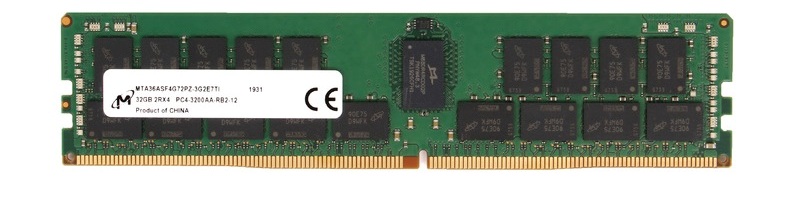
The Micron MTA36ASF4G72PZ-3G2E2UG is a 32GB DDR4-3200 RDIMM built explicitly for servers and workstations where uptime and data accuracy are non-negotiable. Its registered design with ECC directly addresses the top pain points of IT infrastructure managers. In a dense virtualization cluster running dozens of VMs, the Registered buffer stabilizes signal integrity across fully populated memory channels, preventing the sporadic crashes that unregistered modules would suffer under heavy load. Meanwhile, the ECC silently corrects single-bit errors caused by background radiation, safeguarding your financial transactions or customer databases from silent data corruption that could cascade into costly inaccuracies. When paired with an in-memory database like Redis or SAP HANA, the dual-rank x4 organization maximizes bandwidth utilization through interleaving, dramatically accelerating real-time analytics and query response times. That CL22 latency at 3200MT/s, backed by 1.2V efficiency, delivers the ideal balance of speed and thermal control, keeping your 1U nodes cool while maintaining performance under 24/7 operation. This isn’t just memory; it’s the foundation of data integrity and predictable throughput for business-critical workloads.
General Virtualization
For dense server virtualization, populate all memory channels symmetrically with identical 32 GB DDR4-3200 RDIMMs to maximize both capacity and memory bandwidth. In a dual-socket host, installing one DIMM per channel (e.g., 8 modules per CPU) delivers a well‑balanced 256 GB per socket, comfortably supporting dozens of mixed‑load VMs without exhausting resources. Always leverage the ECC and registered design to ensure stability under sustained multi‑tenant operation.
In‑Memory Database
In‑memory databases demand low latency and absolute data integrity, making these ECC Registered DIMMs the correct foundation. Configure the server with the maximum supported DIMMs arranged in a fully balanced, multi‑channel layout – ideally two 32 GB dual‑rank x4 modules per channel – to maximize interleaving and throughput. This approach scales to terabytes of reliable memory, allowing entire datasets to reside in RAM for sub‑millisecond query responses.
High‑Performance Computing
HPC applications thrive on high sustained bandwidth and predictable access times. Fill every memory channel with at least one 32 GB RDIMM, using dual‑rank x4 parts to exploit rank interleaving and keep data streaming to the CPU cores. Employ identical modules across all sockets and avoid mismatched configurations, as balanced population unlocks the full DDR4‑3200 speed and maintains cluster‑wide consistency during large‑scale parallel jobs.
Rigorously tested, compatible with Dell PowerEdge R750, HPE ProLiant DL380 Gen10 Plus, Lenovo ThinkSystem SR650 V2, and more.
Q: Can I mix this MTA36ASF4G72PZ-3G2E2UG with other memory modules of different brands or speeds?
A: Mixing different brands or speeds of Registered ECC RDIMMs is not recommended. It can cause signal integrity issues and system instability. For guaranteed compatibility, always use identical modules with the same Micron part number.
Q: Is this memory compatible with my system?
A: This 32GB DDR4-3200 RDIMM is compatible with Intel Xeon Scalable and AMD EPYC platforms that support Registered ECC DDR4 memory. Please verify your server or workstation motherboard's qualified vendor list (QVL) for this specific part number.
Q: What is the recommended DIMM population order for optimal performance?
A: Follow your server board's memory population guide. Generally, populate identical DIMMs per channel starting with the farthest slots from the CPU. This ensures balanced interleaving across memory channels for maximum bandwidth on dual-socket systems.
Q: Does this module support overclocking or XMP profiles?
A: No, this is a server-grade Registered ECC module adhering to JEDEC DDR4-3200 standards. It does not support overclocking or XMP profiles, as stability and data integrity are paramount in enterprise environments.
Q: What warranty and typical failure rate can I expect?
A: This Micron RDIMM comes with a one-year warranty. As an enterprise-class component, it is designed for 24/7 operation with an extremely low annualized failure rate (AFR), typically under 0.5% under proper conditions.