











 Secure payments
Standard refund policy
Trade Assurance
Secure payments
Standard refund policy
Trade Assurance
| Product Type | Memory Module |
|---|---|
| Memory Capacity | 32 GB |
| Memory Technology | DDR5 |
| Product Voltage | 1.1 V |
| RAM Speed | 4800 MHz |
| RAM Standard | DDR5-4800/PC5-38400 |
| Error Identifying | ECC |
| Signal Type | Registered |
| Column Access Strobe (CAS) | CL40 |
| Rank | Dual Rank x8 |
| Quantity of Pins | 288-pin |
| RAM Genre | RDIMM |
This DDR5-4800 RDIMM with ECC and registered signaling is purpose-built for enterprise servers and workstations running memory-intensive workloads such as virtualization, in-memory databases, and mission-critical applications where data integrity cannot be compromised. Its dual-rank x8 configuration maximizes interleaving for higher sustained bandwidth, while the registered architecture ensures stable signal integrity across densely populated memory channels in multi-DIMM setups.
1. On-the-fly error correction prevents single-bit corruption in large-scale memory arrays, essential for maintaining uptime in always-on enterprise servers.
2. The registered clock driver boosts signal integrity, allowing server boards to support high-density DIMM populations without sacrificing reliability under full load.
3. DDR5’s higher transfer rates and bank concurrency fuel data-intensive tasks, cutting latency in virtualized databases and AI inference pipelines.
4. Dual-rank organization keeps memory channels saturated through rank interleaving, delivering predictable peak performance for multi-tenant cloud hosts.
5. Generous per-DIMM capacity maximizes memory per socket, directly expanding the number of VMs and containers that can run on a single physical node.
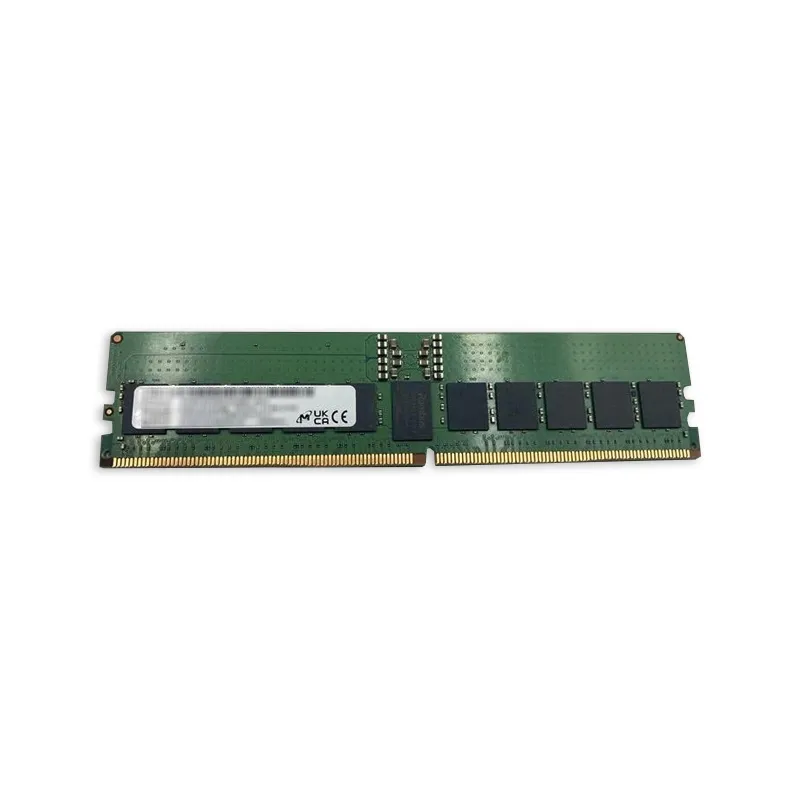
The Micron MTC20F2085S1RC48BA1 is a 32GB DDR5-4800 RDIMM purpose-built for servers, and its four defining characteristics directly address the punishing realities of enterprise computing. In a dense virtualization cluster hosting dozens of business-critical VMs, the integrated Error Correction Code (ECC) is non-negotiable. It silently detects and corrects single-bit memory errors caused by background radiation, preventing random data corruption that could cascade into application crashes or silent file damage, which directly translates into uninterrupted service uptime and data trustworthiness. The Registered signal buffer is equally vital; it stabilizes high-capacity memory channels, allowing the server to populate multiple DIMMs per channel without electrical loading. This guarantees reliable operation at full 32GB capacity even under sustained 24/7 loads, a make-or-break factor when expanding a hypervisor’s memory footprint.
Meanwhile, the Dual Rank x8 architecture unlocks real-world bandwidth through rank interleaving. For an in-memory database like Redis or SAP HANA, the memory controller can access one rank while the other precharges, effectively hiding latency and significantly boosting transaction throughput during peak queries. Paired with a crisp 4800 MHz frequency and a 1.1V power envelope, this module delivers a sharp 38.4 GB/s of peak bandwidth without imposing an excessive thermal burden. The low voltage is a strategic advantage in densely packed 1U or blade servers, where every watt saved on memory cooling directly reduces facility power costs and helps maintain lower sustained processor temperatures, preserving long-term reliability. This module is engineered to make sure your data center performance never becomes the bottleneck.
Server Memory Capacity Planning
This 32GB DDR5-4800 Registered ECC RDIMM (Dual Rank x8, CL40) is designed for servers demanding data integrity and reliability. The following scenarios guide optimal configuration.
General Virtualization
Populate six to eight identical modules across balanced memory channels for a total of 192GB to 256GB. This density comfortably hosts 30–50 moderate VMs, while registered ECC ensures stability under multi-tenant workloads. Distribute DIMMs evenly per CPU socket to maximize memory bandwidth.
In-Memory Database
Deploy a fully populated configuration, such as 16 x 32GB for 512GB, to keep large datasets resident in RAM. The dual-rank design enhances throughput, and ECC corrects single-bit errors critical for transactional consistency. Low latency (CL40) and high speed minimize query response times under heavy concurrency.
High-Performance Computing
Install one DIMM per channel (1DPC) across all available slots to reach peak bandwidth, e.g., 16 x 32GB for 512GB per node. Registered buffering stabilizes signal integrity at 4800MT/s. This setup feeds data-hungry simulations and parallel compute kernels while ECC guards against silent data corruption during long-running jobs.
Rigorously tested, compatible with Dell PowerEdge R760, HPE DL380 Gen11, Lenovo SR650 V3 servers.
Q: Can I mix this MTC20F2085S1RC48BA1 with other memory modules of different brands or speeds?
A: Mixing different brands or speeds is not recommended for this registered ECC module. It can cause signal integrity issues and system instability. For guaranteed reliability, populate all channels with identical Micron DDR5-4800 RDIMMs.
Q: Is this memory compatible with my server platform, such as Intel or AMD systems?
A: This DDR5-4800 ECC RDIMM is compatible with platforms supporting registered DDR5, including Intel Xeon Scalable (Sapphire Rapids) and AMD EPYC 9004 series. Verify your motherboard’s qualified vendor list to confirm 4800MT/s support.
Q: What is the recommended DIMM population order for optimal performance?
A: Follow your server board’s manual for balanced memory configurations. Typically, populate identical DIMMs starting from the farthest slot per channel, filling one DIMM per channel first to maximize bandwidth, then add second DIMMs symmetrically.
Q: Does this module support overclocking or XMP profiles?
A: No. As an enterprise-class registered DIMM, it operates at JEDEC standard DDR5-4800 with CL40 timings. It does not support overclocking or XMP to ensure 24/7 mission-critical stability and data integrity under ECC protection.
Q: What warranty and typical failure rate can I expect?
A: This module includes a one-year warranty. It is built with rigorously tested components, resulting in an extremely low annualized failure rate typical of Micron server memory, ensuring dependable long-term operation in data center environments.