











 Secure payments
Standard refund policy
Trade Assurance
Secure payments
Standard refund policy
Trade Assurance
| Product Type | Memory Module |
|---|---|
| Memory Capacity | 32 GB |
| Memory Technology | DDR5 |
| RAM Speed | 4800 MHz |
| RAM Standard | DDR5-4800/PC5-38400 |
| Error Identifying | ECC |
| Signal Type | Registered |
| Column Access Strobe (CAS) | CL40 |
| Rank | Dual Rank |
| Quantity of Pins | 288-pin |
| RAM Genre | RDIMM |
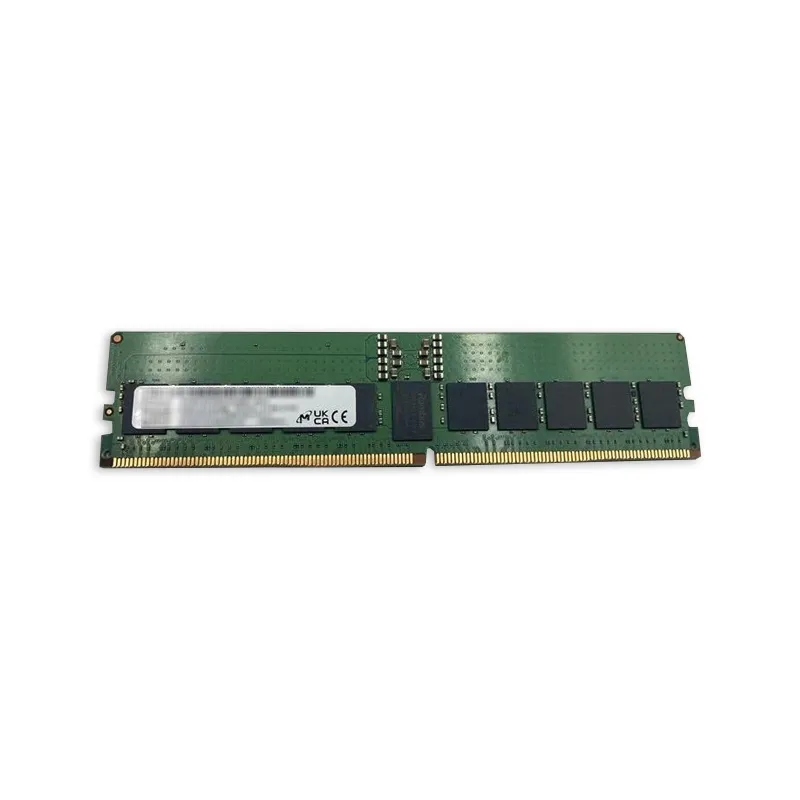
This Micron 32GB DDR5-4800 RDIMM is engineered for enterprise server platforms, where its dual-rank organization maximizes memory bandwidth in multi-DIMM configurations and the registered signal type ensures robust command/address integrity under heavy load. Its ECC capability delivers mission-critical data protection, making it an ideal fit for memory-intensive workloads such as virtualization, in-memory databases, and large-scale data analytics that cannot tolerate silent data corruption.
1. ECC ensures every bit of data is automatically corrected on the fly, preserving transaction integrity and eliminating silent data corruption in continuous-operation financial and database servers.
2. Registered signal buffering decouples the memory bus from the processor, allowing large-capacity arrays to populate all channels without command integrity loss — essential for dense virtualization hosts.
3. A generous per-module capacity lets a single server handle far more concurrent virtual machines, significantly improving consolidation ratios and reducing hardware sprawl in cloud data centers.
4. High memory bandwidth speeds up in-memory analytics and real-time decision workloads, cutting response time for latency-sensitive microservices and AI inference serving at scale.
5. Dual rank interleaving keeps data pipelines saturated by overlapping accesses across rank boundaries, delivering predictable low-latency performance under heavy multi-tenant pressures.
When you are managing a virtualized cluster or running an in-memory database like SAP HANA, the memory module you choose directly dictates uptime, consistency, and performance. The Micron MTC20F2085S1RC48BA2R is a 32GB DDR5-4800 Registered ECC RDIMM, purpose-built for enterprise servers, and its four defining characteristics solve real operational pain points. The Error-Correcting Code (ECC) continuously detects and corrects single-bit memory errors, preventing silent data corruption in transactional databases or bit flips that could crash a hypervisor hosting dozens of production VMs. The Registered (buffered) signal architecture stabilizes the electrical load on the memory bus, allowing you to fully populate all channels with large-capacity modules without signal degradation, which is non-negotiable when scaling a virtualization host to support hundreds of workloads. Its Dual Rank design enables rank interleaving, so while one rank is refreshing, the other can immediately accept read or write commands, delivering notably higher sustained bandwidth and lower latency under the intense, random-access patterns of real-time analytics platforms. Backed by a 4800 MT/s DDR5 interface, this module ensures that massive in-memory datasets are served with the throughput modern multi-core server CPUs demand, keeping your critical services responsive even during peak load.
General Virtualization
For a typical dual-socket server, populate at least eight of these 32 GB DDR5-4800 RDIMMs (256 GB total) to balance density and multi-channel bandwidth. Distributing one DIMM per channel across all memory controllers ensures peak throughput for dozens of mixed-tenant VMs. Scale to 16 modules (512 GB) on supported boards when overcommit ratios drop and guest memory demands grow.
In-Memory Database
Maximize capacity by fully populating each memory channel with these dual-rank 32 GB RDIMMs, targeting 512 GB to 1 TB per host for caching entire datasets. Even with the slight latency from dual-rank loading, the registered ECC guarantees data integrity essential for transactional accuracy. Favor two DIMMs per channel only if total database size exceeds single-slot limits, accepting the speed negotiation to maintain massive in-memory heaps.
High-Performance Computing
Achieve the highest aggregated bandwidth by installing one 32 GB module per channel, typically 8 DIMMs per CPU (256 GB per node), to keep the memory bus at 4800 MT/s. This configuration supplies sufficient headroom for large simulation meshes while avoiding the downclocking that multi-DIMM populations can trigger. For memory-bound MPI workloads, scale out homogeneous nodes with identical RDIMM layouts to prevent imbalance.
Rigorously tested. Compatible with Dell PowerEdge R760, HPE ProLiant DL380 Gen11, Lenovo ThinkSystem SR650 V3, Supermicro SYS-621C-TN12R.
Q: Can I mix this MTC20F2085S1RC48BA2R with other memory modules of different brands or speeds?
A: Mixing is not recommended for registered server memory. Differing speeds or brands may cause training failures, signal integrity issues, or system instability. Always populate identical RDIMMs for validated performance.
Q: Is this memory compatible with my Intel Xeon or AMD EPYC server platform?
A: This DDR5-4800 RDIMM is compatible with Intel Xeon Scalable (Sapphire Rapids or later) and AMD EPYC 9004/8004 series processors. Please verify your server board’s qualified vendor list for 32GB dual-rank ECC support.
Q: What is the recommended DIMM population order for optimal performance?
A: Populate channels symmetrically, starting from the farthest slot in each channel (usually slot 1, blue or white). For dual-rank DIMMs, fill one DIMM per channel first to maintain maximum bandwidth.
Q: Does this module support overclocking or XMP profiles?
A: No. This is a JEDEC-standard RDIMM designed for server stability. It operates only at specified DDR5-4800 timings (CL40) and does not include XMP or overclocking profiles.
Q: What warranty and typical failure rate can I expect?
A: This module includes a one-year warranty. In enterprise environments, DDR5 RDIMMs exhibit an expected annualized failure rate (AFR) typically below 0.5%, ensuring long-term operational reliability.