











 Secure payments
Standard refund policy
Trade Assurance
Secure payments
Standard refund policy
Trade Assurance
| Product Type | Memory Module |
|---|---|
| Memory Capacity | 32 GB |
| Memory Technology | DDR5 |
| RAM Speed | 5600 MHz |
| RAM Standard | DDR5-5600/PC5-44800 |
| Error Identifying | ECC |
| Signal Type | Registered |
| Column Access Strobe (CAS) | CL46 |
| Rank | Single Rank |
| Quantity of Pins | 288-pin |
| RAM Genre | RDIMM |
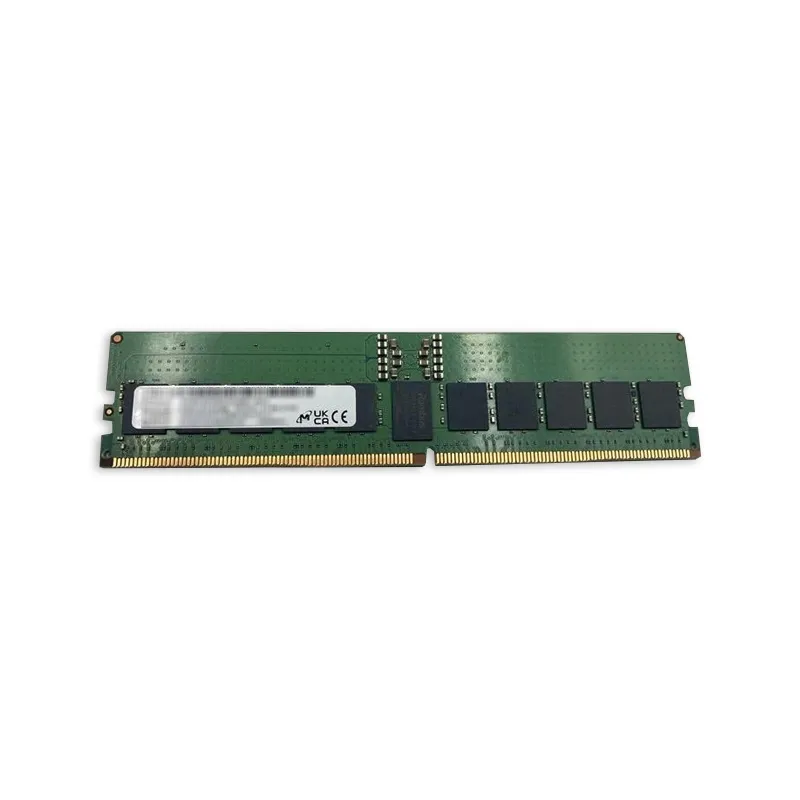
This 32 GB DDR5-5600 registered ECC module (RDIMM) is engineered for server platforms, excelling in virtualization clusters and in-memory databases where data integrity is paramount. Its single‑rank architecture and registered signaling combine to reduce bus loading and maintain clean command/address transmission at high speed, while ECC guards against single‑bit errors in sustained mission‑critical operation.
1. ECC ensures single-bit errors are corrected in real time, safeguarding transactional data integrity for mission-critical database and financial workloads.
2. Registered signal buffering stabilizes command and address lines across densely populated server boards, enabling large-scale deployments without signal degradation.
3. DDR5 technology doubles the burst length and bank groups, delivering the massive memory bandwidth required by AI inference and real-time analytics clusters.
4. 32 GB capacity per module maximizes virtual machine density per rack unit, allowing more simultaneous tenants without sacrificing memory headroom.
5. The 5600 MHz data rate accelerates in-memory caching and reduces latency for latency-sensitive applications like high-frequency trading platforms.
Designed for enterprise servers, this 32 GB DDR5-5600 RDIMM transforms how your infrastructure handles mission-critical workloads. Its four defining characteristics directly address the real pain points of data center operators and system architects.
First, ECC error correction actively detects and repairs single-bit memory errors, preventing silent data corruption in memory databases like SAP HANA or Redis—where a single flipped bit can cascade into financial inaccuracies or transaction loss. Second, the Registered (buffered) architecture re-drives address and command signals, enabling you to populate all DIMM slots without sacrificing signal integrity; in a dense virtualization cluster running dozens of VMs per host, this translates into rock-solid stability even under maximum memory load. Third, the 5600 MT/s bandwidth and Single Rank design work together to deliver predictable low-latency access, critical for in-memory analytics and real-time processing where microseconds decide query completion times. Finally, the 32 GB density per module strikes an optimal balance: it lets you configure high total capacity for large-scale consolidation while keeping rank counts low, avoiding the latency penalties that slow down memory-intensive applications. Together, these attributes ensure that your server infrastructure runs with uncompromised data integrity, maximum uptime, and the consistent high performance demanded by modern virtualized and data-driven environments.
General Virtualization
For dense VM consolidation, populate all memory channels with these 32 GB RDIMMs to reach 256–512 GB per host. A balanced NUMA-aware configuration—one DIMM per channel—maximizes bandwidth while keeping capacity overhead for hypervisor and guest memory overcommit in check.
In-Memory Database
Large data sets like Redis or SAP HANA benefit from high capacity and error correction. Deploy six or eight modules per socket in a balanced layout to deliver the required 192–256 GB with strong fault resilience; ECC and registered buffering ensure data integrity under sustained heavy load.
High-Performance Computing
HPC workloads demand both bandwidth and capacity. Use one DIMM per channel across all eight channels (one 32 GB module per channel) to achieve 256 GB total while saturating DDR5-5600 throughput. This configuration minimizes latency and avoids memory-side bottlenecks in simulation, modeling, or analytics clusters.
Rigorously tested and compatible with Dell PowerEdge R760, HPE ProLiant DL380 Gen11, and Lenovo ThinkSystem SR650 V3.
Q: Can I mix this MTC20F1045S1RC56BD1R with other memory modules of different brands or speeds?
A: Mixing RDIMMs of different brands or speeds is not recommended in server environments. It may cause instability or boot failures. For guaranteed reliability, always use identical modules with the same part number and specifications across all populated channels.
Q: Is this memory compatible with my Intel or AMD server platform?
A: This DDR5-5600 registered ECC module is designed for servers using Intel Xeon Scalable (Sapphire Rapids) or AMD EPYC 9004 Series processors. Verify your motherboard’s qualified vendor list and ensure it supports 288-pin RDIMMs at this speed and capacity.
Q: What is the recommended DIMM population order for optimal performance?
A: Follow your server manufacturer’s population guide. Generally, install a single DIMM per channel first, balancing across memory controllers. For a single-rank module like this, populating symmetric slots maximizes bandwidth and maintains full ECC protection.
Q: Does this module support overclocking or XMP profiles?
A: No. As a registered ECC server memory module, it operates strictly at JEDEC standard DDR5-5600 speed (PC5-44800) with no XMP or overclocking support. This ensures maximum stability and data integrity in mission-critical workloads.
Q: What warranty and typical failure rate can I expect?
A: This module includes a one-year warranty. Server-grade RDIMMs undergo rigorous testing and exhibit very low annualized failure rates (typically under 0.5%), provided they are operated within specified environmental and workload conditions.