











 Secure payments
Standard refund policy
Trade Assurance
Secure payments
Standard refund policy
Trade Assurance
| Model | MT72KSZS4G72LZ-1G4D1A5BF |
|---|---|
| Product Type | Memory Module |
| Compliance Standards | RoHS |
| Memory Capacity | 32 GB |
| Memory Technology | DDR3 |
| Product Voltage | 1.35V |
| RAM Speed | 1333MHz |
| RAM Standard | DDR3-1333/PC3-10600 |
| Error Identifying | ECC |
| Signal Type | Registered |
| Column Access Strobe (CAS) | CL9 |
| Rank | Quad Rank x4 |
| Quantity of Pins | 240-pin |
| RAM Genre | RDIMM |
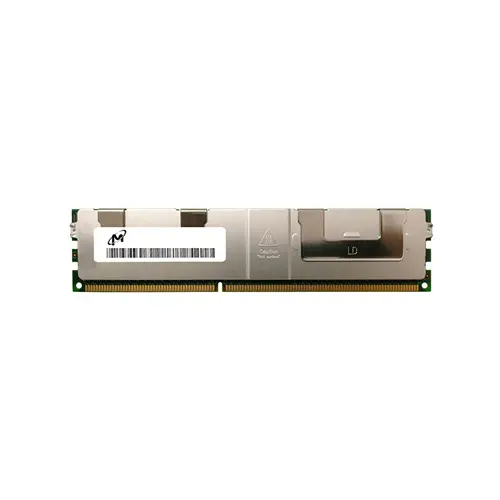
This 32 GB DDR3L-1333 registered ECC RDIMM, featuring a quad-rank x4 organization and CL9 latency, is engineered for enterprise servers and virtualization platforms that require high-density memory with uncompromising data integrity. The 1.35V low-voltage operation and registered buffer enhance signal stability and energy efficiency, making it particularly suitable for in-memory databases and large-scale virtual machine deployments.
1. Substantial module capacity allows servers to host more virtual machines and memory-intensive databases per node, directly increasing consolidation density without hardware expansion.
2. Integrated ECC continuously corrects single-bit errors, preserving data integrity for mission-critical workloads where even silent corruption is unacceptable.
3. Registered signal buffering maintains stable command and address paths when all channels are fully populated, eliminating memory-related crashes in multi-slot server platforms.
4. High-rank architecture maximizes DRAM devices on a single stick, enabling enormous total memory footprints for heavy analytics and large-scale virtualization.
5. Low-voltage operation cuts power consumption and thermal output across large deployments, reducing data center operating expenses while sustaining enterprise-class throughput.
When you are running a virtualized server cluster hosting dozens of mission-critical VMs, or operating an in-memory database where every bit of data drives real-time financial decisions, the memory you choose defines your infrastructure’s reliability. The Micron MT72KSZS4G72LZ-1G4D1A5BF is a 32GB DDR3 Registered ECC RDIMM, engineered explicitly for these demanding enterprise environments, and its four defining characteristics translate directly into operational confidence.
First, ECC error correction actively detects and corrects single-bit memory errors, preventing silent data corruption that could crash a virtual machine or poison a database transaction—this is non-negotiable for data integrity in SQL Server or SAP HANA workloads. Second, the Registered signal buffer stabilizes high-capacity configurations, allowing you to populate all memory channels with quad-rank x4 modules and maintain signal integrity across a dense virtualization host; without it, large memory footprints become unstable. Third, the quad-rank x4 architecture delivers the deep rank interleaving needed to sustain bandwidth under heavy, concurrent access, which directly improves performance in VMware ESXi clusters where dozens of VMs contend for memory I/O, as well as in Redis or Memcached in-memory caches where nanosecond responsiveness matters. Finally, operating at 1.35V low-voltage reduces power draw and thermals inside your rack—meaning lower cooling costs and higher long-term reliability in 24/7 data centers. For your virtualized cluster or memory-hungry analytics engine, this module is not just a specification; it is a guardrail against costly downtime and performance degradation.
General Virtualization
For a hypervisor hosting multiple VMs, populate at least six to eight identical MT72KSZS4G72LZ modules (192–256 GB total) across all memory channels to sustain overcommit ratios. Balance quad‑rank RDIMMs evenly per CPU socket to avoid memory‑channel bottlenecks and leave two DIMM slots free for future VM growth.
In‑Memory Database
Deploy the maximum supported kit of these 32 GB quad‑rank RDIMMs to reach 512 GB or 1 TB, enabling entire datasets to reside in RAM. Populate all channels with identical modules and lock the 1.35 V profile in BIOS to reduce thermal load during sustained high‑bandwidth operations. Use mirroring or sparing modes only if the platform cannot afford unprotected ECC coverage.
High‑Performance Computing
Install one module per channel—typically 8 or 12 DIMMs—to deliver 256–384 GB of registered ECC memory per node. This configuration provides the memory bandwidth needed for tightly coupled MPI workloads while keeping rank loading low. The 1.35 V operation helps control power density rack‑wide, and quad‑rank density lets you scale capacity without sacrificing per‑socket DIMM count.
Server-grade memory rigorously tested and verified compatible with Dell PowerEdge R720, HP DL380p Gen8, Lenovo x3650 M4, and more.
Q: Can I mix this MT72KSZS4G72LZ-1G4D1A5BF with other memory modules of different brands or speeds?
A: Mixing RDIMMs from different vendors or with different speeds may cause instability, signal integrity issues, and is not recommended. For reliable operation, use identical modules across all populated channels and adhere to vendor validated configurations.
Q: Is this memory compatible with my system?
A: This 32 GB DDR3-1333 ECC Registered DIMM is designed for servers using Intel Xeon E5-2600 v1/v2 or AMD Opteron 6300 series platforms. Verify that your motherboard explicitly supports quad-rank x4 RDIMMs and 1.35 V low-voltage operation.
Q: What is the recommended DIMM population order for optimal performance?
A: Populate identical quad-rank RDIMMs starting with the first slot of each memory channel, typically blue slots first, then black. Follow your server's specific population guide; quad-rank modules often limit channel count and speed to 1 DIMM per channel at 1333 MT/s.
Q: Does this module support overclocking or XMP profiles?
A: No. This is a server-class registered DIMM operating strictly at JEDEC standard DDR3-1333 (PC3-10600) with CL9 timings. It does not support XMP profiles, enthusiast overclocking, or voltage adjustments beyond the 1.35 V rated specification.
Q: What warranty and typical failure rate can I expect?
A: This module carries a 1-year warranty. As an enterprise-grade ECC RDIMM built with tested components, it exhibits a very low annualized failure rate under specified conditions, typically orders of magnitude below consumer DIMMs when operated within validated environmental limits.