











 Secure payments
Standard refund policy
Trade Assurance
Secure payments
Standard refund policy
Trade Assurance
| Product Type | Memory Module |
|---|---|
| Memory Capacity | 32 GB |
| Memory Technology | DDR3 |
| Product Voltage | 1.35V |
| RAM Speed | 1066MHz |
| RAM Standard | DDR3-1066/PC3-8500 |
| Error Identifying | ECC |
| Signal Type | Registered |
| Column Access Strobe (CAS) | CL7 |
| Rank | Quad Rank x4 |
| Quantity of Pins | 240-pin |
| RAM Genre | RDIMM |
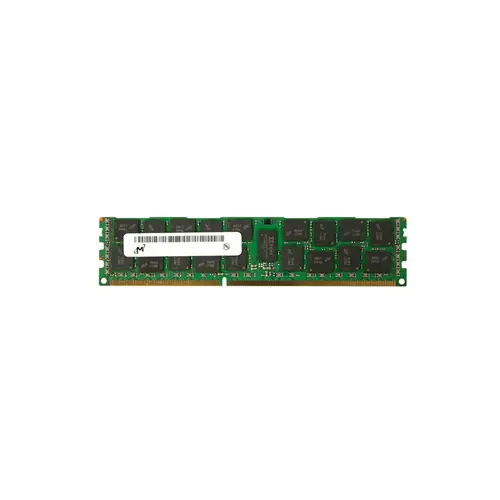
This 32GB DDR3-1066 registered ECC module is designed for legacy server platforms handling memory-intensive workloads like virtualization and in-memory databases. Its quad-rank x4 organization maximizes capacity density while the registered signal type and low 1.35V operating voltage preserve signal integrity and reduce power draw in multi-DIMM configurations.
1. Registered buffering isolates the memory controller from electrical loading, ensuring unwavering signal integrity for large-scale server deployments that cannot tolerate downtime.
2. ECC protection performs real-time data correction, shielding virtualized workloads and in-memory databases from silent bit-flip errors that would otherwise cascade into critical failures.
3. High-density capacity per module allows dense server nodes to allocate massive memory pools, directly increasing virtual machine density and accelerating large dataset analytics.
4. Quad-rank x4 organization maximizes addressable memory within a single slot, enabling deeper memory footprints for caching engines and memory-hungry enterprise applications without sacrificing channel count.
5. Low-voltage operation curtails power draw and thermal waste across fully populated racks, lowering data center cooling overhead and extending the service life of surrounding components.
In data center environments, the Micron MT72KSZS4G72PZ-1G1E1HG is a 32GB DDR3 Registered DIMM engineered to solve the real reliability and density challenges that keep IT architects awake at night. As an RDIMM with ECC, it actively detects and corrects single-bit memory errors the kind of silent data corruption that can quietly poison financial transactions or database indexes in a virtualized cluster before anyone notices. The registered buffer takes that stability further: when you populate all 24 DIMM slots of a dual-socket server to build a large VMware or Hyper-V host, the buffer re-drives address and command signals so your memory bus remains clean under massive load, meaning zero mystery crashes during live migrations. Its quad-rank x4 organization packs more logical banks, which dramatically improves command interleaving and sustained bandwidth for latency-sensitive in-memory databases like SAP HANA or Redis; instead of stalling under mixed read-write contention, the memory serves multiple concurrent requests with noticeably higher effective throughput. Finally, the 1.35V low-voltage operation directly lowers your rack-level power draw and cooling costs every watt saved across hundreds of nodes turns into real operational savings, while still running cooler and preserving long-term reliability for 24/7 uptime.
General Virtualization
When consolidating multiple VMs, populate all memory channels with these 32 GB DDR3L RDIMMs to maximise capacity while staying within power budgets. The 1.35 V operation reduces thermal load in dense racks, and the registered ECC ensures stability for mixed workloads. Aim for a balanced DIMM-per-channel count—typically six or eight modules per host—to avoid memory bottlenecks under peak VM density.
In-Memory Database
In-memory databases demand large, reliable memory pools. Deploy these quad-rank x4 32 GB modules in fully populated configurations, targeting 256–512 GB per node. The low CAS latency (CL7) helps offset the 1066 MHz speed, though you should verify that the memory controller can handle quad-rank loads at full speed. ECC and registered signalling are critical for data integrity during long-running transactional workloads.
High-Performance Computing
HPC clusters often prioritize bandwidth, so use these DIMMs only when capacity-per-node is the primary constraint. Install them in uniform multi-channel sets (e.g., three or four identical modules per socket) to maintain interleaving. The 1.35 V rating helps curb energy costs across scale-out deployments, but consider faster DDR3 variants if memory throughput directly impacts simulation wall-clock time.
Rigorously tested, compatible with Dell PowerEdge R720/R710, HP ProLiant DL380p Gen8, and Lenovo System x3650 M4.
Q: Can I mix this MT72KSZS4G72PZ-1G1E1HG with other memory modules of different brands or speeds?
A: Mixing this RDIMM with modules of different brands or speeds is strongly discouraged. It can cause signal integrity issues, ECC errors, or POST failures. For server stability, always use identical modules.
Q: Is this memory compatible with my Intel or AMD server platform?
A: This DDR3-1066 ECC Registered DIMM is validated for platforms such as Intel Xeon 5500/5600 series and AMD Opteron 6100 series. Verify your board supports 32GB quad-rank x4 RDIMMs before purchase.
Q: What is the recommended DIMM population order for optimal performance?
A: Install quad-rank RDIMMs starting from the slot closest to each CPU, filling identical channels first. Consult your server manual; uneven population may reduce memory speed or prevent normal boot.
Q: Does this module support overclocking or XMP profiles?
A: No, this ECC Registered server memory does not support overclocking or XMP. It operates solely at JEDEC standard DDR3-1066 with fixed timings to guarantee data integrity and 24/7 reliability.
Q: What warranty and typical failure rate can I expect?
A: This module includes a 1-year warranty. Enterprise RDIMMs exhibit a very low annualized failure rate, typically below 0.5%, ensuring long-term dependability in mission-critical server environments.