











 Secure payments
Standard refund policy
Trade Assurance
Secure payments
Standard refund policy
Trade Assurance
| Product Type | Memory Module |
|---|---|
| Compliance Standards | RoHS,WEEE |
| Memory Capacity | 32 GB |
| Memory Technology | DDR4 |
| Product Voltage | 1.2 V |
| RAM Speed | 2400 MHz |
| RAM Standard | DDR4-2400/PC4-19200 |
| Error Identifying | ECC |
| Signal Type | Registered |
| Column Access Strobe (CAS) | CL17 |
| Rank | Dual Rank x4 |
| Quantity of Pins | 288-pin |
| RAM Genre | RDIMM |
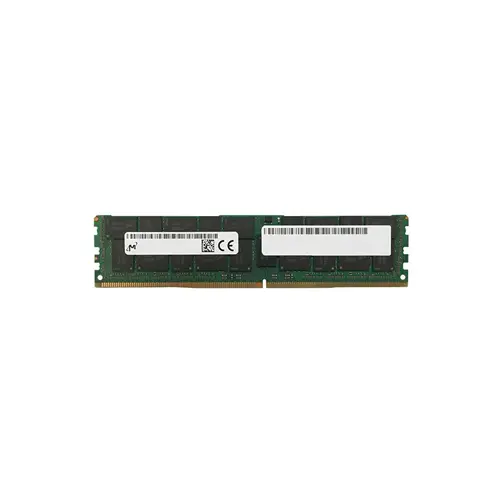
This 32GB DDR4-2400 Registered ECC RDIMM is engineered for server platforms running memory-intensive workloads like virtualization and in-memory databases, where its dual-rank x4 organization boosts bandwidth through rank interleaving while ECC and registered signaling ensure end-to-end data integrity and signal stability under fully populated configurations. Operating at a low 1.2V with CL17 latency, it delivers reliable, power-efficient performance ideal for enterprise-class deployments that demand continuous uptime and error resilience.
1. ECC protection detects and corrects single-bit memory errors transparently, preserving data integrity for virtualized workloads and database transactions where silent corruption is unacceptable.
2. The registered buffer isolates the command and address bus from the memory controller, enabling high-capacity memory scaling while preserving signal integrity under heavily populated server configurations.
3. 32GB per module provides dense memory footprints that expand virtual machine density and in-memory cache pools, directly improving consolidation ratios in cloud and enterprise hosts.
4. DDR4-2400 bandwidth sustains target throughput under concurrent multi-core access, keeping latency-sensitive services responsive in storage servers and hyperconverged infrastructure.
5. Dual rank x4 construction maximizes bank-level parallelism, raising effective bandwidth for write-heavy operations such as journaling, logging, and large-scale data ingestion pipelines.
The Micron MTA36ASF4G72LZ-2G3B1 is a 32GB DDR4-2400 RDIMM engineered for enterprise servers. Four key features—ECC, registered signaling, dual-rank design, and 1.2V efficiency—are vital where uptime and data fidelity are non-negotiable. In a virtualization cluster with dozens of VMs per node, the registered clock driver stabilizes signal paths when all 24 DIMM slots are populated, allowing you to confidently scale to terabytes of memory. ECC corrects memory errors on-the-fly, averting crashes that could corrupt a live-migrating VM or bring down a hypervisor. For in-memory databases like SAP HANA, the dual-rank x4 design uses rank interleaving to speed concurrent transactions and queries, while ECC safeguards data accuracy. Meanwhile, the 1.2V voltage trims power draw and cooling costs in dense racks. This module translates directly into higher VM density, zero-fault database operations, and a leaner energy footprint—exactly what mission-critical infrastructure demands.
General Virtualization
For a balanced virtualized environment running 10–15 mid-sized VMs, deploy six to eight of these 32 GB RDIMMs across dual-socket systems to reach 192–256 GB total capacity. Populate evenly per memory channel (one DIMM per channel) to maintain balanced memory access and avoid performance penalties.
In-Memory Database
In-memory databases like Redis or SAP HANA demand large, error-free datasets. Use a minimum of sixteen modules (512 GB) per node, filling all channels with identical Dual Rank x4 RDIMMs to maximize bandwidth and support ECC correction. When latency is crucial, keep CAS latency at CL17 and stick to 2400 MHz to guarantee stability under sustained loads.
High-Performance Computing (HPC)
HPC workloads benefit from massive memory bandwidth and capacity. Configure nodes with all twenty-four DIMM slots occupied (768 GB total) to feed large-scale simulations. Use registered ECC memory exclusively, placing one 32 GB RDIMM per channel in a balanced population to avoid throttling, while planning for identical part numbers like MTA36ASF4G72LZ to ensure uniform rank and timing characteristics across the cluster.
Rigorously tested, compatible with Dell PowerEdge R760, R740, HPE DL380 Gen10, Lenovo SR650, and more.
Q: Can I mix this MTA36ASF4G72LZ-2G3B1 with other memory modules of different brands or speeds?
A: Mixing this RDIMM with different brands or speeds is not advised. Server platforms demand uniformity to avoid instability, POST issues, or disabled ECC. Use identical modules for guaranteed reliability.
Q: Is this memory compatible with my system? What platforms are supported?
A: This DDR4-2400 registered ECC RDIMM is compatible with Intel Xeon E5-2600 v4/v3 and newer servers, plus select AMD EPYC platforms. Always confirm your motherboard's qualified vendor list for full support.
Q: What is the recommended DIMM population order for optimal performance?
A: Populate DIMMs following your server board’s prescribed slot order, typically filling the slot farthest from the CPU per channel first. Use identical dual-rank DIMMs in symmetric configurations to maximize memory bandwidth and interleaving.
Q: Does this module support overclocking or XMP profiles?
A: No, this server-grade registered ECC module does not support overclocking or XMP. It operates strictly at JEDEC standard DDR4-2400 timings to ensure data integrity and 24/7 stability in enterprise environments.
Q: What warranty and typical failure rate can I expect?
A: It comes with a 1-year warranty. Enterprise RDIMMs exhibit an extremely low annualized failure rate, typically below 0.5%, thanks to rigorous testing and ECC error correction for mission-critical reliability.