











 Secure payments
Standard refund policy
Trade Assurance
Secure payments
Standard refund policy
Trade Assurance
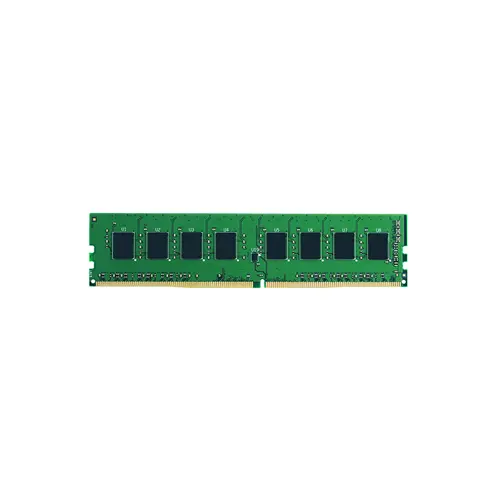
| Product Type | Memory Module |
|---|---|
| Memory Capacity | 32 GB |
| Memory Technology | DDR4 |
| Product Voltage | 1.2 V |
| RAM Speed | 3200 MHz |
| RAM Standard | DDR4-3200/PC4-25600 |
| Error Identifying | ECC |
| Signal Type | Registered |
| Column Access Strobe (CAS) | CL22 |
| Rank | Single Rank x4 |
| Quantity of Pins | 288-pin |
| RAM Genre | RDIMM |
This 32GB DDR4-3200 RDIMM with ECC and registered signaling is purpose‑built for server platforms running memory‑intensive workloads such as virtualization, in‑memory databases, and mission‑critical enterprise applications. Its single‑rank x4 organization improves memory bus efficiency and signal integrity, while the CL22 latency and 1.2V operation deliver a reliable balance of performance and power integrity essential for data‑center environments.
1. 32 GB capacity allows a single server node to host considerably more virtual machines and containers, directly reducing hardware sprawl in dense data centers.
2. ECC protection silently corrects single-bit memory errors, preserving the integrity of financial ledgers and transactional databases around the clock.
3. Registered buffering stabilizes command and address signals across fully loaded memory channels, ensuring dependable operation during peak enterprise workloads.
4. 3200 MT/s bandwidth accelerates in-memory analytics and large-scale virtualization, keeping latency low when hundreds of users hit the application tier simultaneously.
5. Single Rank x4 organization minimizes electrical load on the memory bus, enabling faster access and higher DIMM population without sacrificing signal quality in rack servers.
When your virtualization cluster hosts dozens of virtual machines, a single undetected bit-flip in memory can cascade into data corruption across critical workloads. The Micron MTA18ASF4G72AZ-3G2R is engineered precisely for such environments. As a 32GB DDR4-3200 Registered DIMM, its ECC technology continuously corrects single-bit errors and detects multi-bit faults in real time, preserving data integrity for transactional databases where every record must be flawless. The registered signal buffer stabilizes high-capacity memory channels by minimizing electrical load on the memory controller, enabling you to populate all six or eight DIMM slots per channel without sacrificing 3200 MT/s speed. For an in-memory database like Redis or SAP HANA, the single-rank x4 organization combined with CL22 latency ensures consistent, low-latency access and high sustained bandwidth, eliminating the rank-switching penalties that degrade performance under heavy concurrent requests. In virtualized infrastructure, this module allows you to confidently overcommit memory, knowing that silent data corruption is mitigated by ECC, while the registered architecture keeps large memory configurations stable during live migrations and peak loads. Simply put, it translates directly to fewer application crashes, reduced downtime, and predictable performance when your business depends on always-on services.
General Virtualization
For a dual-socket server, install two 32 GB RDIMMs per CPU (4 modules total) to achieve 128 GB, providing ample headroom for a dozen moderately-sized VMs. Populate one DIMM per channel to maintain balanced memory bandwidth and avoid performance penalties from mixed channel loading. Scale up to 256 GB by using eight modules if hosting dense, memory-overcommitted workloads, while ECC ensures hypervisor stability.
In-Memory Database
Maximize capacity by fully populating all channels with these 32 GB registered DIMMs—e.g., 12 modules yield 384 GB in a 6-channel platform. The single-rank x4 construction and CL22 latency offer consistent performance for large datasets like Redis or SAP HANA. Configure memory sparing or mirroring via the BIOS for an extra fault-tolerance layer, which adds resilience without sacrificing the ECC protection already provided.
High-Performance Computing
Aim for one 32 GB RDIMM per channel to run at the full 3200 MT/s, reaching a balanced 256 GB across 8 channels. The low 1.2 V and single-rank design minimize thermal load during sustained parallel simulations. If capacity is secondary to bandwidth, use just one DIMM per channel to avoid speed degradation, ensuring predictable latency for tightly coupled MPI jobs.
Rigorously tested for servers: compatible with Dell PowerEdge R750, HPE ProLiant DL380 Gen10 Plus, Lenovo ThinkSystem SR650 V2.
Q: Can I mix this MTA18ASF4G72AZ-3G2R with other memory modules of different brands or speeds?
A: Mixing is not recommended for registered ECC memory. Different timings, ranks, or vendors may cause signal integrity issues and system instability. Uniform module configurations ensure validated reliability.
Q: Is this memory compatible with my server platform (Intel or AMD)?
A: This DDR4-3200 RDIMM is designed for servers using Intel Xeon Scalable (2nd Gen and newer) or AMD EPYC 7002/7003 series processors. Verify your board supports 1.2 V registered ECC 288-pin modules.
Q: What is the recommended DIMM population order for optimal performance?
A: Populate identical modules per memory channel, following the server motherboard’s slot numbering. Typically, fill all blue or white slots first, balancing ranks across channels for maximum throughput and interleaving.
Q: Does this module support overclocking or XMP profiles?
A: No. This is an enterprise RDIMM with fixed JEDEC timings (CL22). Overclocking and XMP are not supported on registered server memory, as reliability and error correction take priority over frequency scaling.
Q: What warranty and typical failure rate can I expect?
A: This module includes a 1-year warranty. Enterprise RDIMMs exhibit very low annual failure rates under proper thermal conditions. ECC further mitigates soft errors, ensuring data integrity in 24/7 operation.