











 Secure payments
Standard refund policy
Trade Assurance
Secure payments
Standard refund policy
Trade Assurance
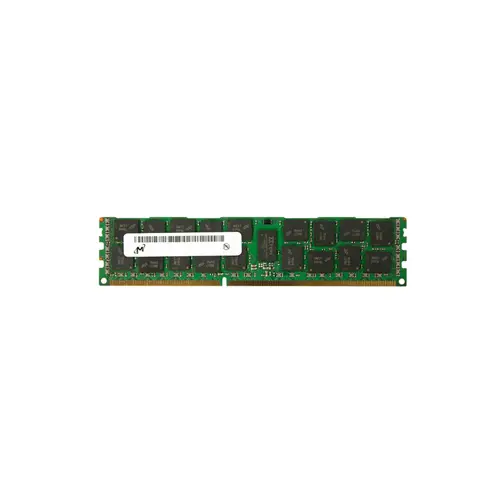
| Model | MT36JSF51272PZ-1G4G |
|---|---|
| Product Type | Memory Module |
| Compliance Standards | RoHS |
| Memory Capacity | 4 GB |
| Memory Technology | DDR3 |
| Product Voltage | 1.5V |
| RAM Speed | 1333MHz |
| RAM Standard | DDR3-1333/PC3-10600 |
| Error Identifying | ECC |
| Signal Type | Registered |
| Column Access Strobe (CAS) | CL9 |
| Rank | Dual Rank x4 |
| Quantity of Pins | 240-pin |
| RAM Genre | RDIMM |
Designed for server-class deployments, this RDIMM’s registered architecture and ECC engine ensure signal integrity and in-transit data protection, making it ideal for virtualization hosts and in-memory databases where uptime and accuracy are non-negotiable. The dual-rank x4 organization at CL9 balances load and command pipelining on dense memory channels, delivering reliable 1333 MHz throughput under sustained write-heavy workloads.
1. ECC protection silently corrects single-bit memory errors, preserving data integrity in long-running database and virtualization workloads.
2. Registered signal buffering stabilizes high-density memory configurations, enabling reliable operation across fully populated server boards.
3. Dual Rank x4 organization delivers balanced interleaving and command pipelining, sustaining peak bandwidth under concurrent multi-VM access.
4. 1333 MT/s speed provides ample throughput for legacy enterprise applications, ensuring smooth scaling of memory-bound tasks without modernization costs.
5. A 4-gigabyte capacity suits lightweight container hosts and edge servers, keeping power draw and boot times minimal for targeted microservice deployments.
Based on the Registered DIMM (RDIMM) designation and ECC support, the MT36JSF51272PZ-1G4G is decidedly a server-grade memory module, and its four defining characteristics directly address the critical pain points of enterprise IT infrastructure. In a dense virtualization cluster, where a single host runs dozens of VMs, the combination of ECC and Registered logic becomes your insurance policy. ECC actively corrects single-bit errors triggered by cosmic radiation or electrical noise, preventing silent data corruption that could corrupt a virtual disk or bring down the entire hypervisor. Simultaneously, the onboard register buffers the command and address signals, dramatically reducing the electrical load on the CPU’s memory controller. This allows you to populate all memory channels with multiple DIMMs for maximum capacity without sacrificing signal integrity, keeping your 24/7 operations stable.
For in-memory databases like Redis or a high-performance Memcached tier, the module’s Dual Rank x4 organization is a genuine performance catalyst. By interleaving memory accesses between two internal ranks, it effectively hides the delays from row precharge cycles, delivering substantially higher effective bandwidth for sub-millisecond key-value lookups and real-time analytics queries. Complemented by a proven 1.5V operating voltage and CL9 latency, the MT36JSF51272PZ-1G4G delivers the deterministic, reliable response that database transactions demand, transforming raw hardware capability into measurable business continuity and application acceleration.
General Virtualization
For a moderate hypervisor host running 8–12 light VMs, install six of these 4 GB RDIMMs across three channels (24 GB total) to balance cost and density. Populate identical DIMMs per channel to maintain triple-channel symmetry and avoid performance penalties. Leave one channel free if future expansion to 32 GB is planned.
In-Memory Database
Low-latency datasets like Redis or Memcached demand maximum capacity within the server’s channel limit. Deploy 12 modules (48 GB) by filling all six slots per CPU in a dual-socket system (six DIMMs per socket, one per channel) to sustain full-speed 1333 MHz operation. The registered ECC buffer ensures data integrity during persistent, hot-data workloads without throttling rank count.
HPC
For memory-bandwidth-sensitive clusters, outfit each node with a balanced 8-module configuration (32 GB) on a typical dual-socket board using four modules per CPU evenly distributed. This provisions one DIMM per channel to maximize interleaving and throughput while meeting common 16–32 GB-per-node requirements. The 1.5 V signaling and CL9 latency keep thermal profiles predictable under sustained floating-point workloads.
Tested server memory; compatible with Dell R710/R610, HP DL380 G7, Lenovo RD330.
Q: Can I mix this MT36JSF51272PZ-1G4G with other memory modules of different brands or speeds?
A: Mixing modules is not recommended for server environments. Differing brands, speeds, or ranks can cause signal integrity issues and system instability. Uniformity ensures reliable ECC and registered operation.
Q: Is this memory compatible with my Intel or AMD server platform?
A: This DDR3-1333 RDIMM is compatible with platforms supporting registered ECC DDR3 memory at 1.5V. Please verify your server board's qualified vendor list (QVL) for the specific Intel Xeon or AMD Opteron generation.
Q: What is the recommended DIMM population order for optimal performance?
A: For dual-rank x4 RDIMMs, populate identical modules per channel starting with the farthest slot from the CPU. Follow the server board's slot numbering guide to balance memory channels and optimize interleaving.
Q: Does this module support overclocking or XMP profiles?
A: No. This is an enterprise-grade registered ECC module, designed for JEDEC-compliant operation at DDR3-1333 CL9. Overclocking and XMP are not supported, as stability and data integrity are prioritized.
Q: What warranty and typical failure rate can I expect?
A: This product carries a 1-year limited warranty. Typical annualized failure rates (AFR) for such server memory are extremely low, usually below 0.5%, under specified operating conditions.