











 Secure payments
Standard refund policy
Trade Assurance
Secure payments
Standard refund policy
Trade Assurance
| Product Type | Memory Module |
|---|---|
| Compliance Standards | RoHS |
| Memory Capacity | 4 GB |
| Memory Technology | DDR3 |
| Product Voltage | 1.35V |
| RAM Speed | 1600MHz |
| RAM Standard | DDR3-1600/PC3-12800 |
| Error Identifying | ECC |
| Signal Type | Registered |
| Column Access Strobe (CAS) | CL11 |
| Rank | Single Rank x8 |
| Quantity of Pins | 240-pin |
| RAM Genre | RDIMM |
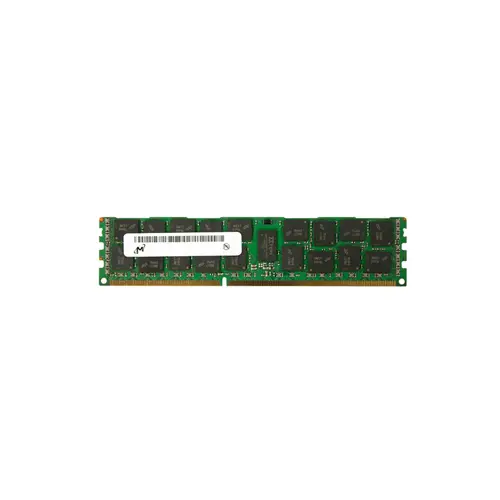
This is a server-grade DDR3-1600 Registered DIMM with ECC, ideally suited for virtualization platforms and in-memory databases where data integrity and 24/7 stability are critical. Operating at a low 1.35V and configured as single-rank x8, it delivers a balanced combination of reduced power consumption and reliable registered signal integrity, helping to maintain consistent latency under heavily loaded multi-DIMM memory channels.
1. Hardware ECC corrects memory errors in real time, a fundamental safeguard for databases and hypervisors where undetected bit flips could corrupt transactions or crash entire virtual machines.
2. Registered clock drivers buffer command signals, allowing the server to support far greater memory densities without signal degradation, a key enabler for maximizing VM density per physical host.
3. Low-voltage DDR3L operation trims per-module energy demand, cumulatively reducing datacenter electrical and cooling costs while maintaining full DDR3 bandwidth.
4. The module’s high data rate sustains peak throughput of 12.8 GB/s per channel, keeping legacy enterprise applications and content caching servers fed with data without latency spikes.
5. Single-rank x8 configuration minimizes bus loading, ensuring stable operation at rated speed even when all server DIMM slots are populated, which is critical for predictable response times in OLTP systems.
The Micron MT9KSF51272PZ-1G6E2HF is a DDR3-1600 Registered DIMM purpose-built for server workloads. Its four core attributes—ECC error correction, registered signal buffering, 1.35V low-voltage operation, and single-rank x8 organization—directly solve pressing data-center challenges. In a dense virtualization cluster, ECC tirelessly corrects single-bit errors and detects multi-bit corruption, preventing silent data corruption that could crash hypervisors and destabilize dozens of virtual machines. Registered logic buffers address and command signals, preserving signal integrity when populating numerous DIMMs per channel; this is critical for scaling memory capacity to hundreds of gigabytes without sacrificing stability. The 1.35V supply significantly reduces power draw and cooling overhead across racks, while the single-rank architecture pairs with 1600MHz bandwidth to deliver consistent, low-latency performance. For an in-memory database like Redis or SAP HANA, this means financial risk calculations and real-time transaction log commits complete error-free and at predictable throughput. Every query benefits from reliable, uninterrupted access to hot data. This DIMM is more than a memory upgrade—it is an engineered safeguard for data integrity and operational continuity in enterprise environments where downtime is not an option.
General Virtualization
Equip a virtualization host with six to eight of these 4 GB registered ECC DDR3L modules (24–32 GB total) to comfortably run a moderate number of lightweight VMs. Install the modules symmetrically across all memory channels—one DIMM per channel—to achieve balanced bandwidth and consistent performance. The 1.35 V low‑voltage operation also reduces power and cooling costs in dense, always‑on server environments.
In‑Memory Database
Build a 64 GB memory pool by fully populating sixteen identical 4 GB RDIMMs, allowing entire datasets to reside in RAM for ultra‑low‑latency processing. Enable channel interleaving and populate all banks to maximize throughput and keep response times predictable under heavy transactional loads. The ECC and registered design ensures end‑to‑end data integrity, a critical requirement for mission‑critical database workloads.
High‑Performance Computing (HPC)
For bandwidth‑hungry HPC jobs, populate every DIMM slot in the server with matching 4 GB RDIMMs—typically 12 or 16 modules in a dual‑socket node—to deliver the maximum aggregate memory bandwidth. This configuration keeps all CPU cores fed with data during parallel simulations and reduces bottlenecks. While the CL11 latency and 1600 MHz speed provide steady, low‑latency access, capacity‑intensive models may require scaling out across additional nodes.
This rigorously tested server memory is compatible with Dell PowerEdge R620/R720, HP ProLiant DL380p Gen8, and similar DDR3 systems.
Q: Can I mix this MT9KSF51272PZ-1G6E2HF with other memory modules of different brands or speeds?
A: Mixing this registered ECC RDIMM with other modules is not recommended. Even slight variations in rank, timing (CL11), or voltage (1.35V) can cause system instability or prevent boot on server platforms.
Q: Is this memory compatible with my server?
A: This module suits DDR3 servers supporting registered ECC DIMMs. Verify your motherboard supports 1.35V low-voltage RDIMMs at 1600MT/s. It is typically compatible with Intel Xeon E5-2400 series and equivalent AMD platforms.
Q: What is the recommended DIMM population order for optimal performance?
A: Install identical single-rank x8 modules in matched sets across memory channels. Consult your server’s manual for balanced configurations; typically fill blue slots first per channel to maintain dual or multi-channel operation.
Q: Does this module support overclocking or XMP profiles?
A: No. As an enterprise-class registered ECC RDIMM operating at JEDEC standard DDR3-1600, it does not support overclocking or XMP profiles. It prioritizes data integrity and strict compliance over enthusiast-level tuning.
Q: What warranty and typical failure rate can I expect?
A: This module includes a 1-year warranty. Failure rates for Micron-based RDIMMs are extremely low under proper conditions, typically delivering a Mean Time Between Failures (MTBF) in the millions of hours within specified environmental ranges.