











 Secure payments
Standard refund policy
Trade Assurance
Secure payments
Standard refund policy
Trade Assurance
| Product Type | Memory Module |
|---|---|
| Compliance Standards | RoHS |
| Memory Capacity | 4 GB |
| Memory Technology | DDR3 |
| Product Voltage | 1.35V |
| RAM Speed | 1600MHz |
| RAM Standard | DDR3-1600/PC3-12800 |
| Error Identifying | ECC |
| Signal Type | Registered |
| Column Access Strobe (CAS) | CL11 |
| Rank | Dual Rank x8 |
| Quantity of Pins | 240-pin |
| RAM Genre | RDIMM |
This DDR3-1600 Registered ECC module, with its 1.35V low-voltage operation and dual-rank x8 organization, is purpose-built for server platforms handling memory-intensive workloads such as virtualization and in-memory databases, where data integrity and reliability are paramount. The registered signal topology and ECC error correction ensure stable operation in multi-DIMM configurations, effectively mitigating single-bit errors in dense, mission-critical enterprise environments.
1. ECC memory detects and corrects single-bit errors silently, preserving data integrity in financial transactions or database operations where memory faults could otherwise halt critical services.
2. Registered DIMM architecture buffers command and address signals, allowing dense server memory populations without signal degradation, crucial for large-scale virtualization hosts.
3. Dual rank configuration interleaves accesses across internal banks, sustaining higher memory bandwidth under concurrent VM workloads and reducing latency spikes during peak consolidation.
4. Low-voltage operation cuts power draw per module, directly lowering energy consumption across fully populated racks and shrinking the thermal footprint in air-cooled data centers.
5. High data rate transfers boost memory throughput, speeding up in-memory analytics and read-heavy workloads that rely on rapid access to large datasets without bottlenecking the CPU.
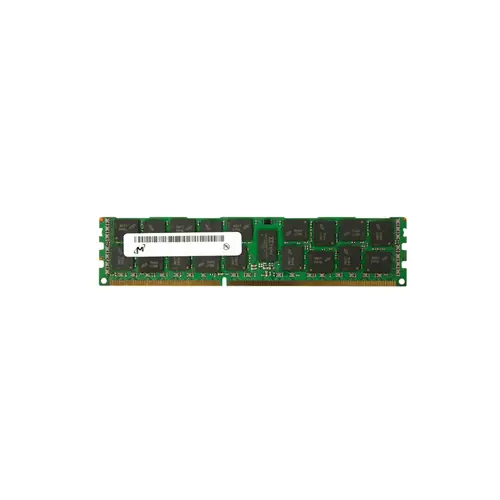
This registered DDR3L RDIMM (MPN MT18KSF51272PDZ-1G6K1HG) delivers what a spec sheet cannot: real-world resilience. Take a VMware cluster: a cosmic ray can flip a single memory bit, silently corrupting guest OS data. ECC instantly corrects such errors, preventing hypervisor crashes and ensuring your virtualized services stay online. In a high-frequency trading or in-memory database scenario like SAP HANA, the registered buffer stabilizes signals across multiple DIMMs per channel, while the dual-rank x8 architecture uses internal bank interleaving to boost sustained bandwidth; your transactions commit faster without risking signal integrity. Operating at just 1.35V, it dramatically cuts power draw in a fully populated 2U server, lowering both electricity and cooling costs. From error correction to low voltage, every parameter is engineered to keep your data accurate and your operations uninterrupted.
General Virtualization
For light to moderate virtualization workloads, populate six to eight identical 4 GB RDIMMs per socket to achieve 24–32 GB of total capacity while leveraging the memory interleaving benefits of the platform. The low 1.35 V operating voltage helps reduce overall power draw in dense multi‑node deployments. Registered ECC ensures data integrity for multiple guest operating systems, making these modules a cost‑effective choice for entry‑level hypervisor hosts.
In‑Memory Database
Capacity is the primary constraint for in‑memory databases, so 4 GB modules are practical only in small test or development datasets. Deploy them in a balanced multi‑channel configuration—typically six or twelve identical DIMMs per processor—to maximize bandwidth while keeping total capacity proportional to the dataset size. The dual‑rank x8 organization aids command‑bus efficiency, and ECC protection is mandatory for financial or transactional in‑memory stores.
High‑Performance Computing
In HPC clusters that scale out rather than up, 4 GB RDIMMs strike a balance between per‑node memory and cost. Populate all memory channels per node with identical modules to sustain peak 1600 MT/s throughput under floating‑point‑intensive workloads. The registered signal type supports large per‑node DIMM counts without signal degradation, and the 1.35 V low‑voltage operation cumulatively saves power across hundreds of nodes during long‑running parallel jobs.
Rigorously tested ECC Registered DDR3 module. Compatible with Dell PowerEdge R720, HP DL380p Gen8, Lenovo x3650 M4.
Q: Can I mix this MT18KSF51272PDZ-1G6K1HG with other memory modules of different brands or speeds?
A: Mixing registered ECC modules is not recommended. It often causes signal integrity issues and system instability. For reliable operation, populate all channels with identical Micron-certified RDIMMs featuring the same rank, speed, and voltage.
Q: Is this memory compatible with my Intel or AMD server platform?
A: It is validated for platforms supporting DDR3-1600 RDIMMs with 1.35V operation, such as Intel Xeon E5-2400/2600 v2 series and select AMD Opteron 6300 series. Verify your motherboard’s RDIMM qualified vendor list to ensure ECC registered support.
Q: What is the recommended DIMM population order for optimal performance?
A: Populate identical DIMMs in sets of three per memory channel for triple-channel architectures, or one DIMM per channel for others. Always consult your server board manual: typically fill blue slots first, then black, to enable balanced interleaving.
Q: Does this module support overclocking or XMP profiles?
A: No. Server-grade registered ECC memory adheres strictly to JEDEC standards and does not support overclocking or Intel XMP. It operates only at the specified CAS latency of 11 and 1600MT/s with guaranteed stability, prioritizing data integrity over speed.
Q: What warranty and typical failure rate can I expect with this module?
A: This Micron server module carries a 1-year warranty. It is built with screened enterprise-class ICs and rigorous qualification, resulting in an annualized failure rate typically below 0.3% under spec conditions, ensuring long-term mission-critical reliability.