











 Secure payments
Standard refund policy
Trade Assurance
Secure payments
Standard refund policy
Trade Assurance
| Product Type | Memory Module |
|---|---|
| Compliance Standards | |
| Memory Capacity | 4 GB |
| Memory Technology | DDR2 |
| Product Voltage | 1.8V |
| RAM Speed | 667MHz |
| RAM Standard | DDR2-667/PC2-5300 |
| Error Identifying | ECC |
| Signal Type | Registered |
| Column Access Strobe (CAS) | CL5 |
| Rank | Dual Rank x4 |
| Quantity of Pins | 240-pin |
| RAM Genre | RDIMM |
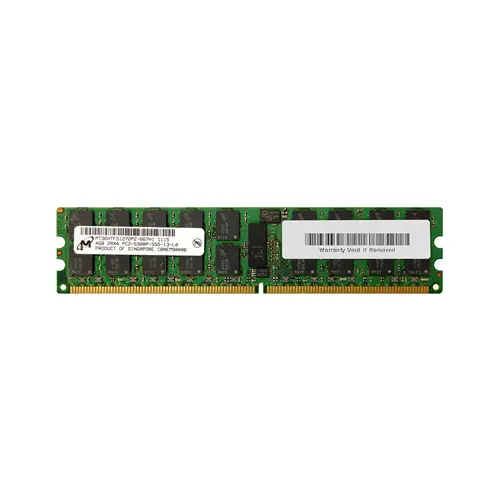
This DDR2-667 Registered ECC memory module, with its four-DRAM-device Dual Rank x4 configuration, is engineered for legacy server platforms where data integrity is paramount—delivering robust error correction for virtualization hosts and memory-intensive database workloads. The registered signal type and 240-pin RDIMM form factor ensure reliable signal stability in fully populated systems, while the CL5 latency provides balanced access timing for sustained throughput under constant load.
1. ECC error correction maintains end-to-end data integrity in long-running server workloads, eliminating silent memory errors that could corrupt financial records or virtualization clusters.
2. Registered signal buffering stabilizes command and address lines across high-density memory configurations, allowing datacenters to fully populate dual-socket boards without signal degradation.
3. Dual Rank x4 organization leverages bank interleaving to overlap precharge and access cycles, squeezing more usable bandwidth out of the memory channel under heavy concurrent request mixes.
4. 667MHz system speed supplies a steady 5.3 GB/s per module, ensuring snappy response in disk-caching arrays and OLTP databases where latency spikes directly impact user-facing transactions.
5. A 4 GB capacity per stick scales servers to respectable total footprints for the era, comfortably hosting multiple hypervisor instances and moderate in-memory datasets without oversubscribing resources.
In today’s legacy server farms and virtualized environments, the Micron MT36HTF51272PZ-667H1 4GB DDR2-667 RDIMM is not just a component—it’s a safeguard. When you run a memory database like SAP HANA or a cluster of KVM hosts, ECC protection becomes non-negotiable: it silently corrects single-bit errors caused by cosmic radiation, preventing transaction corruption and costly downtime. Meanwhile, the registered buffer means you can fill all 16 DIMM slots in a dual-socket server without signal degradation, critical for achieving the memory footprint required to consolidate 20+ virtual machines. The dual-rank x4 organization boosts throughput by interleaving access across ranks, which directly translates to higher queries per second in Redis and smoother live migrations. Finally, the stable 667MHz CL5 timing delivers deterministic latency that aging enterprise boards demand, ensuring 24/7 reliability for budget-conscious IT departments keeping legacy ERP systems alive.
General Virtualization
For lightweight virtualization hosts using DDR2-era servers, populate all available DIMM slots with these 4 GB RDIMMs to maximize memory channels and total capacity. Aim for at least 16 GB (four modules) to comfortably run 3–5 low-resource virtual machines, ensuring registered ECC memory guards against data corruption in multi-tenant environments.
In-Memory Database
In-memory databases demand both capacity and reliability, so install six or eight of these 4 GB dual-rank modules for 24–32 GB total, leveraging the dual-rank design for slightly better bandwidth on older chipsets. The combination of ECC and registered buffering is critical to prevent silent errors during high-speed cache operations, but recognize that DDR2-667 bandwidth may bottleneck heavy write loads.
High-Performance Computing
HPC clusters with DDR2 infrastructure benefit from fully populating each node to 32 GB (eight modules), using dual-rank x4 RDIMMs to maintain signal integrity across all 240-pin channels. Deploy identical modules across nodes to ensure consistent NUMA latency and stable parallel job execution, while the ECC feature protects long-running simulations from single-bit memory errors.
Rigorously tested server memory, compatible with Dell PowerEdge 2970, HP ProLiant DL385 G2, IBM System x3455, and more.
Q: Can I mix this MT36HTF51272PZ-667H1 with other memory modules of different brands or speeds?
A: Mixing RDIMMs of different brands or speeds is not recommended in server environments. It may force the system to run at the slowest common speed, risking instability and compromising mission-critical reliability.
Q: Is this memory compatible with my Intel or AMD based server system?
A: This DDR2-667 Registered ECC module is designed for legacy servers using chipsets like Intel 5000P/5100 or AMD Opteron Socket F platforms that explicitly support 1.8V, 240-pin RDIMMs with x4 organization.
Q: What is the recommended DIMM population order for optimal performance in a server?
A: Populate identical DIMMs per channel, starting with the slot farthest from the CPU. For dual-processor servers, balance memory equally across both processor memory banks according to your motherboard's manual to enable dual-channel interleaving.
Q: Does this module support overclocking or XMP profiles?
A: No. This is a server-grade Registered ECC module strictly adhering to JEDEC standards. It does not support overclocking or XMP profiles, as stability and data integrity take priority over variable frequency operation.
Q: What warranty and typical failure rate can I expect with this memory?
A: This module includes a 1-year warranty. Enterprise-class RDIMMs like this Micron part exhibit very low annualized failure rates under normal operating conditions, but precise AFR figures are not published for end users.