











 Secure payments
Standard refund policy
Trade Assurance
Secure payments
Standard refund policy
Trade Assurance
| Product Type | Memory Module |
|---|---|
| Compliance Standards | RoHS |
| Memory Capacity | 4 GB |
| Memory Technology | DDR2 |
| Product Voltage | 1.8V |
| RAM Speed | 667MHz |
| RAM Standard | DDR2-667/PC2-5300 |
| Error Identifying | ECC |
| Signal Type | Registered |
| Column Access Strobe (CAS) | CL5 |
| Rank | Dual Rank x4 |
| Quantity of Pins | 240-pin |
| RAM Genre | RDIMM |
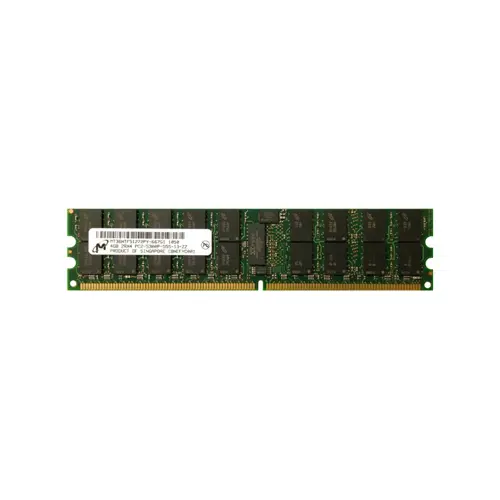
This DDR2-667 Registered ECC RDIMM, with its dual-rank x4 organization and CL5 latency, is engineered for legacy server platforms demanding deterministic performance and data integrity under moderate loads. It is best suited for virtualized environments or small-scale in-memory databases where ECC error correction and registered signaling stabilize multi-DIMM configurations.
1. 4 GB capacity provides sufficient headroom for running multiple legacy enterprise applications concurrently on a single server, reducing the need for costly hardware sprawl.
2. ECC error correction detects and corrects single-bit memory faults in real time, preventing silent data corruption that could compromise financial transactions or database integrity.
3. Registered signal buffering stabilizes high-density memory configurations, ensuring reliable signal integrity across all DIMM slots in a fully populated server board.
4. Dual Rank x4 organization interleaves memory accesses efficiently, sustaining high throughput for the predictable, steady-state workloads typical of database and web serving environments.
5. 667 MHz clock speed delivers consistent bandwidth for synchronous data transfer, matching the rhythm of older server chipsets without introducing unnecessary latency or power overhead.
Designed specifically for legacy server platforms, this Micron RDIMM (MT36HTF51272PY-667G1) translates four critical engineering features into real-world reliability that IT infrastructure teams depend on. The registered signal type places buffers on the command and address lines, dramatically reducing the electrical load on the memory controller. For a virtualization cluster packing six or eight DIMMs per host, this means you can populate all channels without training failures or boot-time instability, keeping your entire hypervisor fleet online. The ECC engine continuously corrects single-bit errors and detects multi-bit faults. In an in-memory database like SAP HANA, a single undetected bit flip can corrupt financial records; ECC makes that risk statistically negligible, protecting data integrity around the clock. The dual-rank x4 organization enables intelligent interleaving, which boosts bandwidth utilization during heavy concurrent query loads, so your OLTP transactions complete faster under pressure. Finally, the PC2-5300 667MHz speed profile delivers predictable, validated throughput that eliminates latency spikes in storage caching operations, ensuring your ZFS or Ceph write cache never becomes a bottleneck.
General Virtualization
For a general virtualization host, install a minimum of four of these 4 GB ECC registered DIMMs (16 GB total) in a balanced dual-channel arrangement to comfortably run several lightweight VMs. The ECC and registered buffering provide the stability required when multiple guest operating systems share memory. If the server board offers additional slots, scaling to eight modules (32 GB) is advised for heavier consolidation scenarios.
In-Memory Database
In-memory database workloads demand both capacity and uncompromising data integrity. Populate all available DIMM slots with these 4 GB RDIMMs—aiming for a fully buffered 64 GB configuration on a typical dual-socket server—to store large working sets entirely in RAM. The registered ECC technology eliminates single-bit errors that could otherwise corrupt transactional data or cached indices.
High-Performance Computing (HPC)
HPC applications benefit most from uniform, high-bandwidth memory access. Install identical pairs of these dual-rank x4 modules in every populated memory channel (e.g., eight RDIMMs in a quad-channel platform) to enable optimal interleaving and maximize throughput. Although the DDR2-667 speed is modest, consistent channel loading and the reliable ECC protection are crucial for preserving correctness during lengthy parallel computations.
Rigorously tested server memory, compatible with Dell PowerEdge 2950, HP ProLiant DL380 G5, IBM System x3650.
Q: Can I mix this MT36HTF51272PY-667G1 with other memory modules of different brands or speeds?
A: We strongly advise against mixing brands or speeds in server environments. Even identical specs can cause signal integrity issues. For guaranteed stability, use identical modules in matched sets, especially with registered ECC memory.
Q: Is this memory compatible with my Intel or AMD server platform?
A: This DDR2-667 Registered ECC module is compatible with server boards using chipsets like Intel 5000/5100 series or AMD Socket F platforms that support 240-pin RDIMMs. Verify your board specifically requires registered ECC DDR2 with 1.8V.
Q: What is the recommended DIMM population order for optimal performance?
A: Follow your server board’s memory population guide. Typically, populate corresponding slots in each memory channel first. For this dual-rank RDIMM, install identical modules in matched banks to enable interleaving and maintain full memory bandwidth.
Q: Does this module support overclocking or XMP profiles?
A: No. This is a server-grade registered ECC module running at JEDEC standard DDR2-667 speeds. It does not feature XMP nor is it designed for overclocking, which could compromise data integrity and system stability in mission-critical environments.
Q: What warranty and typical failure rate can I expect?
A: This module is backed by a one-year warranty. As enterprise-class hardware, MTBF is high under proper conditions. Actual annualized failure rates remain very low, typically below 0.5%, when operated within voltage, thermal, and frequency specifications.