











 Secure payments
Standard refund policy
Trade Assurance
Secure payments
Standard refund policy
Trade Assurance
| Product Type | Memory Module |
|---|---|
| Memory Capacity | 4 GB |
| Memory Technology | DDR2 |
| Product Voltage | 1.8V |
| RAM Speed | 667MHz |
| RAM Standard | DDR2-667/PC2-5300 |
| Error Identifying | ECC |
| Signal Type | Fully Buffered |
| Column Access Strobe (CAS) | CL5 |
| Rank | Dual Rank x4 |
| Quantity of Pins | 240-pin |
| RAM Genre | FB-DIMM |
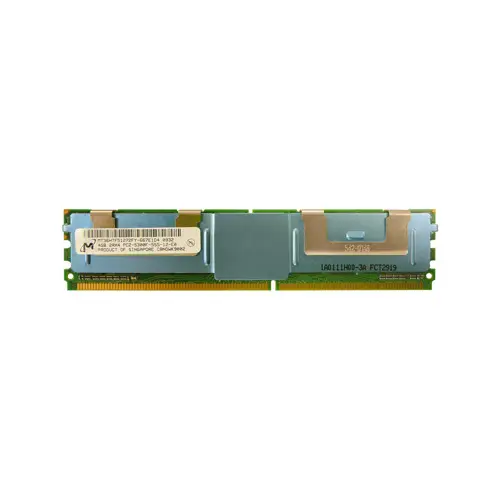
This FB-DIMM is a server-grade DDR2 module engineered for legacy platforms that demand uncompromising data integrity, best suited for memory-intensive workloads such as virtualization and in-memory databases on older Intel Xeon 5000 series servers. Its ECC actively corrects single-bit errors and the Fully Buffered architecture maintains robust signal stability across high-density multi-DIMM channels, while the dual-rank x4 organization enhances access efficiency at a CAS latency of 5.
1. ECC protection corrects single-bit errors and detects multi-bit faults in real time, preventing silent data corruption that could compromise financial transactions or database integrity.
2. Fully Buffered architecture serializes data transfers through an advanced memory buffer, enabling large-scale memory expansion without signal degradation across fully populated server slots.
3. Dual Rank x4 organization interleaves access across multiple internal banks, maximizing bandwidth utilization and reducing latency for virtualized workloads running concurrent guest machines.
4. A four-gigabyte capacity provides a practical memory footprint for lightweight hypervisor hosts, caching tiers, or dedicated appliance instances where density-per-watt still matters.
5. Operating at PC2-5300 speeds delivers consistent throughput matched to legacy front-side bus architectures, ensuring smooth execution of background enterprise services without bottlenecking data flows.
When deployed in mission-critical environments like virtualization clusters and in-memory databases, the Micron MT36HTF51272FY-667E1D4 eliminates the risks standard desktop memory cannot address. As a 4GB DDR2-667 Fully Buffered DIMM with ECC, it translates four engineering decisions directly into operational resilience.
First, ECC actively corrects single-bit errors caused by cosmic radiation or electrical noise. In a financial database or a hypervisor hosting dozens of virtual machines, such bit flips would silently corrupt transactions or crash entire workloads; ECC turns that existential threat into a non-event. Second, the Fully Buffered architecture uses an Advanced Memory Buffer to decouple the DRAM from the memory bus, preserving signal integrity when all channels are fully populated. This allows you to scale to 16 DIMMs per server without reliability degradation, giving your virtualized farm the memory density it demands without compromising uptime. Third, dual-rank x4 organization interleaves accesses across internal banks, sustaining bandwidth under the concurrent, random-access patterns of a busy VM host or a caching tier. Finally, the stable 1.8V operation keeps thermals predictable inside dense racks, preventing throttle-induced performance drops. For you, that means absolute data integrity, consistent responsiveness under multi-tenant load, and the confidence to run your business 24/7.
General Virtualization
For a lightweight hypervisor hosting a few modest virtual machines, install a minimum of eight of these 4 GB FB‑DIMM modules (32 GB total). Populate in matched pairs across dual memory branches to maintain balanced interleaving and reliable ECC protection. This provides enough headroom for hypervisor overhead plus 3–4 VMs with light workloads.
In‑Memory Database
In‑memory datasets demand the largest possible capacity and highest data integrity. Fill all available memory slots—typically 16 modules on a dual-socket server—to reach 64 GB total, as these 4 GB DDR2-667 FB‑DIMMs define the system’s ceiling. Enable memory mirroring or sparing via the BIOS to leverage ECC for resilience against single‑bit errors during write‑intensive cache operations.
High‑Performance Computing
HPC clusters built on older nodes benefit from fully populating each node with 8 to 16 modules (32–64 GB) to minimize disk I/O. Use dual‑rank x4 configurations for optimal bandwidth, and install in symmetric sets to sustain four‑channel fully buffered throughput. This suits MPI‑driven simulations where memory capacity per core remains moderate and ECC ensures long‑run calculation integrity.
Rigorously tested FB-DIMM for servers: fits Dell PowerEdge 2900, HP ProLiant DL380 G5, IBM System x3650.
Q: Can I mix this MT36HTF51272FY-667E1D4 with other memory modules of different brands or speeds?
A: Mixing FB-DIMMs of different brands or speeds is not recommended. ECC and Fully Buffered architecture require matched specifications to maintain signal integrity and avoid system instability on server platforms.
Q: Is this memory compatible with my server system, specifically Intel or AMD platforms?
A: This DDR2-667 FB-DIMM is designed for servers with Intel 5000/5100/5400 series chipsets supporting Fully Buffered memory. Verify your motherboard or system spec sheet for FB-DIMM support before purchasing.
Q: What is the recommended DIMM population order for optimal performance with these FB-DIMMs?
A: For dual-rank x4 FB-DIMMs, populate channels starting with the farthest slot from the CPU, typically in matching pairs. Always refer to your server vendor’s population guide to maintain balanced memory interleaving.
Q: Does this module support overclocking or XMP profiles?
A: No. This is a JEDEC-compliant server memory module. It does not support overclocking or XMP profiles; it runs strictly at PC2-5300 (667 MHz) with CL5 timings for mission-critical stability.
Q: What warranty and typical failure rate can I expect for this memory?
A: This module is covered by a 1-year warranty. Typical annualized failure rate (AFR) for enterprise FB-DIMMs is extremely low, usually well under 0.5%, ensuring reliable 24/7 server operation.