

 Secure payments
Standard refund policy
Trade Assurance
Secure payments
Standard refund policy
Trade Assurance
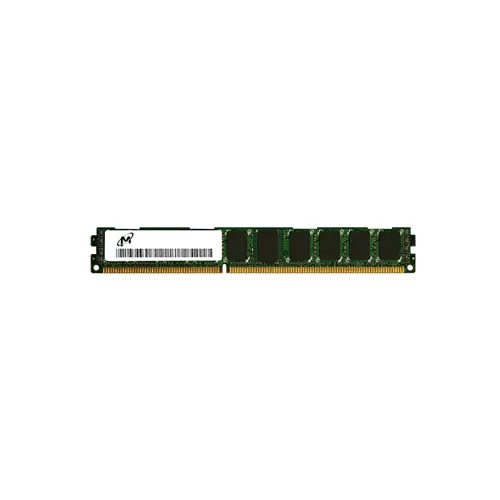
| Model | MT36JSZF51272PDZ-1G1F1 |
|---|---|
| Product Type | Memory Module |
| Compliance Standards | RoHS |
| Memory Capacity | 4 GB |
| Memory Technology | DDR3 |
| Product Voltage | 1.5V |
| RAM Speed | 1066MHz |
| RAM Standard | DDR3-1066/PC3-8500 |
| Error Identifying | ECC |
| Signal Type | Registered |
| Column Access Strobe (CAS) | CL7 |
| Rank | Dual Rank x4 |
| Quantity of Pins | 240-pin |
| RAM Genre | RDIMM |
This Micron 4GB DDR3-1066 Registered ECC RDIMM, with its Dual Rank x4 configuration and CL7 latency, is purpose-built for entry-level servers and small-scale virtualization hosts where data integrity and stable operation under moderate loads are paramount. Its registered signal type and ECC error correction make it ideal for memory-resident databases and always-on applications that demand reliable, low-latency access without the cost of higher-speed modules.
1. ECC error correction silently catches and corrects single-bit memory faults, preserving data integrity for financial ledgers and long-running analytics jobs.
2. Registered buffering decouples the command bus from the memory chips, maintaining signal stability across fully populated server boards and reducing downtime risk.
3. Dual-rank x4 organization interleaves accesses to saturate the memory channel, providing consistent bandwidth for virtualized environments under heavy tenant consolidation.
4. CAS 7 low latency shortens row-to-column turnaround, giving transaction-heavy databases and in-memory caches a measurable response-time advantage.
5. The four-gigabyte capacity per module allows fine-grained capacity planning, letting operators right-size virtual machine density without wasting expensive memory resources.
In today’s data-driven infrastructure, the Micron MT36JSZF51272PDZ-1G1F1 is not just another 4GB DDR3 module—it is a registered RDIMM built explicitly for server environments where uptime and accuracy are non-negotiable. It packs four defining attributes that directly address real-world pain points. First, ECC continuously detects and corrects single-bit memory errors, preventing silent data corruption in a virtualized cluster hosting multiple business-critical VMs; a flipped bit in a hypervisor’s memory could cascade into application crashes or file system inconsistencies, and ECC acts as a silent guardian against this. Second, the registered signal type buffers command and address lines, stabilizing the memory bus when all 18 DIMM slots are populated in a 2U rack server—without this register, high-density configurations become electrically noisy and unreliable. Third, the dual-rank x4 organization drives higher aggregate bandwidth by allowing the memory controller to interleave accesses across ranks, which directly accelerates in-memory databases like Redis or SAP HANA where nanosecond-level latency on frequently accessed tables translates into faster transaction processing. Even at 1066MHz with a tight CL7 latency, this module keeps cache misses predictable under sustained load. Together, these features turn a simple spec sheet into a reliability lifeline for the server closet.
General Virtualization
For dense virtual machine hosting, deploy this 4 GB registered ECC DIMM across all available memory channels to maximize capacity without sacrificing stability. In a dual-socket server with triple-channel architecture, populate six identical modules (24 GB total) or scale to twelve modules (48 GB) for moderate consolidation ratios. Always balance DIMMs evenly per processor to sustain consistent memory access latency under multi-tenant workloads.
In-Memory Database
Capacity-hungry in-memory databases demand the largest possible footprint; aim for at least sixteen of these 4 GB RDIMMs (64 GB) distributed symmetrically across two processors. Configure one DIMM per channel to maintain a single rank-per-channel arrangement where feasible, reducing bus contention and exploiting the CL7 latency. Where data sets exceed this, consider the 4 GB module as a building block but plan to populate all slots with dual-rank x4 devices for optimal bank-level parallelism.
High-Performance Computing (HPC)
HPC clusters benefit from balanced memory bandwidth; using these 1066 MHz RDIMMs, install six or eight modules per node in a three- or four-channel configuration to saturate the memory bus. For capacity-bound simulations, fill all available slots with the dual-rank DIMMs (up to 96 GB on some platforms) while accepting a slight speed trade-off at 1066 MT/s. Select matched batches of modules to ensure uniform signal integrity during tightly synchronized parallel jobs.
Rigorously tested, validated for Dell PowerEdge R710, R610, HP DL380 G7, and Lenovo x3650 M3 servers.
Q: Can I mix this MT36JSZF51272PDZ-1G1F1 with other memory modules of different brands or speeds?
A: Mixing is not recommended for RDIMM server memory. Different timings or ranks may cause instability. Install identical modules with the same speed and rank to ensure reliable system operation.
Q: Is this memory compatible with my system?
A: This 4GB DDR3-1066 ECC Registered DIMM supports Intel Xeon 5500/5600 and AMD Opteron 6100 platforms. Verify your server board accepts 1.5V RDIMMs and consult the compatibility list.
Q: What is the recommended DIMM population order for optimal performance?
A: Populate identical modules per channel, starting from the slots furthest from the CPU. Follow the server motherboard manual for balanced memory configuration and maximum interleaving performance.
Q: Does this module support overclocking or XMP profiles?
A: No. As a standard server RDIMM, this module adheres to JEDEC specifications. It does not support overclocking or XMP profiles, prioritizing data integrity and 24/7 stability.
Q: What warranty and typical failure rate can I expect?
A: The module includes a 1-year warranty. Enterprise-grade RDIMMs typically demonstrate an annualized failure rate below 0.1% when operated within specified temperature and voltage ranges.