

 Secure payments
Standard refund policy
Trade Assurance
Secure payments
Standard refund policy
Trade Assurance
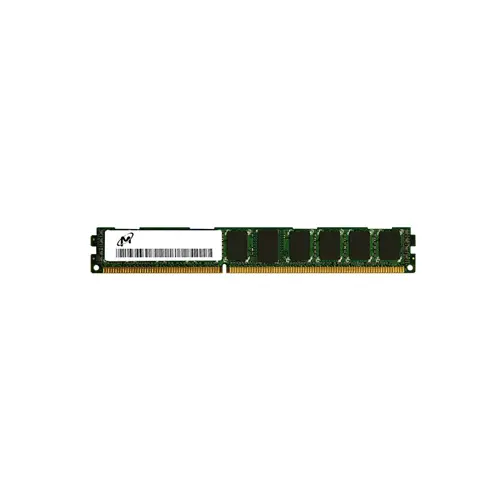
| Model | MT36JSZF51272PDY-1G1D1 |
|---|---|
| Product Type | Memory Module |
| Compliance Standards | RoHS |
| Memory Capacity | 4 GB |
| Memory Technology | DDR3 |
| Product Voltage | 1.5V |
| RAM Speed | 1066MHz |
| RAM Standard | DDR3-1066/PC3-8500 |
| Error Identifying | ECC |
| Signal Type | Registered |
| Column Access Strobe (CAS) | CL7 |
| Rank | Quad Rank x8 |
| Quantity of Pins | 240-pin |
| RAM Genre | RDIMM |
This Micron 4GB DDR3-1066 Registered ECC RDIMM, featuring Quad Rank x8 organization and CL7 latency, delivers reliable data integrity and stable signal buffering for legacy server platforms. It is ideally suited for virtualization hosts and in-memory database applications where registered signaling and error correction are critical to sustaining uptime under continuous multi-rank memory loads.
1. ECC protection detects and corrects single-bit memory errors in real time, preserving transaction integrity for financial databases and mission-critical enterprise applications.
2. Registered signal buffering stabilizes high-density server configurations, allowing fully populated memory channels without compromising system reliability under sustained load.
3. Quad Rank x8 organization maximizes the memory footprint per channel, boosting virtual machine density in consolidation scenarios where capacity outweighs raw frequency.
4. CL7 latency tightens the data access window, reducing CPU stall cycles and accelerating response times in latency-sensitive workloads like in-memory caching.
5. 4 GB capacity provides a cost-effective building block for entry-level virtualization hosts or dedicated lightweight services, ensuring efficient resource allocation in scaled-out clusters.
For IT managers overseeing virtualized clusters or memory-hungry databases, the MT36JSZF51272PDY-1G1D1 is not merely a 4GB DDR3 module—it is a safeguard for mission-critical data and continuous uptime. Engineered as a registered RDIMM with error-correcting code, it directly counters silent data corruption caused by cosmic radiation or electrical noise, a risk that in a dense server environment can flip a single bit and silently crash a financial transaction or corrupt a database index. Its registered signal buffer is equally vital: by re-driving address and command signals, it maintains signal integrity across a fully populated memory bank, allowing you to deploy this quad-rank module en masse in a VMware ESXi host without the boot failures or instability that unbuffered memory would invite. That quad-rank x8 organization translates into higher total memory capacity per channel, which in turn reduces disk I/O latency in large-scale applications like SAP HANA or an online transaction processing database where every millisecond counts. Meanwhile, a true CL7 latency at 1066MHz provides predictable response times under heavy concurrent access, ensuring consistent VMware vMotion migrations and faster in-memory analytics. When a node failure means lost revenue, this module’s combination of ECC, registration, and multi-rank density is not a luxury—it is the foundation of reliable virtualization and database performance.
General Virtualization
For general virtualization, balance capacity and bandwidth by installing identical 4 GB quad‑rank RDIMMs across all memory channels. Populate three DIMMs per channel (e.g., 12 modules for a dual‑socket platform with triple‑channel architecture) to deliver 48 GB of ECC‑protected memory, enabling efficient interleaving and robust VM density. This configuration avoids mixing rank counts and maintains 1066 MHz operation for consistent guest performance.
In‑Memory Database
In‑memory databases require the largest possible capacity to keep hot datasets resident. Fill every available DIMM slot with these 4 GB registered modules, observing the platform’s quad‑rank population guidelines—typically no more than two quad‑rank DIMMs per channel to preserve signal integrity. A fully loaded 18‑slot server yields 72 GB, significantly reducing disk I/O and accelerating key‑value stores or caches even at DDR3‑1066 speeds.
High‑Performance Computing (HPC)
HPC codes thrive on balanced bandwidth and uniform memory latency. Install exactly one 4 GB RDIMM per channel, leaving the second slot empty, to maximize parallelism and run all modules at the native 1066 MHz. A per‑processor build of four DIMMs (16 GB) across four channels supplies sufficient capacity for many computational nodes while keeping memory access symmetric and predictable for floating‑point intensive jobs.
Rigorously tested server memory, compatible with Dell PowerEdge R710, HPE ProLiant DL380 G7, Lenovo ThinkServer RD530, and more.
Q: Can I mix this MT36JSZF51272PDY-1G1D1 with other memory modules of different brands or speeds?
A: Mixing registered ECC modules from different brands or speeds is not recommended; it forces the memory controller to operate at the lowest common speed and may cause signal integrity issues on server platforms.
Q: Is this memory compatible with my system?
A: This DDR3-1066 registered ECC RDIMM is designed for dual-processor servers using Intel Xeon 5500/5600 series or AMD Opteron platforms. Verify your motherboard's Qualified Vendor List (QVL) for 4GB quad-rank support.
Q: What is the recommended DIMM population order for optimal performance?
A: For quad-rank RDIMMs, populate identical DIMMs in sets of three per memory channel, starting with the farthest slot from the CPU. Consult the server board manual, as quad-rank modules often restrict maximum speed and capacity configurations.
Q: Does this module support overclocking or XMP profiles?
A: No, this is an enterprise registered ECC module adhering to JEDEC DDR3-1066 standards. It does not support overclocking or XMP profiles, as server memory prioritizes stability and data integrity over frequency tuning.
Q: What warranty and typical failure rate can I expect?
A: This module comes with a 1-year warranty. As a rigorously tested enterprise RDIMM, its annualized failure rate (AFR) is typically under 0.5%, ensuring reliable operation in 24/7 mission-critical server environments.