











 Secure payments
Standard refund policy
Trade Assurance
Secure payments
Standard refund policy
Trade Assurance
| Model | MT36JSZF51272PY-1G1D1 |
|---|---|
| Product Type | Memory Module |
| Compliance Standards | RoHS |
| Memory Capacity | 4 GB |
| Memory Technology | DDR3 |
| Product Voltage | 1.5V |
| RAM Speed | 1066MHz |
| RAM Standard | DDR3-1066/PC3-8500 |
| Error Identifying | ECC |
| Signal Type | Registered |
| Column Access Strobe (CAS) | CL7 |
| Rank | Dual Rank x4 |
| Quantity of Pins | 240-pin |
| RAM Genre | RDIMM |
This 4GB DDR3-1066 RDIMM is purpose-built for entry-level server and small business virtualization platforms where registered ECC memory ensures data integrity for lightweight hypervisors or memory-resident caching applications. Its dual-rank x4 configuration with CL7 latency maximizes the DIMM’s bandwidth efficiency per channel, while the registered interface stabilizes signal control across fully populated server motherboards.
1. Registered signal type buffers command and address lines, reducing the electrical load on the memory controller and enabling stable operation in dense multi-DIMM server configurations.
2. ECC protection continuously corrects single-bit memory errors, safeguarding transactional integrity and preventing silent data corruption in always-on enterprise environments.
3. Dual Rank organization interleaves memory accesses across internal banks, sustaining high throughput under simultaneous virtual machine workloads.
4. A CAS latency of seven cycles shortens data retrieval delay, improving query response times for latency-sensitive database and caching applications.
5. The modest per-module capacity is well-suited for cost-optimized dedicated appliances, where predictable low-footprint workloads run reliably without overprovisioning.
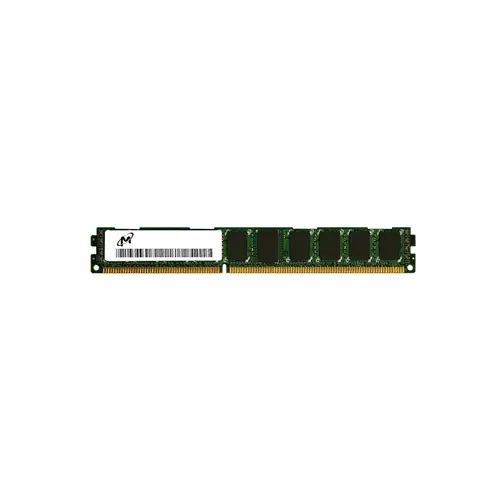
The Micron MT36JSZF51272PY-1G1D1 is a server-grade DDR3 RDIMM engineered for enterprise workloads. Its four vital attributes—ECC error correction, registered buffering, dual-rank x4 organization, and CL7 latency—directly solve the most pressing data center challenges. Consider a virtualized cluster: registered logic stabilizes signals across densely populated memory channels, letting you pack more VMs onto each host without boot failures. ECC then counters cosmic-ray-induced bit flips that would corrupt hypervisor memory states, preserving uptime in 24/7 operations. For in-memory databases like Redis, dual-rank x4 interleaving reduces bank conflicts and yields consistent high throughput, while CL7 response accelerates record lookups under heavy concurrent queries. This means fewer transactions dropped due to timeouts and true data integrity. For server operators, the result is fewer memory-related outages, higher ROI from existing hardware, and the confidence that mission-critical data remains accurate.
General Virtualization
For general virtualization, populate all available memory channels evenly to maximize bandwidth and utilize interleaving. Starting with six identical 4GB RDIMMs (24GB total) provides a cost-effective base for medium-density hosts, while scaling to twelve or more modules per server supports higher VM consolidation ratios. Always balance capacity across channels to avoid NUMA penalties and ensure consistent performance under multi-tenant workloads.
In-Memory Database
An in-memory database demands low latency and high reliability, making ECC Registered DIMMs essential. Configure the server with a fully balanced, multi-channel layout—ideally twelve or eighteen 4GB modules spread across all memory risers—to reach 48GB–72GB. This arrangement saturates memory controllers for peak throughput and uses dual-rank modules to sustain command rate efficiency under heavy analytics or real-time transaction loads.
High-Performance Computing
HPC workloads benefit from consistent memory bandwidth, so install a symmetric configuration that populates at least one DIMM per channel in each processor socket. A common build uses twelve 4GB RDIMMs (48GB total) across hexa-channel or quad-channel platforms to deliver the streams needed for simulation and modeling. Where total capacity is less critical than raw bandwidth, this balanced, fully buffered setup minimizes bottlenecks and supports large, distributed datasets.
Compatible with servers like Dell PowerEdge R710, HP ProLiant DL380 G7; rigorously tested.
Q: Can I mix the MT36JSZF51272PY-1G1D1 with other memory modules of different brands or speeds?
A: Mixing is strongly discouraged. For guaranteed signal integrity and ECC reliability, populate channels only with identical part numbers, speed, rank, and registered type. Mismatches risk instability or silent data corruption.
Q: Is this memory compatible with my Intel Xeon or AMD Opteron server platform?
A: This 4GB DDR3-1066 Registered ECC DIMM fits servers with 240-pin sockets and 1.5V support, typically Intel Xeon 5500/5600 or AMD Opteron 6100-series. Confirm the board's qualified vendor list to ensure compatibility.
Q: What is the recommended DIMM population order for optimal performance?
A: Adhere strictly to the server board’s population guide. Generally, install matched kits starting with the first slot of each memory channel to enable balanced interleaving, maximizing throughput and minimizing latency.
Q: Does this module support overclocking or XMP profiles?
A: No. As a server-grade Registered ECC DIMM, it adheres to JEDEC DDR3-1066 standards for absolute stability. Overclocking and XMP are not supported; it operates only at the specified 1066MHz with CL7 timings.
Q: What warranty and typical failure rate can I expect?
A: It is covered by a one-year warranty. Engineered for 24/7 workloads, its annualized failure rate is typically below 0.5%, reflecting enterprise-class robustness under normal thermal and electrical operating conditions.