











 Secure payments
Standard refund policy
Trade Assurance
Secure payments
Standard refund policy
Trade Assurance
| Product Type | Memory Module |
|---|---|
| Memory Capacity | 4 GB |
| Memory Technology | DDR3 |
| Product Voltage | 1.5V |
| RAM Speed | 1066MHz |
| RAM Standard | DDR3-1066/PC3-8500 |
| Error Identifying | ECC |
| Signal Type | Registered |
| Column Access Strobe (CAS) | CL7 |
| Rank | Single Rank x4 |
| Quantity of Pins | 240-pin |
| RAM Genre | RDIMM |
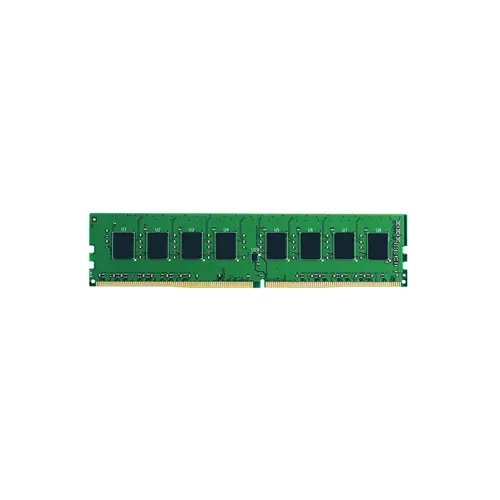
This DDR3-1066 registered ECC module (RDIMM) is designed for server platforms, where its single-rank x4 configuration reduces electrical loading on the memory bus and enables higher memory density in virtualized environments and memory-intensive databases. The combination of ECC error correction and registered signal buffering ensures end-to-end data integrity and stable operation under continuous, mission-critical workloads.
1. ECC protection eliminates silent data corruption in real time, ensuring that transactional databases and financial systems running on the server never suffer from undetected bit flips.
2. Registered signal buffering lightens the memory controller’s electrical load, allowing the server to support more DIMMs per channel for denser virtualization and larger in-memory caches.
3. Single Rank x4 architecture maximizes channel bandwidth efficiency and lowers access latency, directly improving response times for latency-sensitive enterprise workloads like OLTP and VDI.
4. CL7 cycle latency shrinks the delay between data request and delivery, accelerating query throughput in database servers where every nanosecond counts under peak user loads.
5. A 4 GB capacity point provides a balanced unit for scaling server memory in virtualized clusters, keeping per-virtual-machine cost low while maintaining sufficient headroom for guest operating stacks.
When you are running a virtualized cluster where a single host crams dozens of VMs into every available gigabyte, a memory error is not a nuisance—it is a cascading outage. The MT18JSF51272PZ-1G1D1BB 4GB DDR3-1066 RDIMM is engineered precisely for that reality. Its built-in ECC silently detects and corrects single-bit flips caused by background radiation, protecting data integrity in an in-memory database like Redis where a flipped pointer can corrupt an entire dataset. Paired with the registered signal buffer, it stabilizes the command bus even as you fully populate all 24 DIMM slots, so dense virtualization nodes stay up under punishing load. The single-rank x4 organization steps in here as well: by driving fewer DRAM loads per channel, it maintains clean signal timing and higher sustained bandwidth, which is critical when multiple VMs hammer shared memory simultaneously. And with a tight CAS latency of 7, every read command resolves faster, lowering latency for real-time transactional workloads where a few clock cycles are the difference between a responsive application and a user staring at a spinning wheel. This is not generic memory—it is a deliberate choice for infrastructure that cannot afford a single silent failure.
General Virtualization
For light to moderate virtualization hosts, a 4 GB RDIMM is now minimal. Deploy at least six identical modules (24 GB total) in a triple-channel configuration to balance capacity and memory bandwidth for small VM fleets. Avoid mixing ranks or speeds to maintain stable ECC operation at 1066 MHz—ideal for low‑tier hypervisors.
In‑Memory Database
In‑memory databases demand capacity much more than single‑DIMM size; a 4 GB registered module is only suitable for very small test instances. Populate all channels symmetrically—for example, twelve 4 GB DIMMs—to reach 48 GB while leveraging rank interleaving and ECC scrubbing. For production, plan to replace these with 8 GB or 16 GB RDIMMs as dataset growth quickly outpaces a 4 GB building block.
High‑Performance Computing (HPC)
HPC clusters often prioritize memory bandwidth over sheer density. A 4 GB single‑rank x4 RDIMM at 1066 MHz can still serve as a lightweight boot node or a compute node for memory‑capacity‑bound tasks. Configure nodes with one DIMM per channel (e.g., six modules on a dual‑socket platform) to maximize bandwidth per core, and rely on the registered ECC signaling to sustain multi‑day simulation integrity.
Strictly tested, compatible with Dell PowerEdge R710, HP ProLiant DL380 G7, IBM System x3650 M3.
Q: Can I mix this MT18JSF51272PZ-1G1D1BB with other memory modules of different brands or speeds?
A: Mixing with other RDIMMs is possible but not recommended. All installed modules will clock down to the lowest common speed, and mismatched ECC or rank configurations may compromise system stability and data integrity.
Q: Is this memory compatible with my system?
A: This is a DDR3-1066 ECC Registered RDIMM. It is compatible with server platforms supporting DDR3 registered memory, such as Intel Xeon 5500/5600 series or AMD Opteron 4100/6100 series boards. Verify your motherboard’s memory QVL.
Q: What is the recommended DIMM population order for optimal performance?
A: Install identical DIMMs in groups matching memory channel width, starting with the farthest slot from the CPU per channel. For dual-processor systems, balance populations evenly. Refer to your server’s technical guide for exact slot numbering and ECC interleaving rules.
Q: Does this module support overclocking or XMP profiles?
A: No. This is a server-grade Registered ECC DIMM operating at standard JEDEC timings. It does not support overclocking or Intel XMP. It is engineered for stability, data integrity, and 24/7 reliability at the rated 1066MHz.
Q: What warranty and typical failure rate can I expect?
A: This module includes a 1-year warranty. Enterprise Registered DIMMs typically exhibit an annualized failure rate below 0.5% under normal thermal and electrical conditions, backed by strict component screening and final test procedures.