











 Secure payments
Standard refund policy
Trade Assurance
Secure payments
Standard refund policy
Trade Assurance
| Product Type | Memory Module |
|---|---|
| Compliance Standards | RoHS |
| Memory Capacity | 4 GB |
| Memory Technology | DDR3 |
| RAM Speed | 1066 |
| RAM Standard | DDR3-1066/PC3-8500 |
| Error Identifying | Non-ECC |
| Signal Type | Unbuffered |
| Column Access Strobe (CAS) | CL7 |
| Rank | Dual Rank x8 |
| Quantity of Pins | 204-pin |
| RAM Genre | SoDIMM |
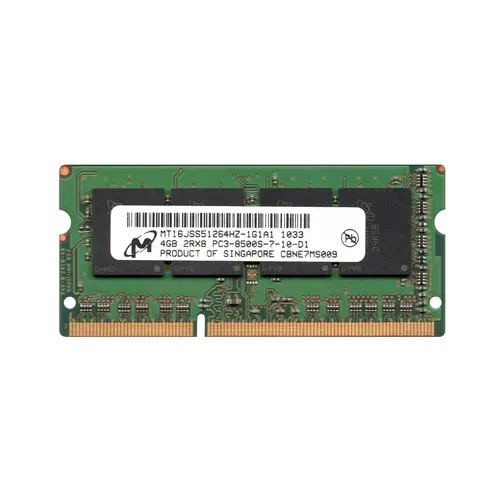
This unbuffered, non-ECC DDR3-1066 SODIMM is purpose-built for notebook upgrades and mobile workstations, delivering a straightforward plug-and-play capacity boost for everyday productivity and light multitasking. Its dual-rank x8 configuration combined with a low CL7 latency improves memory interleaving and reduces access delays, ensuring responsive system performance in thermally constrained portable environments.
1. Sufficient density to comfortably host a modern OS alongside essential productivity applications, breathing new life into aging portable systems without a pricey overhaul.
2. Third-generation DDR architecture ensures drop-in readiness for a wide spectrum of legacy notebooks, minimizing compatibility guesswork during DIY upgrades.
3. A moderate operating frequency strikes a sweet spot between everyday task fluidity and battery longevity, letting you work longer between charges.
4. Tight column access timing reduces latency, delivering perceptibly quicker application launches and smoother system navigation on entry-level mobile platforms.
5. The SoDIMM design enables straightforward, tool-free installation into compact laptop chassis, turning a hardware refresh into a quick, worry-free process.
The MT16JSS51264HZ-1G1A1 SODIMM is purpose-built for notebooks, where mobility and battery life dominate. Its 204-pin footprint slides straight into most thin-and-light laptops and portable workstations, turning a memory upgrade into a one-minute job that extends an older system’s relevance. The unbuffered, non-ECC design strips out server‑grade register and error‑correction silicon, directly cutting power drain and heat – so you gain extra battery runtime during travel or off‑site client work. With a fast CL7 response at DDR3‑1066, the module keeps daily multitasking snappy; bouncing between a video call, a data‑heavy spreadsheet, and multiple browser tabs stays free of frustrating micro‑stutter. The dual‑rank x8 architecture takes this further by letting the memory controller interleave accesses across two internal ranks, raising effective bandwidth. For a mobile workstation running a lightweight local VM or manipulating large datasets, that parallelism means visibly smoother application switching, making the 4 GB capacity feel unexpectedly agile.
Laptop Upgrade
This 4 GB DDR3-1066 SoDIMM is an excellent drop-in upgrade for aging notebooks. If your system currently runs a single 2 GB or 4 GB module, adding this stick in the free slot doubles capacity to 8 GB and enables dual‑channel operation for smoother multitasking. For a quick refresh, verify the motherboard’s maximum supported capacity (often 8 GB for DDR3-era machines) and install two identical modules to eliminate bottlenecks.
Mobile Workstation
For CAD, 3D rendering, or large spreadsheets, capacity matters more than speed. Replace existing memory with the densest supported kits—ideally two 8 GB DDR3 SoDIMMs for 16 GB—while this 4 GB module can serve as a short-term bridge if mixed with a larger stick. Always prioritize matched pairs to maintain stable performance under sustained professional loads and avoid disk swapping during heavy analysis.
Ultrabook Power Saving
Although this standard 1.5 V module fits most ultrabooks, battery-conscious users should pursue DDR3L (1.35 V) equivalents to reduce power draw and heat. If the system only accepts 1.5 V, this 4 GB SoDIMM still offers a cost-effective capacity lift; however, replacing the original module with a single low‑voltage 8 GB stick yields both energy savings and fewer sleep-state wakeups, noticeably extending cordless runtime.
Rigorously tested for notebooks—compatible with ThinkPad T410, HP EliteBook 8440p, and Dell Latitude E6410.
Q: Can I mix this MT16JSS51264HZ-1G1A1 with other memory modules of different brands or speeds?
A: Mixing is possible but not recommended. The system will default to the slowest module’s speed. For best results, pair it with another DDR3-1066, CL7, dual-rank SoDIMM of identical specification.
Q: Is this memory compatible with my laptop? (Provide your model number or confirm it uses DDR3 SoDIMM)
A: It is compatible with laptops that support DDR3 SoDIMM (204-pin), 1.5V standard. Verify your system accepts DDR3-1066 and 4GB per slot. Not for DDR2, DDR4, or desktop systems.
Q: What is the recommended DIMM population order for optimal performance in my laptop?
A: For dual-channel performance, install identical modules in both slots. If using a single module, either slot works. No specific order is required; dual-channel activates automatically with matched pairs.
Q: Does this module support overclocking or XMP profiles?
A: No. This is a standard JEDEC DDR3-1066 module (PC3-8500) operating at fixed CL7 timings. It does not support XMP or overclocking; designed for stable operation in laptops.
Q: What warranty and typical failure rate can I expect?
A: This Micron module includes a one-year warranty. The annualized failure rate (AFR) for such DRAM is typically below 0.5% under normal conditions, ensuring high reliability.