











 Secure payments
Standard refund policy
Trade Assurance
Secure payments
Standard refund policy
Trade Assurance
| Product Type | Memory Module |
|---|---|
| Memory Capacity | 4 GB |
| Memory Technology | DDR3 |
| Product Voltage | 1.5V |
| RAM Speed | 1333MHz |
| RAM Standard | DDR3-1333/PC3-10600 |
| Error Identifying | ECC |
| Signal Type | Registered |
| Column Access Strobe (CAS) | CL9 |
| Rank | Dual Rank x8 |
| Quantity of Pins | 240-pin |
| RAM Genre | VLP RDIMM |
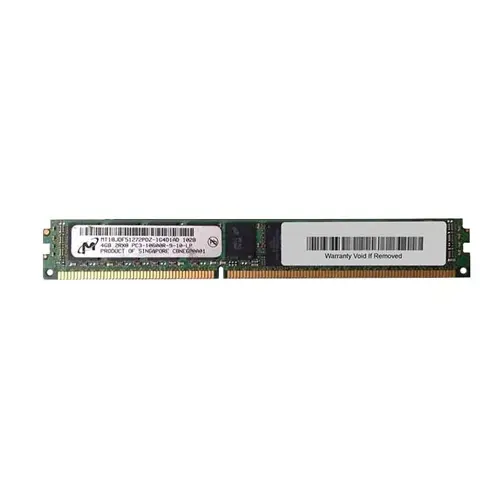
This Micron 4GB DDR3-1333 VLP RDIMM (PC3-10600, CL9, dual-rank x8) is an ECC registered server memory module purpose‑built for virtualization and memory‑intensive database workloads that demand uncompromising data integrity. Its registered signal type and dual‑rank configuration ensure robust signal stability in dense, multi‑DIMM server platforms, while the very low‑profile form factor maximizes cooling clearance in 1U or blade enclosures.
1. ECC protection detects and corrects single-bit errors on the fly, safeguarding critical server workloads like database transactions and virtualization hosts from silent data corruption.
2. Registered buffering strengthens signal integrity across fully populated memory channels, allowing 24/7 operation with dual-socket motherboards under maximum DIMM load.
3. Dual Rank x8 organization interleaves access across two internal ranks per module, improving memory-level parallelism and delivering consistent bandwidth for multi-tenant cloud applications.
4. VLP form factor reduces module height, enabling dense memory configurations in 1U rack servers where vertical clearance is limited and airflow must remain unobstructed.
5. 4 GB capacity per stick provides a granular building block for balanced memory sizing, ideal for scaling total server memory cost-effectively in entry-level enterprise environments.
The Micron MT18JDF51272PDZ-1G4D1AD is a server-class VLP RDIMM engineered for mission-critical enterprise environments, where the cost of memory error or instability is measured in lost revenue and compromised data. Its four defining characteristics address these realities directly. Error Correcting Code (ECC) protection means single-bit errors caused by background radiation are detected and corrected in real time; in a virtualized cluster running dozens of financial transaction databases, this prevents silent data corruption that could cascade into corrupted records or application crashes. The registered signal buffer stabilizes command and address lines, allowing a dual-socket server to be fully populated with multiple modules per channel without signal degradation—crucial for in-memory databases like SAP HANA that demand massive, reliable capacity. Dual-rank x8 organization increases bandwidth through rank interleaving, letting the memory controller access one rank while the other refreshes, which translates into higher sustained throughput for virtualization hosts juggling hundreds of active VMs. Finally, the very low profile (VLP) form factor is indispensable in dense 1U blade servers, where standard-height DIMMs would obstruct airflow and threaten thermal throttling. These features collectively ensure your virtualized infrastructure maintains data integrity, stable latency, and cooling efficiency under peak load.
General Virtualization
For a DDR3-1333 Registered ECC VLP RDIMM, populate channels symmetrically to maximize memory bandwidth. Start with six or twelve 4 GB modules per socket (24–48 GB) for light to moderate VM density, and scale to fully populate all slots with dual-rank x8 DIMMs while respecting rank-per-channel limits to avoid frequency downclocking. Balanced population ensures stable memory interleaving and consistent performance under mixed workload consolidation.
In-Memory Database
In-memory databases demand both capacity and reliability, making Registered ECC mandatory. Deploy the maximum slot count with these 4 GB dual-rank modules to achieve 64–128 GB per node, favoring population across all memory channels for superior data throughput. Keep spare ranks within each channel to handle rank sparing or mirroring if the platform supports it, reducing the risk of uncorrected errors on critical datasets.
High-Performance Computing
HPC clusters benefit from uniform, high-bandwidth memory configurations. Install 4 GB RDIMMs in a balanced 1 DIMM per channel (1DPC) arrangement to sustain 1333 MT/s without throttling, often yielding 24 GB or 48 GB per compute node for memory-bandwidth-bound workloads. Use VLP form factor to improve airflow in dense rack servers, and consider dual-rank modules for the slight performance edge of rank interleaving while remaining within power and thermal budgets.
Rigorously tested server memory; compatible with Dell R720, HP DL380p G8, Lenovo RD630, IBM x3650 M4.
Q: Can I mix this MT18JDF51272PDZ-1G4D1AD with other memory modules of different brands or speeds?
A: Mixing different brands or speeds of registered ECC memory is not recommended. It may cause signal integrity issues and system instability. For reliable operation, use identical modules with the same specifications.
Q: Is this memory compatible with my system?
A: This DDR3-1333 ECC RDIMM suits Intel Xeon 5500/5600 and select AMD servers supporting registered ECC and 240-pin DIMMs. Verify your motherboard or server's compatibility list for these requirements.
Q: What is the recommended DIMM population order for optimal performance?
A: For optimal performance, follow your motherboard's population order. Typically, populate the first slots (e.g., A1, B1) in each memory channel for a balanced multi-channel configuration, maximizing bandwidth.
Q: Does this module support overclocking or XMP profiles?
A: No, overclocking or XMP is not supported. This server module strictly follows JEDEC standards, delivering 1333MHz at 1.5V, with data integrity prioritized over speed tuning.
Q: What warranty and typical failure rate can I expect?
A: This product includes a one-year warranty with a very low failure rate, meeting enterprise-grade standards. As a rigorously tested RDIMM, it offers excellent reliability under normal operating conditions.