











 Secure payments
Standard refund policy
Trade Assurance
Secure payments
Standard refund policy
Trade Assurance
| Product Type | Memory Module |
|---|---|
| Compliance Standards | RoHS |
| Memory Capacity | 4 GB |
| Memory Technology | DDR3 |
| Product Voltage | 1.35V |
| RAM Speed | 1333MHz |
| RAM Standard | DDR3-1333/PC3-10600 |
| Error Identifying | ECC |
| Signal Type | Registered |
| Column Access Strobe (CAS) | CL9 |
| Rank | Single Rank x4 |
| Quantity of Pins | 240-pin |
| RAM Genre | RDIMM |
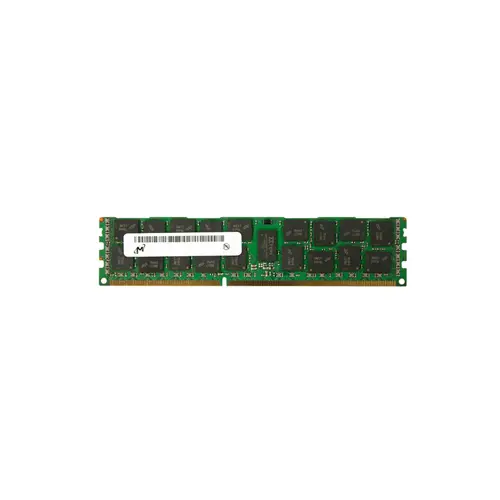
Designed for server environments, this 4GB DDR3-1333 Registered ECC RDIMM (PC3-10600, 1.35V) delivers uncompromising data integrity and stability for virtualization hosts, memory-resident databases, and other mission-critical workloads. Its registered architecture and single-rank x4 organization enable higher memory densities with superior signal integrity, while ECC error correction prevents single-bit data corruption to ensure reliable 24/7 operation.
1. ECC protection actively corrects single-bit memory errors in real time, eliminating silent data corruption risks that could otherwise crash transactional databases or hypervisor hosts.
2. Registered signal buffering stabilizes command and address lines under heavy DIMM population, making it safe to scale memory capacity for dense virtualization without compromising signal integrity.
3. Optimized 4 GB module capacity enables precise memory allocation per virtual machine or container, reducing stranded resources in lightly provisioned private cloud nodes.
4. 1333 MHz clock speed sustains up to 10.6 GB/s of peak bandwidth, keeping latency-sensitive web and application servers responsive during sustained user spikes.
5. Single-rank x4 DRAM organization narrows device width to strengthen advanced ECC techniques like chipkill, isolating a failed chip’s data lane to maintain full server uptime through hardware faults.
When building a virtualization cluster or running an in‑memory database, the stability of every single memory transaction directly impacts service uptime and data accuracy. The Micron MT18KSF51272PZ-1G4K1FG RDIMM is engineered precisely for these missions. Its ECC capability continuously detects and corrects single‑bit errors, shielding your Redis or Memcached instances from silent data corruption that can crash applications or poison analytics—a critical safeguard when a flipped bit in an in‑memory dataset can cost hours of recovery. The registered buffer isolates electrical loading, allowing you to populate all channels with multiple DIMMs while maintaining clean signal integrity; for a dense hypervisor host running dozens of VMs, this means reliable, stutter‑free operation even under peak consolidation ratios. Operating at 1.35V with Single Rank x4 organization, the module draws less power per DIMM and reduces thermal strain across the rack, cutting energy costs in always‑on deployments. Together, ECC, registered buffering, low‑voltage efficiency, and the single‑rank configuration deliver uninterrupted, low‑latency performance where data fidelity and platform scalability are non‑negotiable.
General Virtualization
For light to moderate virtualization hosts, populate at least six to eight identical 4 GB RDIMMs across triple‑channel or quad‑channel memory architectures to achieve 24–32 GB of total capacity. This configuration balances cost and density, allowing 10–15 modest virtual machines while leveraging ECC and registered buffering for stability under mixed workloads. Avoid single‑channel or minimal DIMM counts, as memory bandwidth contention will degrade guest performance.
In‑Memory Database
For in‑memory databases such as Redis or Memcached, maximize capacity by filling all available DIMM slots with these 4 GB low‑voltage RDIMMs, targeting 64–128 GB per server. The 1.35 V operating voltage reduces thermal load, enabling denser packing in 1U or blade chassis while maintaining ECC protection—critical for data integrity when cache resides entirely in RAM. Pair with dual‑socket platforms to push capacity beyond 256 GB when application growth demands it.
High‑Performance Computing (HPC)
In HPC clusters, populate one DIMM per channel across all memory controllers to maximize bandwidth for memory‑bound parallel applications. A typical dual‑socket node with eight or twelve channels benefits from 8–12 of these registered DIMMs running at 1333 MHz, providing both low latency (CL9) and stable signal integrity over many ranks. Prioritize channel balance over absolute capacity: install equal‑capacity RDIMMs per socket to maintain uniform memory access times across NUMA domains.
This server memory is rigorously tested and compatible with Dell PowerEdge R720, HP DL380p Gen8, etc.
Q: Can I mix this MT18KSF51272PZ-1G4K1FG with other memory modules of different brands or speeds?
A: Mixing different brands or speeds is not recommended for this registered ECC server memory. It may cause stability issues or system failure. Use identical modules to ensure reliable operation in enterprise environments.
Q: Is this memory compatible with my system?
A: This DDR3-1333 Registered ECC RDIMM works with server platforms supporting ECC RDIMM, such as Intel Xeon E5-2400/2600 series or AMD Opteron 4000/6000 series. Verify your motherboard's Qualified Vendor List for full compatibility.
Q: What is the recommended DIMM population order for optimal performance?
A: Populate DIMMs following the server motherboard manual, typically starting with identical modules in the first slot of each memory channel. For multi-CPU systems, balance modules evenly across CPU sockets for optimal interleaving.
Q: Does this module support overclocking or XMP profiles?
A: No. This is a server-grade Registered DIMM using JEDEC standard DDR3-1333 timings only. It does not support overclocking or Intel XMP profiles, prioritizing stability and data integrity for enterprise workloads.
Q: What warranty and typical failure rate can I expect?
A: This module comes with a 1-year warranty. Typical failure rates are extremely low, matching industry standards for server memory, provided proper ESD handling and compatible platform guidelines are followed.