











 Secure payments
Standard refund policy
Trade Assurance
Secure payments
Standard refund policy
Trade Assurance
| Product Type | Memory Module |
|---|---|
| Compliance Standards | RoHS |
| Memory Capacity | 4 GB |
| Memory Technology | DDR3 |
| Product Voltage | 1.5V |
| RAM Speed | 1333MHz |
| RAM Standard | DDR3-1333/PC3-10600 |
| Error Identifying | ECC |
| Signal Type | Registered |
| Column Access Strobe (CAS) | CL9 |
| Rank | Dual Rank x4 |
| Quantity of Pins | 240-pin |
| RAM Genre | RDIMM |
Designed for enterprise servers, this 4 GB DDR3-1333 RDIMM (PC3-10600) with ECC and registered signaling delivers uncompromising data integrity and stability, making it ideally suited for virtualization environments and memory-resident databases where even single-bit errors are unacceptable. Its dual-rank x4 configuration and CL9 latency strike an optimal balance between bank-level parallelism and responsive access, ensuring consistent throughput under sustained, mission-critical loads.
1. Error-correcting code detects and corrects single-bit memory errors, preventing silent data corruption in transactional databases and long-running analytic workloads.
2. Registered buffering strengthens signal integrity across fully loaded server memory channels, ensuring reliable operation even with densely populated DIMM slots per node.
3. Dual-rank x4 organization interleaves access across two sets of memory banks, sustaining peak channel utilization and reducing latency spikes under multi-tenant virtualization.
4. This module’s capacity granularity enables incremental scaling of server memory pools, aligning RAM expansion with fluctuating virtual machine demands.
5. That clock rate translates to 10.6 GB/s of sustained bandwidth per channel, accommodating high-throughput data-intensive applications like in-memory caching and live migration.
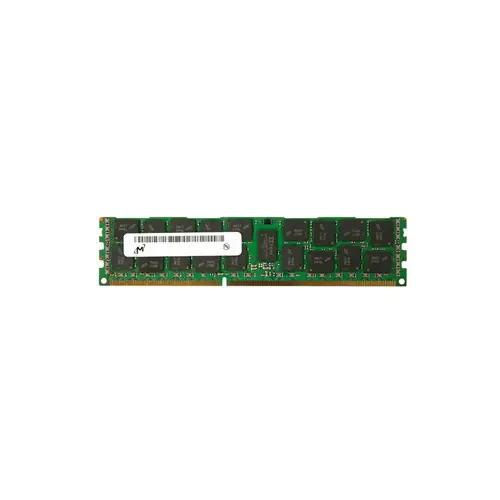
When deploying mission‑critical enterprise workloads, the integrity and availability of data are non‑negotiable. The Micron MT36JSZF51272PY-1G4D1 is a 4GB DDR3‑1333 Registered DIMM engineered precisely for these demands, and four of its design characteristics directly translate to tangible reliability and performance gains in server environments.
First, the Error Correcting Code (ECC) continuously detects and corrects single‑bit memory errors. In a large‑scale virtualization cluster hosting dozens of VMs, a cosmic ray‑induced bit flip is a statistical certainty. Without ECC, such an error silently corrupts a transaction log or hypervisor state, risking cascading failures. This module safeguards against that. Second, the Registered signal type buffers the command and address lines, dramatically reducing electrical loading on the memory controller. For a database server running an in‑memory analytics engine, this enables the use of multiple DIMMs per channel without signal degradation, allowing you to scale to hundreds of gigabytes of stable, coherent memory.
Third, the dual‑rank x4 organization exploits rank interleaving, overlapping activate and read cycles to boost sustained bandwidth. This directly accelerates parallel queries in a relational database, where one rank can prepare data while another is transferring results. The 1333 MHz speed and CL9 latency further ensure responsive data fetches under heavy concurrency. Together, these features mean fewer hardware‑induced anomalies, higher virtual machine density, and faster insight from your memory‑intensive applications, keeping your data center both resilient and productive.
General Virtualization
For general virtualization hosts using this 4 GB DDR3-1333 RDIMM, populate all memory channels symmetrically to maximize interleaving and bandwidth. A typical dual-socket server often requires at least 64 GB, so plan for 16 identical modules (8 per CPU) to balance capacity and cost while maintaining stable 1.5 V operation.
In-Memory Database
In-memory databases demand low latency and high reliability, making these ECC Registered DIMMs a solid fit. Configure with the maximum supported DIMMs per channel—commonly three per channel in a triple-channel Nehalem/Westmere-era platform—to push capacity toward 96 GB or more, while CL9 dual-rank x4 organization helps sustain fast column access under heavy transactional loads.
High-Performance Computing (HPC)
For HPC clusters where memory bandwidth often limits performance, install at least one DIMM per channel to enable full memory interleaving. Since the module is dual-rank x4, populating two DIMMs per channel delivers a good compromise between capacity and speed, keeping 1333 MT/s signalling stable with registered buffering and ECC protection for large-scale simulations.
Rigorously tested, this server memory is compatible with Dell PowerEdge R710, HP ProLiant DL380 G7, and IBM System x3650 M3.
Q: Can I mix this MT36JSZF51272PY-1G4D1 with other memory modules of different brands or speeds?
A: Mixing is not recommended. Registered ECC modules require matched groups. Mixing brands, speeds, or ranks can cause signal integrity issues and system instability on server platforms.
Q: Is this memory compatible with my system? For example, which Intel or AMD server platforms support it?
A: This DDR3-1333 Registered ECC RDIMM is compatible with servers using Intel Xeon 5500/5600 series or AMD Opteron 6100 series platforms that require 1.5V, 240-pin RDIMMs. Consult your system’s qualified vendor list.
Q: What is the recommended DIMM population order for optimal performance in a server?
A: For optimal performance, populate identical DIMMs per channel starting from the furthest slot from the CPU. Follow your server's memory population guide to maintain balanced memory interleaving and full ECC protection.
Q: Does this module support overclocking or XMP profiles?
A: No. This is an enterprise-grade Registered ECC module designed for stability. It adheres strictly to JEDEC DDR3-1333 standards and does not support overclocking or XMP profiles.
Q: What warranty and typical failure rate can I expect with this memory?
A: This Micron RDIMM carries a 1-year warranty. Enterprise memory exhibits a very low annualized failure rate under proper conditions, ensuring high reliability for mission-critical server workloads.