











 Secure payments
Standard refund policy
Trade Assurance
Secure payments
Standard refund policy
Trade Assurance
| Product Type | Memory Module |
|---|---|
| Memory Capacity | 4 GB |
| Memory Technology | DDR3 |
| Product Voltage | 1.5V |
| RAM Speed | 1333MHz |
| RAM Standard | DDR3-1333/PC3-10600 |
| Error Identifying | ECC |
| Signal Type | Registered |
| Column Access Strobe (CAS) | CL9 |
| Rank | Dual Rank x8 |
| Quantity of Pins | 240-pin |
| RAM Genre | RDIMM |
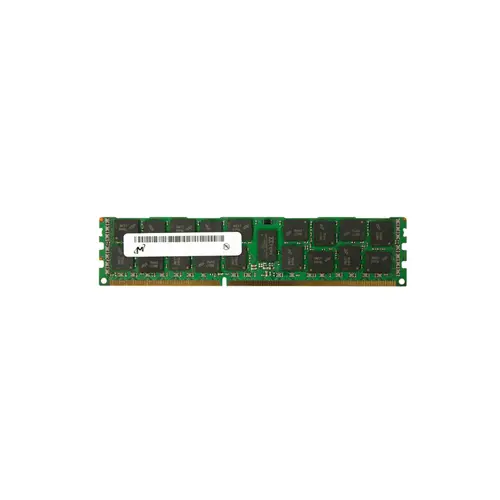
This Micron 4GB DDR3-1333 Registered ECC RDIMM is engineered for server platforms requiring rock-solid data integrity, making it ideal for virtualization hosts, entry-level memory databases, and mission-critical applications where uptime is paramount. The registered signal architecture, combined with true ECC error correction and a dual-rank x8 organization, ensures stable operation under heavy concurrent memory access while efficiently leveraging rank interleaving to mitigate latency in multi-DIMM configurations.
1. Registered signal buffering decouples the memory bus from direct CPU load, enabling large-scale server deployments to populate every DIMM slot without compromising command integrity.
2. ECC protection detects and corrects single-bit errors in real time, preventing silent data corruption in financial transactions or long-running database operations.
3. Dual Rank x8 organization interleaves access across rank boundaries, boosting effective bandwidth for virtualized environments where multiple guest machines compete for memory throughput.
4. 1333MHz clock speed delivers a steady 10.6 GB/s per channel, matching the needs of mid-tier application servers that prioritize sustained throughput over peak burst.
5. 4 GB capacity supplies just enough headroom for lightweight hypervisor installations or dedicated caching appliances, keeping power draw predictable within 1U rack thermal limits.
When your virtualization cluster hosts dozens of mission-critical VMs, a single bit flip in memory can cascade into data corruption, unplanned downtime, or silent error propagation that storage checksums never catch. The Micron MT18JSF51272PDZ-1G4D1DD, a 4GB DDR3-1333 registered ECC RDIMM, transforms that risk into resilience. Its ECC engine detects and corrects single-bit errors in real time, a non-negotiable safeguard for hypervisor integrity and financial transaction logs where accuracy is everything. The registered design buffers command and address signals, stabilizing the memory bus as you populate all channels in a dense 2U node—eliminating the signal degradation that silently throttles memory throughput under heavy consolidation workloads. Meanwhile, the dual-rank x8 organization amplifies concurrency. In an in-memory database like Redis or SAP HANA, rank interleaving allows the memory controller to issue a read to one rank while the other completes a write, flattening access latency spikes and sustaining high IOPS even as datasets grow into terabytes across the cluster. For a VMware farm running mixed SQL Server and web services, this RDIMM ensures that every guest sees predictable, dependable performance—not just benchmarks, but business continuity.
General Virtualization
For dual-socket servers, install a minimum of 8 identical 4 GB RDIMMs (32 GB total) to balance capacity and channel interleaving. Distribute modules evenly across all memory channels—typically one DIMM per channel—to maximize throughput for moderate VM density. Increase to 16 modules (64 GB) when hosting more RAM-intensive guest workloads while maintaining ECC protection.
In-Memory Database
Maximize total capacity by populating all available DIMM slots, aiming for 24 to 32 modules (96–128 GB) on supported platforms. The registered ECC design ensures data integrity under heavy write loads, and using dual-rank x8 modules improves signal stability. Configure identical modules in every channel to avoid NUMA imbalances, which is critical for low-latency in-memory processing.
High-Performance Computing (HPC)
Fully populate each memory channel with one 4 GB RDIMM to achieve optimum bandwidth on dual- or quad-socket nodes. A typical 16-module setup (64 GB) per node delivers balanced throughput for parallel MPI jobs while keeping power within budget. Where single-threaded memory band-width matters less, denser configurations using 32 modules (128 GB) can serve large shared-memory applications without sacrificing registered ECC reliability.
Rigorously tested server memory, compatible with Dell PowerEdge R710, HP DL380 G7, IBM x3650 M3.
Q: Can I mix this MT18JSF51272PDZ-1G4D1DD with other memory modules of different brands or speeds?
A: Mixing is not recommended for registered server memory. Different brands or speeds may cause instability or POST failures. For reliable operation, always install identical RDIMMs with matching CAS latency and voltage.
Q: Is this memory compatible with my system?
A: This is a DDR3-1333 Registered ECC DIMM for dual-socket or single-socket servers with Intel Xeon 5500/5600 series or AMD Opteron 6100/6200 platforms. Verify your motherboard supports 1.5V RDIMMs before purchase.
Q: What is the recommended DIMM population order for optimal performance?
A: Populate identical DIMMs per channel following your server board's memory population guide. Typically, install pairs in matching color slots first to enable multi-channel interleaving and maximize throughput. Balance capacity across memory controllers.
Q: Does this module support overclocking or XMP profiles?
A: No. This is a standard JEDEC-compliant registered server module running at fixed 1333MHz with CAS 9. Overclocking and XMP are not supported; it is designed for stability in enterprise environments.
Q: What warranty and typical failure rate can I expect?
A: This Micron RDIMM carries a one-year warranty. Enterprise-class memory has an extremely low annualized failure rate (under 0.2% AFR) under specified conditions, ensuring high reliability for mission-critical workloads.