











 Secure payments
Standard refund policy
Trade Assurance
Secure payments
Standard refund policy
Trade Assurance
| Product Type | Memory Module |
|---|---|
| Compliance Standards | RoHS |
| Memory Capacity | 4 GB |
| Memory Technology | DDR3 |
| Product Voltage | 1.35V |
| RAM Speed | 1333MHz |
| RAM Standard | DDR3-1333/PC3-10600 |
| Error Identifying | ECC |
| Signal Type | Registered |
| Column Access Strobe (CAS) | CL9 |
| Rank | Dual Rank x8 |
| Quantity of Pins | 240-pin |
| RAM Genre | RDIMM |
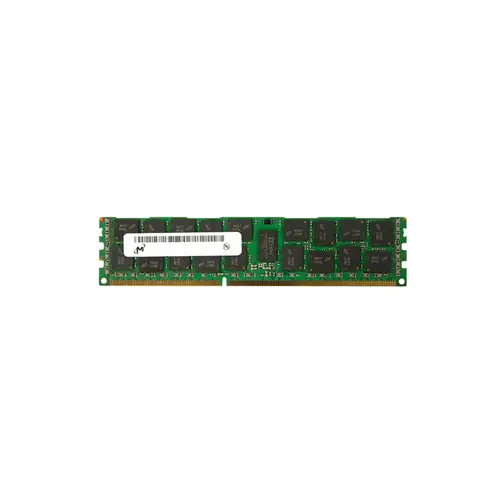
This Micron 4GB DDR3-1333 Registered ECC RDIMM, operating at a low 1.35V, delivers the data integrity and signal stability essential for virtualization and memory-intensive server workloads where silent errors cannot be tolerated. Its dual-rank x8 organization and CL9 latency strike a thoughtful balance of capacity density and responsiveness, making it a reliable choice for small-scale database caching or legacy enterprise deployments.
1. ECC protection silently corrects single-bit errors, safeguarding transactional data integrity for mission-critical databases and preventing costly server downtime.
2. Registered buffer strengthens signal integrity across fully populated memory channels, allowing dense server configurations to scale without stability compromises.
3. 4 GB capacity per module provides an ideal density for lightweight virtualization hosts, boosting container counts while keeping power and cost per VM in check.
4. 1.35V low power operation reduces the thermal envelope and cumulative wattage in multi-node data centers, directly translating to lower cooling overhead.
5. Dual Rank x8 organization leverages interleaved access to sustain higher bandwidth, which accelerates parallel query execution and in-memory analytics under concurrent user loads.
In today's data-critical server environments, the Micron MT18KSF51272PDZ-1G4 4GB DDR3-1333 RDIMM addresses real operational challenges. As a Registered DIMM with ECC, it combats silent data corruption in virtualized clusters. A single cosmic-ray-induced bit-flip can crash a VM or corrupt a financial database; ECC detects and corrects it on the fly, ensuring data integrity and continuous service. The registered buffer re-drives signals, letting you fully load all 24 memory slots in a 2U server without signal degradation—critical for achieving high VM density. For in-memory databases, the dual-rank x8 design enables rank interleaving, which boosts effective bandwidth and reduces latency by overlapping memory operations to accelerate transaction processing. Additionally, operating at just 1.35V significantly lowers power draw across racks of servers, slashing cooling overhead while delivering steady performance. This module quietly keeps your virtualization farm and data-hungry applications reliable, efficient, and uncorrupted around the clock.
General Virtualization
For a typical dual-socket virtualization host, populate at least six identical 4 GB RDIMMs per processor (12 modules total for 48 GB) to enable triple-channel mode and provide sufficient headroom for moderate VM density. Distribute modules evenly across all memory channels to maximize bandwidth and ensure balanced NUMA access. Leave room for future expansion by using 4 GB DIMMs initially but reserving slots, or scale to 16 or more modules if hosting memory-intensive VMs.
In-Memory Database
In-memory databases demand low latency and high single-instance capacity. Install a full set of eighteen 4 GB RDIMMs in a dual-processor server (72 GB total) with balanced channel population—three DIMMs per channel—to sustain maximum throughput and minimize access skew. While 4 GB modules limit per-socket density, this configuration provides a cost-effective entry point; for larger datasets, plan to replace with higher-capacity RDIMMs and keep electrical loading within registered DIMM limits.
High-Performance Computing (HPC)
In HPC clusters, memory bandwidth often outweighs raw capacity. Populate all memory channels identically with one 4 GB RDIMM per channel (e.g., six modules per CPU for triple-channel systems) to deliver a total of 24 GB per node while fully utilizing interleaving. This configuration reduces per-core memory cost and sustains high bandwidth for floating-point workloads, and it simplifies large-scale deployment by standardizing on a single, low-power 1.35 V module that lowers overall thermal footprint.
Rigorously tested, compatible with servers like Dell PowerEdge R720, HP DL380p Gen8, and IBM x3650 M4.
Q: Can I mix this MT18KSF51272PDZ-1G4 with other memory modules of different brands or speeds?
A: Mixing brands or speeds is strongly discouraged in server environments. Registered ECC modules require identical ranks, timings, and voltages to maintain signal integrity; mismatched DIMMs may cause POST failures or data corruption.
Q: Is this memory compatible with my system?
A: This RDIMM is compatible with server boards supporting DDR3L ECC Registered memory. Verify your board uses the Intel Xeon E5/Core i or AMD Opteron platform with 240-pin slots and 1.35V support, and consult the official memory QVL.
Q: What is the recommended DIMM population order for optimal performance?
A: Populate identical DIMMs per memory channel, starting from the farthest slot from the CPU. For dual-processor boards, balance capacity evenly across both sockets and follow the platform’s mirroring or sparing guidelines for maximum throughput.
Q: Does this module support overclocking or XMP profiles?
A: No. This is a JEDEC-compliant DDR3L-1333 ECC RDIMM engineered for 24/7 stability. Overclocking and XMP are unsupported, as they compromise error correction and signal registration critical for server workloads.
Q: What warranty and typical failure rate can I expect?
A: It comes with a 1-year warranty. Enterprise-class Registered ECC modules like this typically demonstrate an annualized failure rate (AFR) below 0.5%, far lower than standard desktop memory, given proper thermal management.