











 Secure payments
Standard refund policy
Trade Assurance
Secure payments
Standard refund policy
Trade Assurance
| Product Type | Memory Module |
|---|---|
| Compliance Standards | RoHS |
| Memory Capacity | 4 GB |
| Memory Technology | DDR3 |
| Product Voltage | 1.35V |
| RAM Speed | 1333MHz |
| RAM Standard | DDR3-1333/PC3-10600 |
| Error Identifying | ECC |
| Signal Type | Registered |
| Column Access Strobe (CAS) | CL9 |
| Rank | Dual Rank x8 |
| Quantity of Pins | 240-pin |
| RAM Genre | RDIMM |
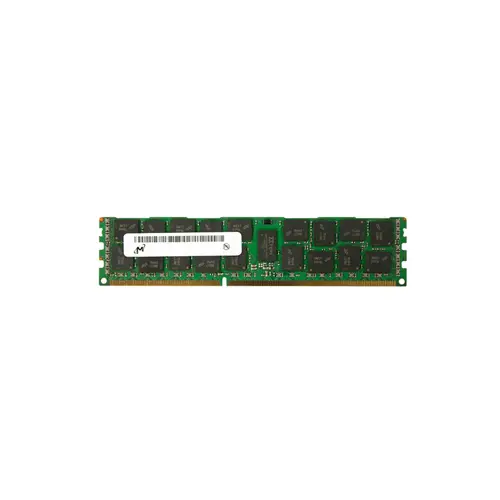
This DDR3-1333 Registered ECC module in a dual-rank x8 configuration is specifically engineered for legacy servers and workstations running memory-intensive workloads such as virtualization and in-memory databases, where its ECC and registered signal buffering ensure data integrity and stable operation under high-density, multi-DIMM configurations. The 1.35V low-voltage operation combined with CL9 latency offers an efficient balance of reduced power consumption and responsive access times for 24/7 enterprise environments.
1. ECC protection detects and corrects single-bit memory errors, safeguarding transactional databases and financial systems from silent data corruption during prolonged operation.
2. Registered signal buffering isolates the memory controller from excessive electrical loads, enabling dense memory configurations that keep virtual machine fleets responsive under high consolidation ratios.
3. Low-voltage operation reduces thermal stress and data center power bills, allowing higher rack density without sacrificing long-term reliability in always-on server deployments.
4. Dual Rank x8 organization interleaves access across internal banks, sustaining steady bandwidth for in-memory caching and real-time analytics under parallel query workloads.
5. The proven DDR3-1333 speed grade balances throughput and compatibility, delivering consistent performance for legacy enterprise applications that demand uptime without costly platform overhauls.
With the MT18KSF51272PDZ-1G4D1BB, you are looking at a server-grade Registered DIMM engineered for mission-critical enterprise workloads. Its four defining characteristics are not mere specifications; they directly determine uptime, data fidelity, and total cost of ownership in the data center.
The ECC functionality means silent data corruption from single-bit errors—a catastrophic risk in financial transaction databases—is detected and corrected in real time, safeguarding your ledger integrity without administrator intervention. The registered signal buffer elevates stability when populating dense server boards: in a virtualization cluster running dozens of VMs on a single host, the RDIMM’s redrive circuitry prevents signal degradation across ranks of memory, ensuring VMware ESXi or Hyper-V hosts can fully utilize all DIMM slots without boot failures or runtime crashes. The Dual Rank x8 organization doubles the row-hitting probability, enabling interleaved memory access that accelerates in-memory databases like Redis or SAP HANA, where sub-millisecond response is directly linked to revenue. Finally, the 1.35V low-voltage design cuts thermal footprint and power draw per node, which, at rack scale for a 24/7 virtualized cluster, translates into tangible savings in cooling and energy bills over the hardware lifecycle. This module turns raw capacity into dependable business continuity.
General Virtualization
For general virtualization, this 4 GB DDR3-1333 ECC Registered DIMM fits light-duty hypervisors. Install at least four identical modules (16 GB total) evenly across memory channels to enable multi-channel interleaving and host several small VMs. The low 1.35 V operating voltage reduces power consumption, and registered ECC safeguards guest OS stability.
In-Memory Database
In-memory databases demand maximum capacity. Populate every socket with these 4 GB RDIMMs—e.g., 12 modules per CPU for 48 GB—to enlarge dataset caches. The dual-rank, 1.35 V design lowers power and heat, while symmetric DIMM population across NUMA nodes ensures predictable low latency for real-time queries.
High-Performance Computing (HPC)
For bandwidth-sensitive HPC, populate each memory channel with one DIMM (1DPC) to sustain the full 1333 MT/s speed. An eight-channel system with eight modules provides 32 GB of high-bandwidth memory. The dual-rank x8 configuration and CL9 latency balance capacity and access time, and registered ECC delivers the accuracy required for long-running simulations.
Rigorously tested DDR3 ECC registered DIMM for servers: Dell R720, HP DL380p Gen8, IBM x3650 M4.
Q: Can I mix this MT18KSF51272PDZ-1G4D1BB with other memory modules of different brands or speeds?
A: Mixing RDIMMs of different brands, speeds, or ranks is not recommended. It can compromise signal integrity and ECC functionality, leading to system instability or data corruption in server environments.
Q: Is this memory compatible with my system? Which Intel or AMD platforms support it?
A: This DDR3-1333 ECC Registered DIMM requires a server board with a 240-pin socket and a chipset supporting Registered ECC memory, such as Intel C600 series or equivalent AMD G34/C32 platforms.
Q: What is the recommended DIMM population order for optimal performance?
A: Follow your server motherboard’s specific population guide. Typically, populate identical DIMMs per channel, starting with the slots furthest from the CPU to balance interleaving and achieve optimal memory throughput.
Q: Does this module support overclocking or XMP profiles?
A: No. This is a JEDEC-compliant server RDIMM operating at standard DDR3-1333 timing. It does not support overclocking or Intel XMP profiles, as mission-critical stability is prioritized.
Q: What warranty and typical failure rate can I expect?
A: This module includes a one-year warranty. Its enterprise-grade construction and stringent testing ensure an extremely low annualized failure rate (AFR), typical for registered server memory operating within spec.