











 Secure payments
Standard refund policy
Trade Assurance
Secure payments
Standard refund policy
Trade Assurance
| Product Type | Memory Module |
|---|---|
| Memory Capacity | 4 GB |
| Memory Technology | DDR3 |
| Product Voltage | 1.35V |
| RAM Speed | 1333MHz |
| RAM Standard | DDR3-1333/PC3-10600 |
| Error Identifying | ECC |
| Signal Type | Registered |
| Column Access Strobe (CAS) | CL9 |
| Rank | Dual Rank x8 |
| Quantity of Pins | 240-pin |
| RAM Genre | RDIMM |
This DDR3-1333 registered ECC module with dual-rank x8 organization is engineered for server platforms requiring uncompromising data integrity, making it ideal for memory-intensive virtualization and in-memory database workloads. Operating at 1.35V with ECC and registered signal buffering, it delivers reliable, low-power performance while the dual-rank configuration enhances overall memory bandwidth and capacity per channel in dense multi-DIMM deployments.
1. ECC protection actively detects and corrects single-bit errors, safeguarding transactional data integrity in always-on enterprise databases.
2. Registered signal buffering stabilizes command and address lines, enabling reliable operation across fully populated memory channels in dense rack servers.
3. Dual Rank x8 organization interleaves accesses to maximize channel utilization, sustaining throughput for concurrent virtual machine workloads.
4. 1333MHz clock speed delivers adequate bandwidth per DIMM, keeping response times predictable under moderate multi-tenant hosting loads.
5. CL9 column access latency reduces the delay to first data word, improving the performance of latency-sensitive cache miss handling in memory-bound server applications.
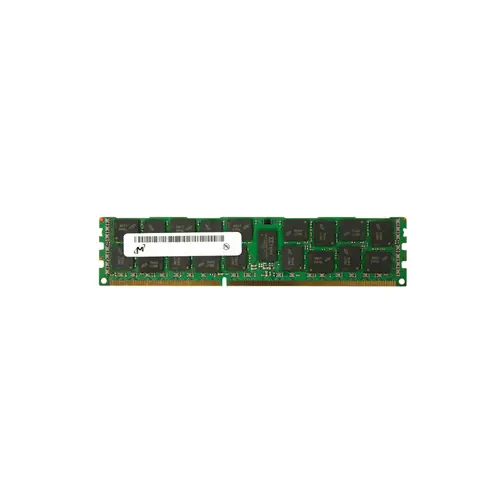
Judging by the RDIMM form factor, 240-pin interface, Registered signal type, and ECC support, the Micron MT18KSF51272PDZ-1G4M1 is unmistakably a server-grade memory module, and its four defining characteristics directly address the critical pain points of data center operators. The ECC capability means silent data corruption from cosmic bit-flips is actively detected and corrected, keeping your financial transactions or virtualization metadata absolutely trustworthy—non-negotiable for a hypervisor cluster running dozens of VMs. The Registered design buffers command and address signals, so you can populate all memory channels without signal degradation; this directly translates to confidently scaling up an in-memory database like Redis or SAP HANA without random reboots under heavy load. Operating at 1.35V instead of the standard 1.5V, this DDR3L module cuts cooling costs and power draw in a densely packed rack, which accumulates real savings across a fleet. Finally, its dual-rank x8 organization enables memory interleaving, giving the memory controller parallel access to two independent ranks on a single DIMM. For a virtualized environment, this boosts effective bandwidth and lowers latency, meaning your critical VMs respond faster during simultaneous user spikes, without the cost of adding twice the number of modules.
This is a server-class DDR3 ECC Registered DIMM (DDR3L-1333, dual-rank x8) designed for legacy platforms. Its low 1.35V operation and registered signalling make it suitable for capacity planning in the following workloads.
General Virtualization
Populate all memory channels symmetrically to avoid NUMA bottlenecks. A balanced starter configuration using six to eight identical 4 GB modules (24–32 GB) across both sockets comfortably supports a light hypervisor and a handful of virtual machines. When consolidating heavier workloads, plan to pair these with higher‑density RDIMMs in the same channel for extra headroom.
In-Memory Database
Memory capacity is paramount, so fill every available DIMM slot. A dual‑socket server with 18 slots yields 72 GB with these modules, which is adequate only for small test or development instances. Production in‑memory databases require much larger capacities—invest in higher‑density DIMMs to reach hundreds of gigabytes while preserving expansion room.
High Performance Computing (HPC)
Maximize memory bandwidth by populating all channels identically. Install two of these dual‑rank modules per channel (e.g., 16 × 4 GB = 64 GB on an 8‑channel node) to leverage rank interleaving and keep all channels active. The 1.35 V low‑voltage design also helps reduce overall power draw in dense clusters. Always mirror the DIMM population across all CPU sockets to prevent performance asymmetry.
Rigorously validated server memory. Compatible with Dell PowerEdge R710, HP ProLiant DL380 G7, and Lenovo ThinkServer RD430.
Q: Can I mix this MT18KSF51272PDZ-1G4M1 with other memory modules of different brands or speeds?
A: Mixing RDIMMs of different brands or speeds is not recommended in server environments. It may cause instability, weakened error correction, or boot failures. Always use identical part numbers for guaranteed compatibility and reliable 24/7 operation.
Q: Is this memory compatible with my server platform, such as Intel Xeon or AMD Opteron systems?
A: This 4GB DDR3-1333 ECC Registered DIMM is compatible with servers using Intel Xeon E5-2400/2600 v1/v2 or AMD Opteron 4300/6300 series processors. Please verify your motherboard supports DDR3L 1.35V RDIMMs via its qualified vendor list.
Q: What is the recommended DIMM population order for optimal performance with this module?
A: Populate identical RDIMMs per channel, starting with the farthest DIMM slot from the CPU. For dual-rank modules on a dual-processor board, balance memory across all memory channels equally to maintain maximum throughput and minimize latency.
Q: Does this module support overclocking or XMP profiles?
A: No, this is a JEDEC-compliant server RDIMM. It does not support overclocking, XMP profiles, or manual timing adjustments. It is designed to run exclusively at DDR3-1333 with CL9 for maximum stability in mission-critical systems.
Q: What warranty and typical failure rate can I expect with this memory?
A: This module includes a one-year warranty. As an enterprise-grade Micron RDIMM, it exhibits an annualized failure rate typically below 0.2% under standard operating conditions, ensuring reliable long-term deployment in your infrastructure.