











 Secure payments
Standard refund policy
Trade Assurance
Secure payments
Standard refund policy
Trade Assurance
| Product Type | Memory Module |
|---|---|
| Compliance Standards | RoHS |
| Memory Capacity | 4 GB |
| Memory Technology | DDR3 |
| Product Voltage | 1.35V |
| RAM Speed | 1333MHz |
| RAM Standard | DDR3-1333/PC3-10600 |
| Error Identifying | ECC |
| Signal Type | Registered |
| Column Access Strobe (CAS) | CL9 |
| Rank | Single Rank x4 |
| Quantity of Pins | 240-pin |
| RAM Genre | RDIMM |
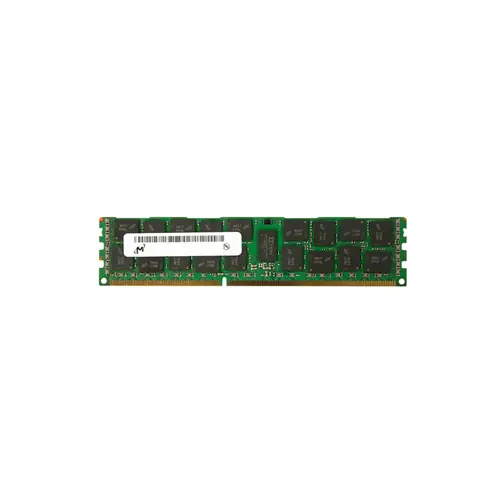
Designed for server platforms demanding high data integrity, this 4GB DDR3-1333 RDIMM leverages 1.35V low-power operation and registered signal buffering to maintain stability in dense, multi-rank memory configurations. Its ECC with single-rank x4 organization minimizes electrical loading while delivering reliable error correction, making it ideally suited for lightweight virtualization hosts and memory-resident database caches.
1. ECC memory detects and corrects single-bit errors in real time, preventing silent data corruption in mission-critical server workloads where uptime and data integrity are non-negotiable.
2. Registered signal buffering reduces electrical load on the memory controller, enabling servers to populate more DIMMs per channel and scale memory capacity for dense virtualization without sacrificing stability.
3. Single Rank x4 organization strikes a balance between capacity and command bus efficiency, helping maintain consistent memory access latencies in multi-slot server configurations under sustained transactional loads.
4. 1333MHz clock speed delivers ample memory bandwidth for legacy enterprise applications and mid-range database servers, ensuring smooth operation where modern throughput demands remain moderate.
5. 4GB module capacity provides a cost-effective building block for entry-level server nodes or light containerized environments, allowing right-sized memory allocation without overprovisioning resources.
When deploying dense virtualization clusters or in-memory databases, data integrity and uptime are non-negotiable. The Micron MT18KSF51272PZ-1G4K1HF RDIMM runs at an energy-efficient 1.35V, delivering meaningful power savings across hundreds of nodes while reducing thermal stress in 24/7 data centers. Its ECC technology actively corrects single-bit errors caused by cosmic radiation or electrical noise, preventing silent data corruption that could silently poison a hypervisor’s memory state or return an incorrect financial calculation in a Redis or SAP HANA instance. The registered buffer isolates the command and address bus from heavy DRAM loads, ensuring clean signal distribution so you can populate all channels without training failures or boot-time surprises. A Single Rank x4 organization with CL9 latency balances fast access and high bandwidth, giving virtual machines predictable response times during live migration and allowing in-memory analytics to scan large datasets without clogging the memory controller. This is not just a module—it is a safeguard for transactional consistency and service availability in environments where a single uncorrected bit flip erodes trust.
General Virtualization
Populate at least one module per memory channel to utilize full interleaving, then scale with a second DIMM per channel to safely increase capacity. In a dual‑socket server with eight channels, sixteen of these 4 GB Registered ECC DIMMs deliver 64 GB, comfortably supporting 10–15 light virtual machines. This module fits entry‑level virtualization but slot constraints limit larger deployments.
In-Memory Database
Fill every available slot with identical modules to maximize small‑scale capacity. A 24‑slot server configured with these 4 GB RDIMMs provides 96 GB, suitable for caching layers or development Redis instances. Production databases demand far greater capacity, so treat this as a cost‑effective solution for non‑critical, memory‑resident workloads.
High-Performance Computing
For peak bandwidth, install a single DIMM per channel (1DPC) to avoid speed penalties from heavy channel loading. Eight channels yield 32 GB of balanced, low‑latency memory ideal for bandwidth‑sensitive MPI tasks. Expand further by adding identical modules while keeping all channels symmetrically populated to maintain predictable performance.
Rigorously tested, compatible with Dell PowerEdge R710, HP ProLiant DL380 G7, and more.
Q: Can I mix this MT18KSF51272PZ-1G4K1HF with other memory modules of different brands or speeds?
A: Mixing is not recommended for server environments. All installed RDIMMs should be identical in speed, rank, and timing to ensure signal integrity and system stability.
Q: Is this memory compatible with my server system using Intel or AMD platforms?
A: This DDR3-1333 Registered ECC module is compatible with servers supporting 1.35V RDIMMs. Please consult your motherboard’s Qualified Vendor List for validated configurations, such as Intel Xeon E5-2400 or AMD equivalent platforms.
Q: What is the recommended DIMM population order for optimal performance?
A: Follow your server board’s manual, typically populating identical RDIMMs per channel starting from the furthest slot. Balance capacity across memory channels and avoid mixing single and dual rank DIMMs for best throughput.
Q: Does this module support overclocking or XMP profiles?
A: No. As a Registered ECC server module, it operates at standard JEDEC specifications only. Overclocking and XMP are not supported, prioritizing data integrity and 24/7 reliability over performance tuning.
Q: What warranty and typical failure rate can I expect?
A: This module includes a one-year warranty. Annualized failure rate is typically below 0.5% under normal server operating conditions, backed by rigorous testing and compliant manufacturing per RoHS standards.