











 Secure payments
Standard refund policy
Trade Assurance
Secure payments
Standard refund policy
Trade Assurance
| Product Type | Memory Module |
|---|---|
| Compliance Standards | RoHS |
| Memory Capacity | 4 GB |
| Memory Technology | DDR3 |
| Product Voltage | 1.5V |
| RAM Speed | 1333MHz |
| RAM Standard | DDR3-1333/PC3-10600 |
| Error Identifying | ECC |
| Signal Type | Registered |
| Column Access Strobe (CAS) | CL9 |
| Rank | Dual Rank x8 |
| Quantity of Pins | 240-pin |
| RAM Genre | RDIMM |
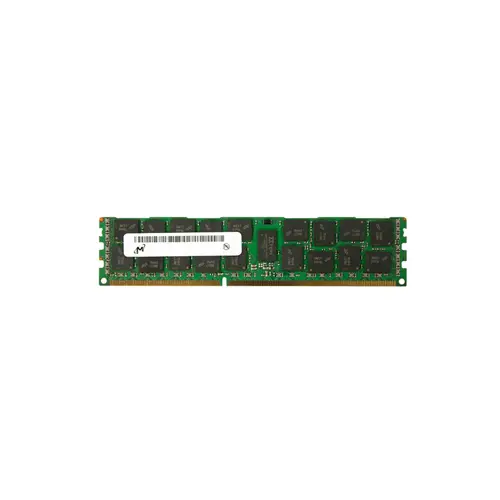
This Micron 4GB DDR3-1333 Registered ECC RDIMM (PC3-10600, CL9, dual-rank x8) is engineered for legacy server platforms, delivering data integrity and system stability through error-correcting code and registered signal buffering. Its dual-rank configuration with CL9 latency is particularly well-suited for memory-intensive workloads like virtualization and small-scale in-memory databases where reliable, consistent performance under moderate load is critical.
1. Registered signal buffering decouples the electrical load from the memory controller, enabling server boards to populate all DIMM slots without compromising signal integrity—critical for maximizing uptime in always-on data center environments.
2. ECC error correction actively detects and repairs single-bit memory faults in real time, shielding hypervisor and critical application data from silent corruption during extended mission-critical operations.
3. Dual Rank x8 organization leverages rank interleaving to keep memory channels highly utilized, which lifts effective bandwidth for virtual machines and reduces latency under mixed-workload consolidation.
4. 1333MHz clock speed provides a balanced throughput envelope that saturates legacy server memory channels efficiently, sustaining consistent application performance within established thermal and power envelopes.
5. 4 GB capacity per module offers a right-sized building block for memory-dense configurations on older platforms, allowing cost-effective scaling of light virtualization hosts or dedicated network appliance roles.
This is a server-grade Registered DIMM, and its design speaks directly to the realities of data-center workloads. In a virtualized cluster running dozens of VMs, ECC error correction silently catches single-bit memory errors triggered by background radiation or voltage noise; a single uncorrected bit flip could silently corrupt a hypervisor page table or poison a financial transaction, making ECC the difference between five-nines uptime and mysterious crashes. The registered buffer on this 4GB DDR3-1333 module stabilizes the electrical load when all 240-pin slots are populated, so your virtualization farm scales to hundreds of gigabytes without intermittent boot failures or signal degradation. Shift to an in-memory database like Redis or SAP HANA, and the dual-rank x8 organization elevates performance by interleaving accesses across two internal banks—effectively widening the data pipeline and sustaining high throughput under massive concurrent queries. Paired with CL9 latency, the 1333MHz speed delivers predictable, low-latency responses that keep real-time analytics crisp. ECC integrity, registered scalability, dual-rank bandwidth, and tight 1333MHz timing together turn this module into a quiet enabler of always-on enterprise infrastructure.
Capacity Planning Guide for DDR3 Registered ECC Server Memory
The provided module is a 4GB DDR3-1333 RDIMM with ECC and Registered signaling, clearly designed for server-class platforms. Its 1.5V operating voltage and dual-rank x8 organization suit environments where data integrity and stability under continuous load are paramount. The following scenario-based guidance assumes a typical dual-socket server with triple- or quad-channel memory architecture.
General Virtualization
In virtualized environments hosting mixed workloads, balance total capacity with memory bandwidth. Deploy modules in matched sets to populate all memory channels per CPU for optimal interleaving. A baseline configuration of six 4GB modules (24GB total) per socket supports approximately 10–15 light to medium VMs. Scale horizontally by adding identical kits, monitoring overcommitment ratios to avoid ballooning.
In-Memory Database
In-memory databases such as Redis or SAP HANA demand low latency and absolute data integrity. Maximize capacity by fully populating all DIMM slots with identical 4GB RDIMMs, leveraging the registered buffer to maintain signal integrity at high densities. A dual-CPU server with 18 slots can reach 72GB, suitable for moderate in-memory datasets. Prioritize ECC to prevent silent data corruption during cache operations.
High Performance Computing (HPC)
For memory-bandwidth-sensitive HPC codes, populate at least one DIMM per channel across both processors to achieve peak theoretical bandwidth. A minimum of six 4GB modules per node (24GB) ensures correct channel interleaving. While 4GB DIMMs limit per-node capacity, this configuration serves entry-level CFD or molecular dynamics tasks where dataset size is modest but bandwidth per core is critical. Upgrade to higher-capacity DIMMs for larger problem sets.
Rigorously tested server DDR3 RDIMM; compatible with Dell PowerEdge R710, HP ProLiant DL380 G7, IBM System x3650 M3, and more.
Q: Can I mix this MT36JSF51272PZ-1G4F1DD with other memory modules of different brands or speeds?
A: Mixing is not recommended. Registered DDR3 modules should match speed, rank, and timings exactly; otherwise, the system may downclock or become unstable. Use identical part numbers for guaranteed reliability.
Q: Is this memory compatible with my server? Which platforms are supported?
A: This DDR3-1333 ECC Registered DIMM is designed for Intel Xeon 5500/5600 series and AMD Opteron 6100/6200 platforms. Please consult your server's qualified vendor list (QVL) for exact compatibility.
Q: What is the recommended DIMM population order for optimal performance with this module?
A: Follow your server manual. Typically, populate identical DIMMs in the farthest slots per channel first. Balance across memory channels for optimal interleaving and bandwidth, especially in dual-socket systems.
Q: Does this module support overclocking or XMP profiles?
A: No. This is a JEDEC-standard server memory module engineered for stability and data integrity. It does not support overclocking or Intel XMP, as those compromise ECC reliability in mission-critical environments.
Q: What warranty and typical failure rate can I expect?
A: This module carries a 1-year warranty. It adheres to enterprise-class quality standards with a typical annualized failure rate (AFR) below 0.3%, ensuring high reliability for server deployments.