











 Secure payments
Standard refund policy
Trade Assurance
Secure payments
Standard refund policy
Trade Assurance
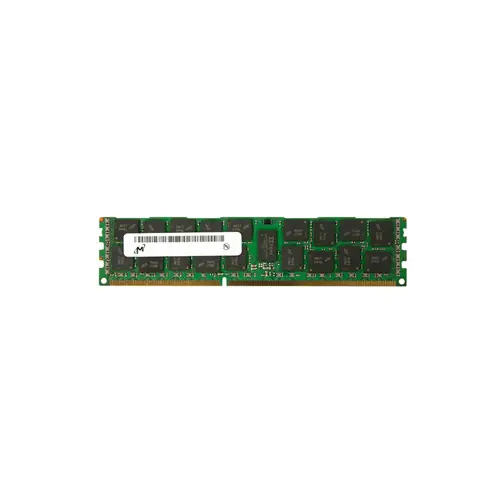
| Model | MT36JSZF51272PZ-1G |
|---|---|
| Product Type | Memory Module |
| Compliance Standards | RoHS |
| Memory Capacity | 4 GB |
| Memory Technology | DDR3 |
| Product Voltage | 1.5V |
| RAM Speed | 1333MHz |
| RAM Standard | DDR3-1333/PC3-10600 |
| Error Identifying | ECC |
| Signal Type | Registered |
| Column Access Strobe (CAS) | CL9 |
| Rank | Dual Rank x4 |
| Quantity of Pins | 240-pin |
| RAM Genre | RDIMM |
Designed as a server-grade DDR3-1333 Registered ECC module, this 4GB RDIMM is optimized for virtualization platforms and memory-intensive enterprise workloads where data integrity is paramount. The registered signal type ensures stable operation in fully populated multi-DIMM configurations, while its dual-rank x4 organization and ECC jointly enhance throughput and protect against single-bit errors in critical applications such as in-memory databases.
1. ECC error correction silently detects and repairs single-bit memory faults, safeguarding transactional databases and financial computations against silent data corruption in always-on server environments.
2. Registered signal buffering stabilizes command and address lines under heavy DIMM population, enabling hyperscale virtualization nodes to scale memory capacity without sacrificing signal integrity.
3. Dual Rank x4 organization keeps the memory pipeline fully interleaved, delivering sustained throughput that prevents bottlenecks during simultaneous live migration and high-frequency OLTP workloads.
4. 1333MHz clock speed yields up to 10.6 GB/s of peak bandwidth per channel, efficiently feeding multi-core server CPUs through memory-intensive tasks like real-time analytics and large in-memory caches.
5. CL9 latency provides a tuned balance of swift data access and operational stability, minimizing response lag for latency-sensitive services such as high-availability clustering and virtualized network functions.
The MT36JSZF51272PZ-1G is a registered DDR3 memory module purpose-built for server infrastructure, where downtime is not an option. Its four critical attributes — ECC error correction, registered signal buffering, dual-rank x4 organization, and a disciplined CAS latency of 9 — directly solve the hardest reliability and performance challenges in virtualized clusters and in-memory databases. In a virtualization host running dozens of VMs, a single cosmic-ray-induced bit flip can silently corrupt financial transactions or hypervisor states; hardware ECC immediately detects and corrects such errors, preserving data integrity without performance penalties. The registered buffer isolates the memory controller from excessive electrical loading, enabling you to populate all 24 DIMM slots per server without signal degradation, so your cluster scales smoothly to support hundreds of enterprise workloads. The dual-rank x4 architecture interleaves banks internally, significantly raising sustainable bandwidth when an in-memory database like Redis or SAP HANA processes millions of concurrent reads and writes. Meanwhile, CL9 timings keep access latency predictably tight under relentless load, preventing the micro-stutters that can cascade into transaction timeouts. For enterprise architects, this translates into one incontestable advantage: always-on application availability backed by memory that refuses to compromise.
General Virtualization
For moderate consolidation of virtual machines, install a balanced configuration of six or eight identical MT36JSZF51272PZ-1G modules to reach 24 GB or 32 GB. Dual-rank x4 RDIMMs maximize the memory channels when populated in multiples of three per processor (for triple-channel platforms), allowing smooth operation of mixed workloads without exhausting the memory controller.
In-Memory Database
In-memory datasets demand the largest viable capacity. Populate all available DIMM slots with these 4 GB registered modules, aiming for 64 GB or higher per server. The ECC and registered design ensures data integrity under heavy sustained writes, while dual-rank organization helps sustain bandwidth under concurrent read-intensive query patterns.
High-Performance Computing (HPC)
For memory-bandwidth-sensitive HPC jobs, deploy fully balanced memory populations — typically six or twelve modules per dual-socket node. This approach yields 24 GB or 48 GB per node while leveraging all available channels. Registered DDR3-1333 with CAS 9 provides deterministic latency, and ECC prevents silent data corruption across long-running parallel simulations.
Rigorously tested server memory, compatible with Dell R720, HP DL380p Gen8, and IBM x3650 M4.
Q: Can I mix this MT36JSZF51272PZ-1G with other memory modules of different brands or speeds?
A: Mixing Registered DIMMs of different brands, speeds, or ranks is strongly discouraged in server environments. It can introduce signal integrity issues and system instability. Always populate identical modules with matching part numbers for guaranteed compatibility.
Q: Is this memory compatible with my Intel or AMD server platform?
A: This DDR3-1333 Registered ECC module is designed for Intel 5500/5520/5600 series and AMD Opteron 6100/6200 series platforms. Please confirm your motherboard supports RDIMMs and PC3-10600 standard. Consult the vendor's memory QVL list for precise validation.
Q: What is the recommended DIMM population order for optimal performance?
A: For dual-processor servers, populate identical DIMMs per channel, starting with the slots furthest from each CPU. This balances interleaved memory channels for maximum bandwidth. Refer to your system's service manual for the exact slot numbering sequence.
Q: Does this module support overclocking or XMP profiles?
A: No, enterprise RDIMMs do not support overclocking or XMP profiles. This module follows strict JEDEC standards for 1333MHz operation at CL9 with 1.5V. Stability and data integrity under continuous load take precedence over frequency tuning.
Q: What warranty and typical failure rate can I expect?
A: This module includes a one-year warranty covering manufacturing defects. Typical annualized failure rates for enterprise RDIMMs are very low, generally under 0.1%, when operated within specified voltage and temperature conditions in compliant server platforms.