











 Secure payments
Standard refund policy
Trade Assurance
Secure payments
Standard refund policy
Trade Assurance
| Product Type | Memory Module |
|---|---|
| Compliance Standards | RoHS |
| Memory Capacity | 4 GB |
| Memory Technology | DDR3 |
| Product Voltage | 1.5V |
| RAM Speed | 1333MHz |
| RAM Standard | DDR3-1333/PC3-10600 |
| Error Identifying | ECC |
| Signal Type | Registered |
| Column Access Strobe (CAS) | CL9 |
| Rank | Dual Rank x4 |
| Quantity of Pins | 240-pin |
| RAM Genre | RDIMM |
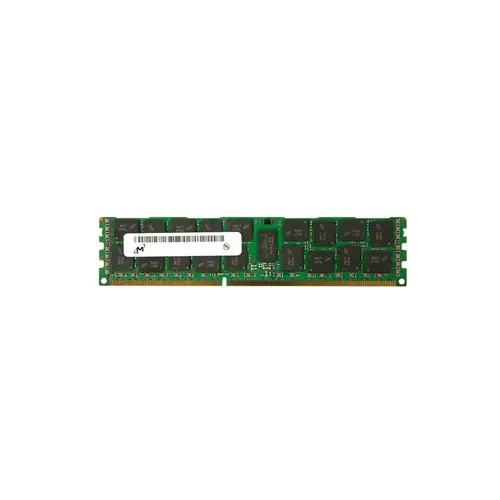
This DDR3-1333 RDIMM is ideally suited for entry-level servers and virtualization platforms where data integrity is non-negotiable, leveraging ECC and registered signal buffering to ensure stable operation under moderate memory loads. Its dual-rank x4 configuration enhances interleaving efficiency and enables the system to sustain reliable throughput for memory-resident databases and light multi-tenant hypervisor workloads.
1. Registered DIMM architecture buffers command and address signals, preserving signal integrity across fully loaded server banks and preventing silent data corruption in multi-socket configurations.
2. ECC protection transparently corrects single-bit errors and detects multi-bit faults, safeguarding transactional databases and in-memory caches from undetected data corruption.
3. Dual Rank x4 organization keeps memory controllers fed via rank interleaving, smoothing out latency spikes when hosting dense virtual machine fleets that hammer storage and networking.
4. PC3-10600 bandwidth sustains a generous ten-plus gigabyte-per-second throughput per channel, preventing I/O bottlenecks for content servers and real-time analytics under concurrent request floods.
5. A conservative four-gigabit-per-module capacity supports fine-grained memory scaling in virtualized hosts, allowing more guests per rack without exceeding power ceilings or compromising adequate error overhead.
Designed for mission-critical servers, the MT36JSZF51272PZ-1G4F1 RDIMM transforms four engineering attributes into real-world reliability. Its ECC and registered buffer directly combat the top concern in dense virtualization clusters: memory errors and signal instability. When a hypervisor runs dozens of VMs, a single bit flip in non-ECC memory can corrupt an entire virtual disk, leading to downtime. ECC corrects these errors on the fly, while the register isolates the memory controller from electrical loading, letting you fill all channels with confidence. In transactional in-memory databases like SAP HANA, the dual-rank x4 chip architecture is a lifeline. It not only enables rank interleaving for higher bandwidth at 1333MHz but also supports Chipkill—if a whole x4 DRAM chip fails, the system keeps running error-free, preventing revenue loss from transaction errors. With a tight CL9 latency, every query returns consistent, low-latency results. It’s a barrier against silent corruption.
Server Memory Capacity Planning Guide – DDR3-1333 ECC Registered (4GB RDIMM)
This 4GB DDR3-1333 RDIMM is a registered, ECC server memory module operating at 1.5V. It is designed for stability in multi-slot server platforms that require error correction and high memory capacity. The following scenarios outline typical deployment patterns using this module.
General Virtualization
Equip the server with a balanced set of identical 4GB RDIMMs across all memory channels to maximize bandwidth. A minimum of six to eight modules (24–32 GB) supports a modest number of virtual machines, while populating all 12 or more DIMM slots with matched 4GB sticks can comfortably serve dense VM clusters.
In-Memory Database
In-memory databases benefit from large absolute capacity and low latency. Fill every available channel with these ECC Registered DIMMs to reach 64–128 GB or more, depending on the platform. The ECC protection safeguards data integrity, and the registered architecture allows stable operation when all slots are populated for peak capacity.
High-Performance Computing (HPC)
For HPC nodes, memory bandwidth is critical. Install an equal number of these Dual Rank x4 DIMMs per channel to enable balanced interleaving and maximize throughput. A configuration such as 12 x 4GB (48 GB) or 16 x 4GB (64 GB) provides sufficient capacity for many parallel workloads while maintaining uniform access speeds across the memory fabric.
Rigorously tested, compatible with Dell PowerEdge R710, R720, HP ProLiant DL380 G8, and similar servers.
Q: Can I mix this MT36JSZF51272PZ-1G4F1 with other memory modules of different brands or speeds?
A: Mixing is not recommended. For server stability, use identical RDIMMs—same speed, rank, and CAS latency. Mismatched modules may cause POST failures or data integrity issues in registered ECC environments.
Q: Is this memory compatible with my system? Which Intel or AMD server platforms support it?
A: It is compatible with dual-processor servers using Intel 5500/5600 series or AMD Opteron 6100 platforms. Verify that your board supports registered DDR3-1333 ECC DIMMs with 1.5V and 240-pin slots.
Q: What is the recommended DIMM population order for optimal performance?
A: Populate identical Dual Rank x4 RDIMMs per channel, matching the server board's manual. Typically, start with the first slot of each memory channel, balancing across both processor sockets for symmetric NUMA configuration.
Q: Does this module support overclocking or XMP profiles?
A: No, this is a server-grade registered ECC module. It adheres strictly to JEDEC DDR3-1333/PC3-10600 specifications and does not support XMP or overclocking, prioritizing data integrity in 24/7 operation.
Q: What warranty and typical failure rate can I expect?
A: This product includes a one-year warranty. Enterprise-class RDIMMs have an annualized failure rate (AFR) well under 0.5% under proper cooling, ensuring long-term reliability in mission-critical deployments.