











 Secure payments
Standard refund policy
Trade Assurance
Secure payments
Standard refund policy
Trade Assurance
| Product Type | Memory Module |
|---|---|
| Compliance Standards | RoHS |
| Memory Capacity | 4 GB |
| Memory Technology | DDR3 |
| Product Voltage | 1.5V |
| RAM Speed | 1333MHz |
| RAM Standard | DDR3-1333/PC3-10600 |
| Error Identifying | ECC |
| Signal Type | Registered |
| Column Access Strobe (CAS) | CL9 |
| Rank | Single Rank x4 |
| Quantity of Pins | 240-pin |
| RAM Genre | RDIMM |
This DDR3-1333 RDIMM is purpose-built for server platforms, delivering strong data integrity for virtualization and in-memory database workloads through its registered signal architecture and integrated ECC. Its single-rank x4 configuration with CL9 latency helps reduce bus loading and maintains efficient access timing, making it a reliable choice for capacity-optimized enterprise deployments.
1. ECC protection silently detects and corrects single-bit memory errors in real time, eliminating silent data corruption risks that could crash transactional databases or hypervisors.
2. Registered signal buffering stabilizes command and address signals across fully loaded memory channels, enabling massive RAM footprints for dense virtualization without sacrificing reliability.
3. Single Rank x4 organization minimizes bus loading per module, allowing more DIMMs per server node while maintaining clean signal integrity under continuous load.
4. A 4 GB capacity per module serves as a flexible scaling unit for light container hosts or balanced memory interleaving in dual‑socket platforms, optimizing cost per virtual machine.
5. Running at 1333 MHz, the module delivers a 10.6 GB/s peak bandwidth per channel, keeping latency‑sensitive analytics and high‑concurrency web services fed without stalling the CPU.
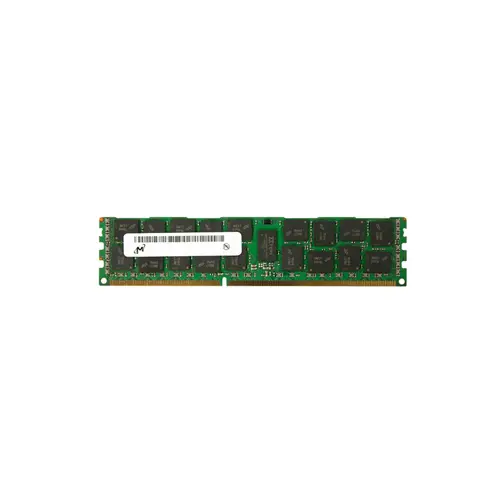
The Micron MT18JSF51272PZ-1G4 is a 4GB DDR3-1333 Registered ECC DIMM purpose-built for servers. ECC actively corrects single-bit errors, preventing silent data corruption that could crash virtual machines or corrupt transactional databases such as those running Redis. The registered buffer offloads the memory controller, allowing stable operation with multiple DIMMs per channel—essential in virtualization clusters where large, reliable memory pools consolidate numerous VMs. The single-rank x4 organization leverages x4 DRAM chips to improve chip-level interleaving and fault tolerance, sustaining low-latency access under heavy concurrent loads. Finally, 1333MHz speed at CL9 provides 10.6 GB/s bandwidth, accelerating memory-intensive operations in analytics platforms or VDI deployments. In a virtualized environment, these attributes ensure no VM experiences memory-related downtime; for an in-memory database, they mean queries return accurate, uncorrupted results instantly. This module transforms server memory into a trusted, high-performance asset.
General Virtualization
For light to moderate consolidation, populate all memory channels with identical 4 GB RDIMMs to maximize bandwidth. A dual‑socket server with six channels per CPU using one DIMM per channel (12 modules total) yields 48 GB, enough for a dozen typical VMs. Avoid mixing ranks in a channel to prevent speed downgrades from 1333 MHz; single-rank x4 modules like this one help maintain low latency under NUMA‑aware hypervisors.
In-Memory Database
Capacity is paramount, yet using only 4 GB DIMMs forces high module counts that increase power and thermal load. To reach 128 GB on a two‑socket system you would need thirty‑two modules, fully populating all slots, which stresses the memory controller and complicates future expansion. For production deployments, substitute 8 GB or 16 GB RDIMMs where possible; retain these 4 GB DIMMs only for small development instances or caching tiers where total demand is under 64 GB.
High-Performance Computing
HPC workloads favor bandwidth over capacity. On a dual‑CPU server with triple‑channel architecture, install three 4 GB RDIMMs per processor (one per channel, 24 GB total) to sustain 1333 MHz with CL9 timings. This balanced configuration delivers peak memory throughput for MPI‑based simulations. Avoid using more than one DIMM per channel: populating a second slot drops the speed to 1066 MHz and increases latency, undermining the low‑latency advantage of this single‑rank x4 module.
Rigorously tested for compatibility with Dell PowerEdge R720, HP DL380p Gen8, and IBM x3650 M3.
Q: Can I mix this MT18JSF51272PZ-1G4 with other memory modules of different brands or speeds?
A: Mixing different brands or speeds is not recommended on server platforms. It may cause signal integrity issues and instability. For guaranteed reliability, populate all channels with identical RDIMMs of the same part number.
Q: Is this memory compatible with my system?
A: This DDR3-1333 Registered ECC RDIMM is designed for servers using Intel Xeon 5500/5600 series or AMD Opteron 6100 series platforms. Please verify your motherboard's qualified vendor list for this exact 1.5V 240-pin module.
Q: What is the recommended DIMM population order for optimal performance?
A: Follow your server board's manual to populate each memory channel symmetrically. Typically, start with the primary slots (often blue) per channel to enable balanced interleaving and maximize throughput, then add matching DIMMs in sets.
Q: Does this module support overclocking or XMP profiles?
A: No, overclocking and XMP profiles are not supported. This is a JEDEC-compliant, enterprise-grade registered DIMM engineered for 24/7 stability and data integrity, not for performance tuning.
Q: What warranty and typical failure rate can I expect?
A: This module includes a 1-year warranty. Under normal server operating conditions, the annualized failure rate is extremely low, typically below 0.1%, reflecting high manufacturing and screening standards.