











 Secure payments
Standard refund policy
Trade Assurance
Secure payments
Standard refund policy
Trade Assurance
| Product Type | Memory Module |
|---|---|
| Memory Capacity | 4 GB |
| Memory Technology | DDR3 |
| Product Voltage | 1.5V |
| RAM Speed | 1333MHz |
| RAM Standard | DDR3-1333/PC3-10600 |
| Error Identifying | ECC |
| Signal Type | Registered |
| Column Access Strobe (CAS) | CL9 |
| Rank | Dual Rank x4 |
| Quantity of Pins | 240-pin |
| RAM Genre | RDIMM |
This 4GB DDR3-1333 registered ECC RDIMM is tailored for entry-level servers and small-scale virtualization platforms where data integrity and system uptime are critical. Its dual-rank x4 configuration and registered signal type deliver enhanced signal stability and reliable multi-DIMM operation, while full ECC support actively corrects single-bit errors to protect in-memory databases and lightweight transactional workloads.
1. ECC protection automatically detects and corrects single-bit memory errors, preserving data accuracy in mission-critical database and financial transaction servers where even a silent bit flip is unacceptable.
2. Registered signal buffering stabilizes command and address lines when multiple DIMMs populate a server channel, enabling the reliable high-capacity memory configurations that dense virtualization clusters demand.
3. Dual Rank x4 organization interleaves accesses across internal banks, maximizing sustained bandwidth and reducing read latency for memory-intensive analytics and large-scale in-memory caching workloads.
4. CAS 9 latency at 1333MHz strikes a server-optimized balance between access speed and clock cycle economy, delivering responsive performance for latency-sensitive OLTP and real-time messaging applications.
5. A 4GB RDIMM capacity serves as an efficient granular unit for lightweight virtualized nodes, letting operators right-size memory for container hosts or branch-office deployments without wasteful overprovisioning.
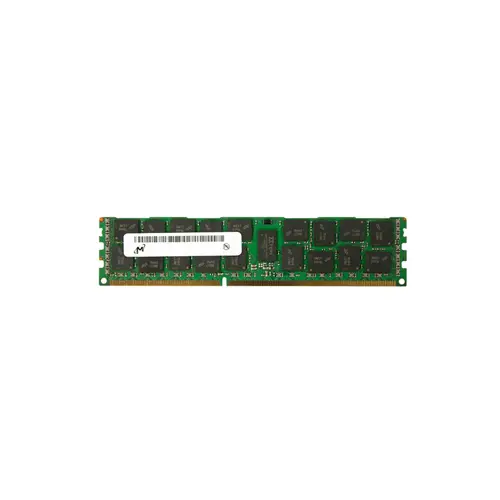
Let's focus on the Micron MT36JSZF51272PZ-1G4F1DD, a 4GB DDR3-1333 Registered DIMM operating at 1.5V. The RDIMM form factor and ECC capability immediately position this as a server-grade memory module, purpose-built to address the unforgiving demands of enterprise environments. Its four key characteristics are not just specifications; they are the non-negotiable foundation of infrastructure reliability.
The integrated ECC engine directly shields your mission-critical workloads. In a memory-resident database like Redis or SAP HANA, an undetected single-bit flip in a transaction record could silently corrupt financial figures or inventory data, leading to cascading business errors. ECC actively detects and corrects these flips in real time, transforming a catastrophic silent corruption into a logged, corrected event. Meanwhile, the registered signal buffer solves the physical limitations of memory controllers. In a dense virtualization cluster running dozens of VMs, populating all 18 or 24 DIMM slots on a board without a register chip would degrade signal integrity, causing mysterious server crashes. The register stabilizes this massive load, allowing you to confidently scale to maximum capacity without sacrificing uptime. The dual-rank x4 architecture further amplifies performance via rank interleaving; while one rank waits for a refresh cycle, the controller can read or write to the other, squeezing out additional bandwidth critical for juggling simultaneous requests across containers. Finally, CL9 latency at 1333MHz strikes a finely tuned balance between responsive data access and the power overhead, ensuring consistent throughput without unnecessary thermal strain in 24/7 operations. This module means your virtualization farm stays online and your data remains pristine.
Capacity Planning Guide for Server Memory
The specified module is a 4 GB DDR3-1333 Registered ECC DIMM (RDIMM), designed exclusively for servers and workstations. With error correction and signal buffering, it provides the stability required for enterprise workloads. However, the 4 GB capacity per stick means careful planning is essential to meet modern demands without overspending on obsolete platforms.
General Virtualization
For light virtualization with 3–5 low-resource VMs, a minimum of 6 to 8 identical modules (24–32 GB total) is advisable, populating three channels per CPU to balance capacity and memory bandwidth. Homogeneous dual-rank x4 modules like this one ensure optimal interleaving and ECC coverage. Consolidating more VMs will quickly exhaust the 4 GB granularity, so plan for 64 GB or higher by fully populating all available DIMM slots with matched kits.
In-Memory Database
In-memory databases demand both capacity and low latency. While CL9 is acceptable, 4 GB sticks limit total RAM per host; deploy the maximum supported modules—often 12 or 18 per dual-socket system—to reach 48–72 GB for moderate datasets. Configure all memory channels identically to sustain the high throughput needed for caching and real-time analytics, and prefer dual-rank DIMMs as they deliver better bank-level parallelism.
High Performance Computing (HPC)
HPC clusters typically require massive throughput and reliability. A single node should be fully populated with RDIMMs (e.g., 12 or 24 slots) to maximize memory bandwidth per core, which is critical for simulation and modeling codes. While 4 GB modules can serve as a low-cost entry point, modern MPI workloads will outgrow them quickly; consider using all identical, registered DIMMs across nodes to guarantee cluster-wide consistency and correct ECC behavior during long-running jobs.
Rigorously tested server memory; compatible with Dell PowerEdge R720, HP ProLiant DL380p Gen8, and more.
Q: Can I mix this MT36JSZF51272PZ-1G4F1DD with other memory modules of different brands or speeds?
A: Mixing different brands or speeds is not recommended in servers. ECC Registered DIMMs must be identical to ensure signal integrity and reliability. Deviation may cause POST failures or silent data corruption.
Q: Is this memory compatible with my system?
A: This RDIMM fits servers supporting DDR3-1333 ECC Registered memory, such as Intel Xeon 5500/5600 or AMD Opteron 6100 platforms. Confirm your board supports 1.5V, 240-pin Registered DIMMs via the qualified vendor list.
Q: What is the recommended DIMM population order for optimal performance?
A: Install identical modules across memory channels for balanced interleaving. Begin with the first slot of each channel, typically blue slots, and follow your motherboard’s manual to maximize throughput and avoid NUMA latency.
Q: Does this module support overclocking or XMP profiles?
A: No. This is a JEDEC-compliant server DIMM engineered for 24/7 stability under enterprise workloads. It runs strictly at DDR3-1333 CL9 with no overclocking or XMP support.
Q: What warranty and typical failure rate can I expect?
A: Micron offers a 1-year warranty. In a controlled data center environment, this module’s annualized failure rate (AFR) is typically below 0.5%, reflecting enterprise-grade testing and reliability standards.