











 Secure payments
Standard refund policy
Trade Assurance
Secure payments
Standard refund policy
Trade Assurance
| Product Type | Memory Module |
|---|---|
| Compliance Standards | RoHS |
| Memory Capacity | 4 GB |
| Memory Technology | DDR3 |
| Product Voltage | 1.35V |
| RAM Speed | 1333MHz |
| RAM Standard | DDR3-1333/PC3-10600 |
| Error Identifying | ECC |
| Signal Type | Registered |
| Column Access Strobe (CAS) | CL9 |
| Rank | Dual Rank x8 |
| Quantity of Pins | 240-pin |
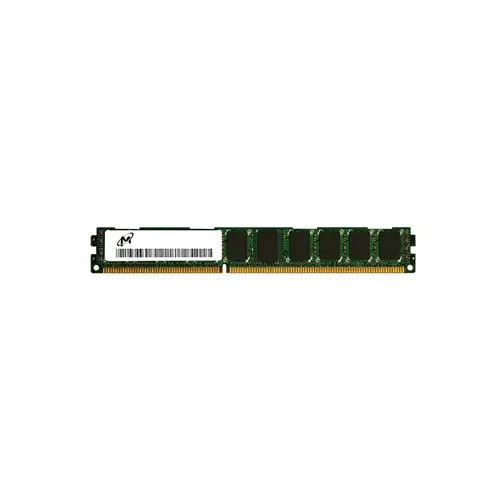
| RAM Genre | VLP RDIMM |
This VLP RDIMM module with ECC and registered signaling is engineered for dense server environments, ideally suited for virtualization platforms and in-memory databases where data integrity and maximum uptime are critical. Its dual-rank x8 configuration and low 1.35V operating voltage enhance memory bandwidth and thermal efficiency, while the registered interface ensures stable signal integrity across high-capacity configurations.
1. VLP RDIMM form factor minimizes airflow obstruction in dense server chassis, allowing fully populated memory channels without compromising thermal headroom.
2. ECC protection transparently corrects single-bit errors, preserving data integrity for transactional databases and long-running virtualization workloads.
3. Registered signal buffering stabilizes command and address lines, enabling reliable operation across heavily loaded memory banks in multi-socket servers.
4. Dual Rank x8 organization enables rank interleaving that boosts effective throughput, reducing memory access latency for consolidated virtual machines.
5. 1.35V low-voltage operation cuts per-DIMM power consumption, directly lowering energy costs and cooling requirements in scale-out data center environments.
With the MT18KDF51272PDZ-1G4, you are looking at a Very Low Profile Registered DDR3L server module — and that single classification tells you everything about the rigorous environments it was engineered for. In a virtualized cluster running dozens of VMs, any uncorrected memory error can cascade into corrupted transactions and costly downtime. Here, the integrated ECC is your silent guardian, detecting and correcting single-bit flips caused by background radiation before they compromise your hypervisor or guest operating systems. When you populate a 2U rack server with dense compute blades, the Registered signal buffer steps in to stabilize the command bus as you scale to massive capacities, ensuring clean signal integrity across all DIMMs — no mysterious reboots under full load. Meanwhile, the dual-rank x8 organization interleaves memory accesses to maximize bandwidth, translating directly into higher throughput for in-memory databases like Redis or Memcached during peak traffic bursts. And because energy density and thermal headroom are perpetual battles in the data center, the module operates at just 1.35V with a VLP form factor, drawing less power and allowing unimpeded airflow in narrow 1U chassis — keeping your operating costs manageable even as your real-time analytics workloads consume terabytes of memory. This is not simply a 4GB stick; it is a building block for transactional reliability, sustained virtual machine density, and the unwavering uptime your business depends upon.
General Virtualization
For moderate-density virtualization hosts, install six to eight of these 4 GB VLP RDIMMs per CPU socket, yielding 24–32 GB total capacity. The ECC and registered design ensure data integrity under mixed-VM workloads, while low 1.35 V operation reduces power draw in always-on environments. Populate symmetric channels to maintain balanced memory bandwidth across virtual instances.
In-Memory Database
When low latency is critical, configure all memory channels with identical 4 GB modules to maximize parallelism, typically 12–16 DIMMs per server for 48–64 GB of cached dataset space. The registered ECC architecture prevents silent data corruption during high-throughput query executions, and the dual-rank x8 organization delivers a good compromise between rank interleaving and bus loading for Redis or Memcached nodes.
High-Performance Computing
For compute-bound HPC clusters that prize bandwidth more than capacity, use a minimum of one DIMM per memory channel on each node—often six to twelve modules. The 1333 MHz CAS 9 timing provides predictable access patterns for MPI workloads, and the very low-profile form factor permits dense 1U deployments. Registered ECC stability is indispensable during multi-day simulation runs where even a single-bit error could invalidate results.
This RDIMM is rigorously tested, compatible with Dell PowerEdge R710, HP DL360p Gen8, Lenovo ThinkServer RD430.
Q: Can I mix this MT18KDF51272PDZ-1G4 with other memory modules of different brands or speeds?
A: Mixing Registered ECC memory across brands or speeds is not recommended. It may cause system instability, POST failures, or forced downclocking to the slowest module, undermining server reliability.
Q: Is this memory compatible with my system?
A: It is compatible with Intel Xeon E5-2600 v1/v2 and AMD Opteron 6300 series platforms using DDR3-1333 Registered ECC DIMMs. Please consult your server's Qualified Vendor List (QVL) for exact validation.
Q: What is the recommended DIMM population order for optimal performance?
A: Populate identical DIMMs per channel, starting with the farthest slots from the CPU. For dual-socket servers, balance memory symmetrically across both processors to maximize bandwidth and enable NUMA efficiency.
Q: Does this module support overclocking or XMP profiles?
A: No. This is a JEDEC-compliant Registered ECC server module operating at fixed 1333MHz. Overclocking and XMP profiles are not supported, as they compromise data integrity and platform stability.
Q: What warranty and typical failure rate can I expect?
A: This Micron module includes a 1-year warranty. Enterprise Registered ECC memory typically exhibits an annualized failure rate (AFR) well below 0.5%, reflecting rigorous component screening and burn-in.