











 Secure payments
Standard refund policy
Trade Assurance
Secure payments
Standard refund policy
Trade Assurance
| Product Type | Memory Module |
|---|---|
| Compliance Standards | RoHS |
| Memory Capacity | 4 GB |
| Memory Technology | DDR3 |
| Product Voltage | 1.35V |
| RAM Speed | 1333MHz |
| RAM Standard | DDR3-1333/PC3-10600 |
| Error Identifying | ECC |
| Signal Type | Registered |
| Column Access Strobe (CAS) | CL9 |
| Rank | Single Rank x4 |
| Quantity of Pins | 240-pin |
| RAM Genre | RDIMM |
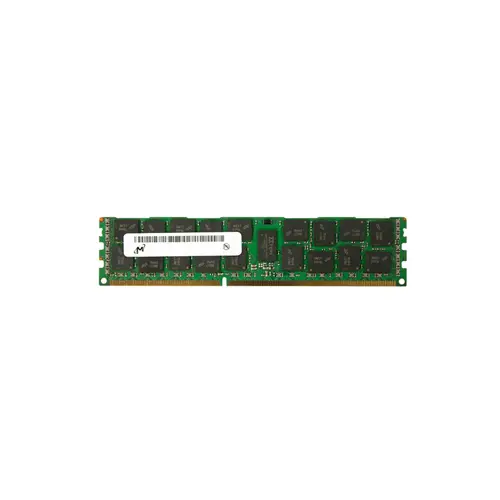
This 4GB DDR3-1333 RDIMM with ECC and registered signaling is purpose-built for entry-level servers and small-scale virtualization hosts where data integrity is paramount, such as lightweight hypervisors or memory-resident database caches. The single-rank x4 organization and CL9 latency ensure stable, low-load signal integrity on the memory bus, while the 1.35V low-voltage operation reduces thermal burden and power consumption in densely packed rackmount systems.
1. On-die ECC error correction silently detects and corrects single-bit faults, preserving transactional integrity and preventing silent data corruption in always-on database instances.
2. The registered clock driver buffers address and command signals, enabling stable multi-DIMM population per channel for maximal capacity and reliability under heavy virtualization workloads.
3. Operating at just 1.35 volts drastically lowers per-module power draw and cuts cooling demands, directly reducing datacenter TCO in dense rack deployments.
4. A Single Rank x4 design with x4-wide DRAMs strengthens advanced error containment and lightens electrical loading, sustaining signal integrity for consistent latency-sensitive application performance.
5. The 4 GB capacity provides a fine provisioning granularity, aligning memory footprint precisely with lightweight container hosts or edge workloads without costly over-allocation.
The Micron MT18KSF51272PZ-1G4 is a DDR3L Registered ECC DIMM built for always-on servers. Its four defining strengths translate directly to data-center reliability. ECC continually corrects single-bit errors, eliminating silent data corruption that could crash virtual machines across a virtualization cluster. The registered buffer stabilizes high-capacity configurations by reducing electrical loading, so you can fully populate every memory slot in a host without degrading signal integrity—critical when scaling RAM for a growing hypervisor fleet. At 1.35V, the module draws significantly less power than legacy 1.5V parts, meaningfully cutting cooling and electricity costs across dense server racks. The single-rank x4 organization delivers uniform low-latency access that excels with in-memory databases: CL9 at 1333MHz keeps Redis or real-time financial analytics responsive under heavy concurrent queries, preventing the latency spikes that erode transactional performance. Together, these features keep your services up, your capacity expansion simple, your total cost of ownership low, and your data-critical workloads running predictably fast.
General Virtualization
For lightweight virtualization hosts running multiple VMs, populate at least six identical 4 GB RDIMMs across triple‑channel memory banks to reach 24 GB total, which comfortably supports a dozen small Linux instances or several Windows Server guests. The 1.35 V low‑voltage operation and ECC protection help keep power and cooling costs in check while guarding against silent data corruption in multi‑tenant environments.
In-Memory Database
In‑memory databases such as Redis or SAP HANA demand capacity and fault resilience, so install eight or more of these 4 GB registered DIMMs to build a 32 GB+ pool – sufficient for moderate working sets. Populate all memory channels evenly to maximize bandwidth, and rely on the single‑rank x4 organization for lower electrical loading, which allows the memory controller to drive more ranks at full 1333 MHz speed.
High-Performance Computing (HPC)
For memory‑bandwidth‑bound HPC workloads, fill every DIMM slot on a dual‑socket server with these 4 GB RDIMMs to reach 64–128 GB while maintaining one DIMM per channel for peak throughput. The registered ECC design ensures calculation integrity across long‑running simulations, and the consistent CL9 latency across all channels guarantees predictable performance scaling in MPI‑based clusters.
Proven reliable server memory; compatible with Dell PowerEdge R720, HP ProLiant DL380p Gen8, and more.
Q: Can I mix this MT18KSF51272PZ-1G4 with other memory modules of different brands or speeds?
A: Mixing is not recommended for registered ECC server memory. Different brands or speeds may cause timing conflicts, stability issues, or fail to initialize. Always install identical modules for reliable operation.
Q: Is this memory compatible with my Intel or AMD server platform?
A: This DDR3-1333 RDIMM works with servers supporting registered ECC DDR3 memory, such as Intel Xeon E5/E3 v2 or AMD Opteron 4300 series. Please verify your motherboard’s memory QVL for guaranteed compatibility.
Q: What is the recommended DIMM population order for optimal performance in a server?
A: Populate identical DIMMs per channel, starting with the slot farthest from the CPU. For dual-socket servers, balance memory across both processors and follow the manufacturer’s slot numbering for maximum bandwidth.
Q: Does this module support overclocking or XMP profiles?
A: No. This is a standard JEDEC-compliant server memory module. It does not support overclocking or XMP profiles, as ECC RDIMMs prioritize data integrity and stability over maximum frequency.
Q: What warranty and typical failure rate can I expect?
A: This module includes a one-year warranty. With stringent manufacturing standards and RoHS compliance, the annualized failure rate is typically below 0.5% under normal server operating conditions.