











 Secure payments
Standard refund policy
Trade Assurance
Secure payments
Standard refund policy
Trade Assurance
| Product Type | Memory Module |
|---|---|
| Compliance Standards | RoHS |
| Memory Capacity | 4 GB |
| Memory Technology | DDR3 |
| Product Voltage | 1.35V |
| RAM Speed | 1333MHz |
| RAM Standard | DDR3-1333/PC3-10600 |
| Error Identifying | ECC |
| Signal Type | Registered |
| Column Access Strobe (CAS) | CL9 |
| Rank | Single Rank x4 |
| Quantity of Pins | 240-pin |
| RAM Genre | RDIMM |
This DDR3-1333 Registered ECC RDIMM is engineered for server platforms handling virtualization, in-memory databases, and mission-critical workloads where data integrity is paramount. Its single-rank x4 configuration and 1.35V low-voltage operation reduce power consumption and thermal load, while the registered signal type enhances signal stability in high-density memory configurations.
1. ECC protection proactively detects and corrects single-bit errors, preserving data integrity in mission-critical databases and financial transactions where even silent corruption is unacceptable.
2. Registered signal architecture buffers command and address lines, allowing servers to populate all memory channels densely without compromising stability under sustained heavy loads.
3. The RDIMM form factor ensures multi-generational server board compatibility and enables consistent, validated operation across scale-out data center deployments.
4. Single Rank x4 organization balances signal loading and DRAM page depth, optimizing cache-line accesses for virtualized environments with moderate memory bandwidth demands.
5. A modest capacity point keeps per-slot power draw low, making it an energy-efficient building block for hyper-scale clusters running lightweight containerized services.
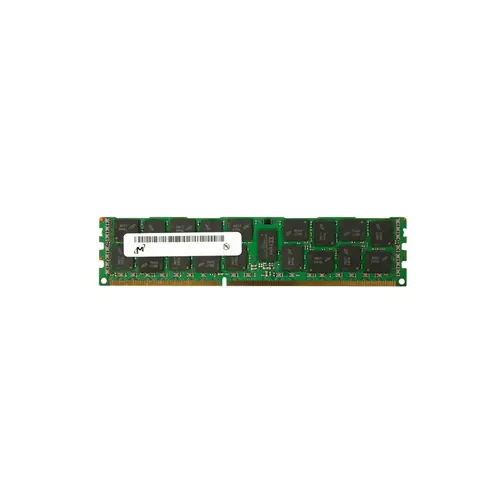
When you install this Micron 4GB DDR3-1333 RDIMM (MT18KSF51272PZ-1G4K1), you are hardening your server against silent data corruption rather than merely adding capacity. In virtualized clusters running multiple tenant workloads, the integrated ECC engine corrects single-bit errors in real time, preventing a flipped bit from crashing an entire VM or quietly corrupting financial transactions inside a database. For memory-intensive caching tiers and in-memory databases, the Registered buffer conditions command and address signals, stabilizing the platform even when every channel is fully populated. This directly eliminates the signal degradation that triggers sudden, costly boot failures in dense servers. The module’s 1.35V operation, compared to standard 1.5V, meaningfully lowers thermal load and ongoing power draw: in a rack of dozens of nodes, that efficiency compounds into reduced cooling OPEX and longer component life. Additionally, the Single Rank x4 organization guarantees clean command timing and wide platform compatibility, delivering consistent 1333MHz throughput without the latency penalties of dual-rank setups. The result is predictable SQL query response and seamless live migration, keeping mission-critical services available around the clock.
General Virtualization
For moderate-density virtualization hosts, this 4 GB registered DDR3-1333 module can serve as a baseline. Deploy six to twelve identical modules per server (24–48 GB total) to balance cost and VM density, ensuring all channels are populated for optimal interleaving. Stick to homogeneous configurations to maintain ECC integrity and avoid performance penalties from mixed ranks.
In-Memory Database
In-memory databases demand both capacity and reliability, so pair multiple 4 GB RDIMMs for a minimum of 64 GB across all memory channels. Use a fully balanced setup—typically 16 identical modules in a dual-socket system—to maximize throughput at 1333 MT/s while leveraging registered ECC for data protection. Avoid mixing single-rank x4 DIMMs with different CAS latencies to ensure stable low-latency operations.
High-Performance Computing (HPC)
HPC clusters often prioritize bandwidth over sheer capacity, so populate every memory channel with one of these 4 GB RDIMMs (e.g., 8 or 16 modules per node) to achieve peak theoretical bandwidth. The 1.35 V low-voltage operation helps reduce power draw across dense nodes, and registered ECC safeguards long-running calculations. For memory-bound workloads, consider scaling node count horizontally rather than increasing per-node capacity beyond 64 GB.
Rigorously tested server memory, compatible with Dell PowerEdge R710, R720, HP DL360p Gen8, Lenovo ThinkServer RD430.
Q: Can I mix this MT18KSF51272PZ-1G4K1 with other memory modules of different brands or speeds?
A: Mixing RDIMMs of different brands or speeds is not recommended. It can cause instability, force lower speeds, or prevent system boot. Use identical modules for reliable performance.
Q: Is this memory compatible with my Intel or AMD server platform?
A: This DDR3-1333 Registered ECC module is compatible with servers supporting dual-rank RDIMMs, such as Intel Xeon E5-2400/2600 v1 and v2 or AMD Opteron 6300 series. Ensure 1.35V operation is supported by the board.
Q: What is the recommended DIMM population order for optimal performance?
A: Install identical modules per channel, starting with the first slot (commonly blue) on each memory channel. Follow the motherboard’s guide to balance across channels for maximum bandwidth and interleaving.
Q: Does this module support overclocking or XMP profiles?
A: No. As a server-grade Registered ECC DIMM, it strictly follows JEDEC standards. Overclocking and XMP profiles are not supported to ensure maximum data integrity and 24/7 stability in enterprise environments.
Q: What warranty and typical failure rate can I expect?
A: This module is backed by a 1-year warranty. Manufactured with high-quality, tightly-screened components, it delivers a very low annualized failure rate typical of Micron’s enterprise server memory.