











 Secure payments
Standard refund policy
Trade Assurance
Secure payments
Standard refund policy
Trade Assurance
| Product Type | Memory Module |
|---|---|
| Memory Capacity | 4 GB |
| Memory Technology | DDR3 |
| Product Voltage | 1.5V |
| RAM Speed | 1333MHz |
| RAM Standard | DDR3-1333/PC3-10600 |
| Error Identifying | ECC |
| Signal Type | Unbuffered |
| Column Access Strobe (CAS) | CL9 |
| Rank | Dual Rank x8 |
| Quantity of Pins | 240-pin |
| RAM Genre | UDIMM |
This unbuffered ECC UDIMM is tailored for entry-level servers and workstations, delivering single-bit error correction critical for data integrity in lightweight virtualization and memory-resident database tasks. Its dual-rank x8 organization leverages rank interleaving to improve bandwidth efficiency, while the unbuffered architecture ensures minimal latency for latency-sensitive operations.
1. ECC error correction safeguards critical data integrity, preventing silent memory errors that could compromise financial transactions or authentication services in small business servers.
2. Unbuffered UDIMM construction eliminates register latency, delivering straightforward signal paths that improve boot reliability for cost-conscious NAS and edge appliances.
3. Dual Rank x8 organization doubles the bank count for interleaved accesses, maintaining steady throughput under mixed read/write loads typical of light virtualization hosts.
4. DDR3-1333 speed yields a peak transfer rate suitable for stable, moderate concurrency, matching the needs of legacy enterprise platforms where consistent operation outweighs raw bandwidth.
5. Four-gigabyte capacity handles base hypervisor footprints and container runtimes efficiently, maximizing deployable units per node in dense microserver clusters.
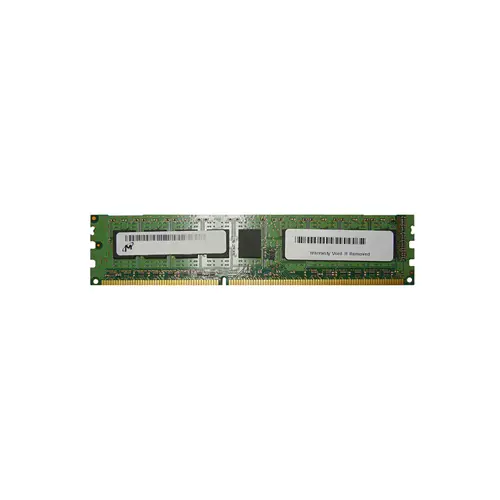
Designed for entry-level servers and workstations, the Micron MT18JSF51272AZ-1G4K1 is an ECC Unbuffered DDR3 module that brings mission-critical reliability to environments where data accuracy is non-negotiable. In a virtualized cluster running multiple lightweight VMs, a single undetected bit-flip in memory can corrupt guest operating systems or silently propagate errors into your storage stack. The integrated ECC engine actively detects and corrects single-bit errors in real time, meaning your hypervisor stays stable and your overnight batch jobs complete without silent data corruption. When paired with a memory-intensive in-memory database like Redis or a small MySQL instance, the dual-rank x8 organization increases bank-level parallelism, delivering consistently lower latency under high query concurrency. This isn’t just about speed, it's about predictable response times during peak loads. Furthermore, the standard 1.5V operating voltage ensures broad compatibility with a wide range of server boards while keeping thermals predictable inside dense 1U chassis. For the IT administrator, this translates to fewer unexplained crashes, reduced memory-related support tickets, and a platform that scales your on-premises workloads without compromising data integrity.
General Virtualization
For a hypervisor hosting multiple lightweight VMs, deploy these 4GB ECC UDIMMs in matched pairs to populate both memory channels. A configuration of four modules (16GB total) supports 8–10 typical virtual machines; scaling to eight modules (32GB) provides headroom for memory overcommitment and future growth. Always balance each channel identically to maintain stable error correction and symmetric memory access.
In‑Memory Database
A memory-resident database such as Redis or SAP HANA demands maximum capacity and data integrity. Fill every available DIMM slot with these 4GB modules—8 slots yielding 32GB is a practical starting point for moderate datasets. The ECC protection is critical here to guard against single‑bit corruption in “hot” data, so populate all channels evenly to avoid NUMA penalties on multi‑socket platforms while leveraging the dual‑rank design for improved command‑per‑clock efficiency.
High Performance Computing (HPC)
HPC workloads thrive on memory bandwidth. Install modules in identical pairs per channel to enable dual‑channel interleaving. A cluster node equipped with four of these dual‑rank x8 DIMMs (16GB total) delivers consistent 1333‑MT/s throughput for simulation pre‑processing or distributed tasks. For memory‑bandwidth‑bound codes, avoiding mixed ranks and keeping all channels equally loaded reduces access latency, while ECC scrubbing safeguards long‑running compute jobs against silent data errors.
Rigorously tested server DDR3 UDIMM ECC memory. Compatible with Dell PowerEdge R210 II, HP ML110 G7, Lenovo TS140.
Q: Can I mix this MT18JSF51272AZ-1G4K1 with other memory modules of different brands or speeds?
A: Not recommended. Mixing ECC UDIMMs of different brands or speeds may cause stability issues and disabled ECC. For reliable server operation, use identical modules with matching part numbers.
Q: Is this memory compatible with my system?
A: It is compatible with Intel Xeon E3 and AMD Ryzen/Opteron platforms that support DDR3 ECC unbuffered memory. Verify your motherboard specifically accepts 240-pin 1.5V UDIMM with ECC.
Q: What is the recommended DIMM population order for optimal performance?
A: Populate identical modules per channel to enable dual-channel mode. Refer to your server motherboard manual for the correct slot sequence, typically starting with the primary slots of each channel.
Q: Does this module support overclocking or XMP profiles?
A: No. This is a JEDEC-compliant DDR3-1333 CL9 module designed for server reliability. It does not support overclocking or XMP profiles, as data integrity takes precedence over speed.
Q: What warranty and typical failure rate can I expect?
A: It includes a one-year limited warranty. As an enterprise-grade ECC module, it demonstrates extremely low annualized failure rates, typically below 0.5% under normal operating conditions.