











 Secure payments
Standard refund policy
Trade Assurance
Secure payments
Standard refund policy
Trade Assurance
| Model | MT18KSF51272AZ-1G4M2 |
|---|---|
| Product Type | Memory Module |
| Compliance Standards | RoHS |
| Memory Capacity | 4 GB |
| Memory Technology | DDR3 |
| Product Voltage | 1.35V |
| RAM Speed | 1333MHz |
| RAM Standard | DDR3-1333/PC3-10600 |
| Error Identifying | ECC |
| Signal Type | Unbuffered |
| Column Access Strobe (CAS) | CL9 |
| Rank | Dual Rank x8 |
| Quantity of Pins | 240-pin |
| RAM Genre | UDIMM |
Given its UDIMM form factor with ECC functionality and 1.35V low-voltage operation, this DDR3-1333 module is tailored for entry-level servers and workstations where data integrity is paramount. Its dual-rank x8 organization and ECC error correction deliver stable, reliable throughput ideal for light virtualization, file serving, and memory-sensitive productivity tasks that demand consistent uptime.
1. ECC detects and corrects single-bit errors in real time, preserving transactional data integrity for entry-level server workloads where silent corruption is unacceptable.
2. Unbuffered signal type trims command latency by eliminating the register chip, making it suitable for microsecond-sensitive applications in dedicated hosting or caching appliances.
3. Low 1.35V operation keeps thermal output and power draw minimal in dense rack-mount deployments, directly lowering ongoing energy costs for small datacenter environments.
4. Dual Rank x8 organization interleaves two groups of memory banks, maintaining steady bandwidth during heavy multi-process loads such as virtualized container instances.
5. A 4 GB capacity fits precisely into lightweight virtualization nodes or edge servers, balancing per-slot density with cost constraints when populating single-socket cost-sensitive builds.
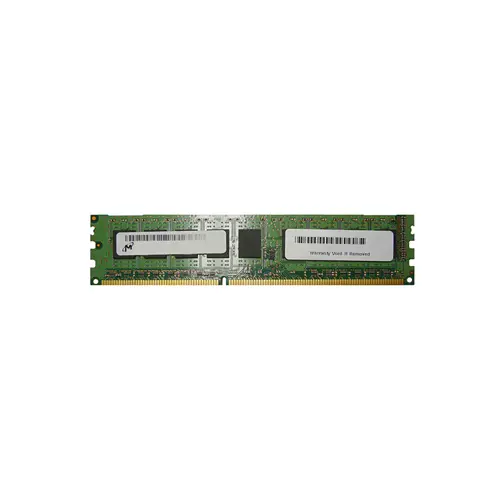
The Micron MT18KSF51272AZ-1G4M2 is a 4GB DDR3L UDIMM with ECC designed for entry‑level servers and workstations. ECC is non‑negotiable in a virtualization host because a single cosmic ray can silently flip a bit, corrupting hypervisor state and crashing multiple guest VMs; ECC detects and corrects single‑bit errors instantly, safeguarding 24/7 uptime and your data’s integrity. The 1.35V low‑voltage operation directly tackles power and thermal constraints in a microserver or storage node that runs around the clock — it reduces heat dissipation and electricity costs across dense deployments, making scaling sustainable. The dual‑rank x8 architecture enables rank interleaving, which lets the memory controller pipeline requests and sustains higher bandwidth; this translates into an in‑memory database like Redis staying responsive under concurrent user loads, retrieving keys without stalling. The unbuffered design eliminates register chip latency, giving latency‑sensitive caching workloads a faster command‑to‑data response. For an IT manager, this means a power‑sipping, reliable module that prevents silent data corruption and helps virtualized services and databases feel tangibly snappier, delivering enterprise‑class reliability without the premium of registered memory.
General Virtualization
Populate all available memory channels with identical 4 GB ECC UDIMMs—four modules for a 16 GB dual‑channel foundation—to comfortably host several light to medium virtual machines. The ECC protection guards guest data against single‑bit errors during continuous hypervisor operation. For heavier VM consolidation, expand to eight modules (32 GB) while keeping matched ranks to preserve system stability.
In‑Memory Database
Maximize capacity by installing eight of these low‑voltage 4 GB ECC UDIMMs, delivering 32 GB of resilient storage for demanding in‑memory datasets. The unbuffered ECC design immediately corrects memory faults that could corrupt cached transactions or index tables. Consistent dual‑rank x8 DIMMs and 1.35 V operation help maintain thermal headroom inside densely packed 24×7 servers.
High‑Performance Computing
Fit balanced dual‑channel sets—four or eight modules—to provide the bandwidth that parallelized HPC codes require, with 16 GB or 32 GB total per node. ECC ensures computational accuracy across lengthy jobs, while the DDR3‑1333 CL9 timing and 1.35 V draw keep cluster energy costs in check. Uniform module population across nodes guarantees predictable, repeatable runtimes in scale‑out deployments.
Rigorously tested server memory, validated for Dell PowerEdge T20, HP MicroServer Gen8, and Lenovo ThinkServer TS140.
Q: Can I mix this MT18KSF51272AZ-1G4M2 with other memory modules of different brands or speeds?
A: Mixing is not recommended for server environments. Unmatched DIMMs can compromise ECC integrity, force lower speeds, and cause instability. Identical modules are strongly advised to ensure validated reliability and performance.
Q: Is this memory compatible with my system?
A: This ECC Unbuffered DDR3 module is designed for single-socket Intel Xeon E3/E5 or AMD Opteron 4000 platforms. Please verify your motherboard or CPU specifically supports 1.35V UDIMM ECC memory, not registered RDIMMs.
Q: What is the recommended DIMM population order for optimal performance?
A: Populate identical modules per channel starting with the slots furthest from the CPU. For dual-rank configurations, filling symmetrical blue or black slots first enables balanced interleaving and maximizes memory bandwidth.
Q: Does this module support overclocking or XMP profiles?
A: No. As a server-class ECC DIMM, it strictly adheres to JEDEC DDR3-1333 at CL9. Overclocking and XMP are not supported, as they would jeopardize data integrity and the error correction function.
Q: What warranty and typical failure rate can I expect?
A: This module carries a 1-year warranty. Typical failure rates are extremely low for this mature, industrial-grade ECC UDIMM, far below 0.5% AFR under specified operating conditions.