











 Secure payments
Standard refund policy
Trade Assurance
Secure payments
Standard refund policy
Trade Assurance
| Product Type | Memory Module |
|---|---|
| Compliance Standards | RoHS |
| Memory Capacity | 4 GB |
| Memory Technology | DDR3 |
| Product Voltage | 1.5V |
| RAM Speed | 1333MHz |
| RAM Standard | DDR3-1333/PC3-10600 |
| Error Identifying | ECC |
| Signal Type | Unbuffered |
| Column Access Strobe (CAS) | CL9 |
| Rank | Dual Rank x8 |
| Quantity of Pins | 240-pin |
| RAM Genre | UDIMM |
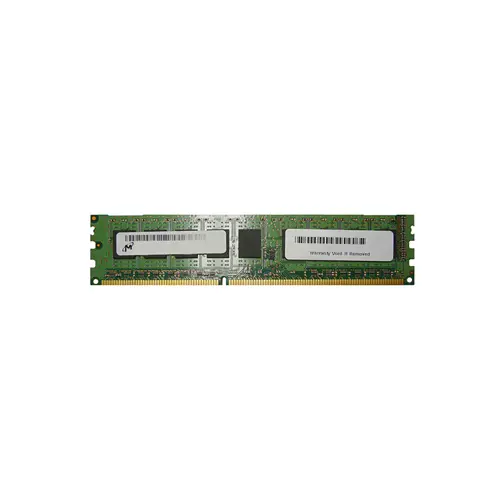
This DDR3-1333 ECC unbuffered DIMM is engineered for entry-level servers and single-socket workstations where data integrity is paramount, employing error-correcting code to detect and correct single-bit memory errors in critical environments. The dual-rank x8 organization improves interleaved memory access for steady bandwidth, making it particularly suitable for reliable virtualization, lightweight database applications, and business continuity workloads that leverage its registered-free signal path for compatible chipset stability.
1. ECC error correction silently resolves single-bit faults in real time, preserving data accuracy for critical log-aggregation and light database roles where integrity is non-negotiable.
2. Unbuffered signal topology removes register delays, keeping memory access latency low for micro-services that demand fast, jitter-free responses.
3. Dual Rank x8 arrangement enables rank interleaving, amplifying sustained throughput to prevent bottlenecks during simultaneous backups and monitoring tasks.
4. 1333 MHz clock delivers 10.6 GB/s of peak bandwidth, comfortably supporting mid-density app hosting without saturating the memory bus.
5. CAS 9 timing tightens column access, accelerating small-block transactions that enhance OLTP query performance on entry-level server nodes.
Designed for entry-level servers and workstations, this DDR3 UDIMM with ECC turns memory from a potential liability into a pillar of dependability. The ECC engine continuously corrects single-bit errors, which is non-negotiable when you run a small business file server or a lightweight virtualization host where even one flipped bit can corrupt financial records or crash a customer-facing VM. Because it is unbuffered, the module eliminates the extra clock cycle of registered memory, delivering lower latency right where it matters most—accelerating cache lookups in a ZFS-based NAS or keeping response times snappy during multi-user database queries. The dual-rank x8 organization ensures that while one rank is being accessed, the other can prepare data, effectively boosting sustained bandwidth for real workloads such as concurrent 1080p media transcodes or continuous data replication between nodes. Operating at 1.5V with CL9 timing, it operates within a proven thermal envelope, allowing dense deployments in 1U chassis to stay cool without throttling. This combination of error correction, low-latency signaling, interleaved throughput, and predictable power draw means you can consolidate those four wall-powered microservers into one reliable platform, protecting your data integrity and maintaining seamless availability around the clock.
Memory type: Server DDR3 ECC unbuffered DIMM (UDIMM).
General Virtualization
Populate all DIMM slots with identical 4GB modules to maximise capacity. A typical single-socket server with four slots provides 16GB, comfortable for 4–5 light VMs. For denser consolidation, select an eight-slot board to reach 32GB; always fill every memory channel to sustain bandwidth and enable safe memory overcommitment.
In-Memory Database
Install one 4GB module per memory channel to utilise full bandwidth, delivering 16GB on a quad-channel platform—adequate only for small test datasets. Where the board supports two DIMMs per channel, install matched pairs to reach 32GB. Be aware that legacy 4GB density tightly caps in-memory dataset size for any production workload.
High-Performance Computing
Configure one dual-rank 4GB DIMM per channel to guarantee symmetric interleaving and consistent 1333MT/s CL9 latency. A four-channel HPC node therefore receives 16GB of uniformly addressed memory, eliminating bandwidth bottlenecks during parallel simulations. Never mix capacities; identical modules ensure deterministic, repeatable performance.
Rigorously tested server memory, compatible with Dell PowerEdge T110 II, HP ProLiant MicroServer Gen8, Lenovo ThinkServer TS130.
Q: Can I mix this MT18JSF51272AZ-1G4 with other memory modules of different brands or speeds?
A: Mixing is possible if the modules share identical DDR3-1333 speed, ECC, unbuffered type, and CL9 timing. However, same-rank configurations are strongly recommended to avoid stability risks in server environments.
Q: Is this memory compatible with my server? What platforms are supported?
A: This ECC UDIMM is designed for single-socket servers/workstations using Intel Xeon E3 series or AMD Opteron 4000/3000 platforms with appropriate chipsets. Verify board ECC UDIMM support before purchasing.
Q: What is the recommended DIMM population order for optimal performance?
A: Install identical modules in matching slots per the server’s user guide, typically starting with blue slots for channel-A. Populating all channels symmetrically ensures proper ECC operation and peak memory bandwidth.
Q: Does this module support overclocking or XMP profiles?
A: No, server DDR3 ECC UDIMMs do not support XMP or overclocking. The module adheres to JEDEC DDR3-1333 CL9 standards, prioritizing data integrity and 24/7 stability over adjustable speed profiles.
Q: What warranty and typical failure rate can I expect from this memory?
A: This product includes a one-year warranty. Server-grade ECC memory exhibits a very low annualized failure rate under normal operating conditions when properly cooled and handled. Advanced replacement support is available.