











 Secure payments
Standard refund policy
Trade Assurance
Secure payments
Standard refund policy
Trade Assurance
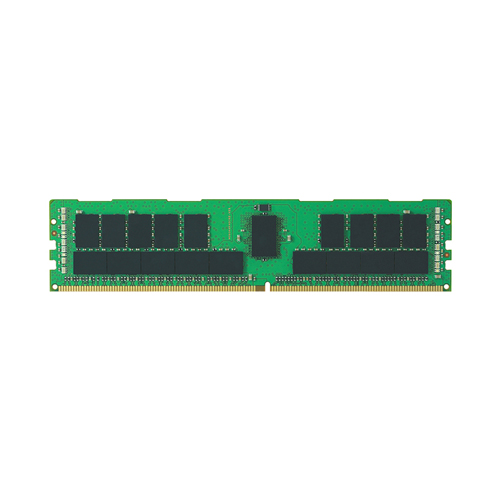
| Product Type | Memory Module |
|---|---|
| Memory Capacity | 4 GB |
| Memory Technology | DDR3 |
| RAM Standard | DDR3-1333/PC3-10600 |
| Error Identifying | ECC |
| Signal Type | Unbuffered |
| Column Access Strobe (CAS) | CL9 |
| Rank | Dual Rank |
| Quantity of Pins | 240-pin |
| RAM Genre | DIMM |
This unbuffered ECC DIMM with a dual-rank configuration and CL9 latency is optimized for entry-level servers and workstations where data integrity is critical. It delivers reliable performance in memory-intensive workloads such as virtualization and light database applications, with dual-rank interleaving improving bandwidth efficiency under load.
1. ECC error correction detects and corrects single-bit memory faults in real time, safeguarding financial transactions and database integrity against silent data corruption.
2. Dual Rank interleaving boosts effective bandwidth under multi-threaded workloads, ensuring smooth virtual machine responsiveness even when overcommitment peaks.
3. Unbuffered signal topology lowers electrical loading for reduced latency, which benefits single-socket server nodes running latency-sensitive edge analytics.
4. Four-gigabyte capacity per module hits a sweet spot for lightweight hypervisor deployments, maximizing density without wasting memory on underutilized containers.
5. DDR3-1333 mainstream frequency balances throughput and power budget, sustaining stable web hosting and file-serving operations while keeping platform thermals predictable.
Based on its 240-pin DIMM form factor, ECC capability, and unbuffered signaling, the MT18JSF51272AZ-1G4K2 is a server memory module built to solve real infrastructure challenges. Its ECC protection is non-negotiable for virtualized environments: a single-bit error triggered by cosmic radiation or aging silicon can silently corrupt guest memory, causing workload crashes or data inconsistencies. This module detects and corrects those errors on the fly, preserving cluster-wide stability and preventing unplanned outages. When running memory-resident databases like MySQL or in-memory caches, the dual-rank organization maximizes bus efficiency by interleaving commands across two internal rank groups, reducing idle gaps and boosting sustained bandwidth per channel. Meanwhile, the unbuffered architecture strips away the register chip’s clock latency found in RDIMMs, so read access times drop dramatically—a critical advantage where microseconds directly define transaction throughput. In a multi-slot server board, this 4GB DDR3-1333 module lets you scale capacity while delivering the error-free, low-latency data pipeline your users and services depend on.
General Virtualization
For typical hypervisor consolidation, provision 24–32 GB by installing six to eight 4 GB ECC UDIMMs evenly across memory channels (e.g., three modules per channel in a triple‑channel server). Dual‑rank modules boost interleaving efficiency, and ECC protection guards against soft errors, maintaining stability for multiple virtual machines. Keep population symmetric and leave a few slots free for future scaling to avoid bandwidth bottlenecks.
In-Memory Database
In-memory databases demand maximum capacity with uncompromised integrity. Fill every available DIMM slot to reach at least 64 GB (sixteen 4 GB modules). The ECC feature corrects single-bit errors, while mirroring or sparing modes, if supported, add resilience for critical datasets. Given the limited per‑module capacity, prioritize slot density over raw speed, but the dual‑rank, CL9 DDR3-1333 still provides consistent low-latency access.
High-Performance Computing
For HPC workloads, configure a balanced quad‑channel layout using eight identical 4 GB modules (32 GB total) to sustain uniform memory bandwidth. The dual‑rank design and CL9 timing deliver predictable latency, essential for tightly coupled parallel jobs. ECC ensures result accuracy during extended simulation runs, and strict module‑batch uniformity avoids NUMA imbalances or clock skew across nodes.
Rigorously tested server memory, compatible with Dell PowerEdge T20, HP ProLiant ML310e Gen8, Lenovo ThinkServer TS140.
Q: Can I mix this MT18JSF51272AZ-1G4K2 with other memory modules of different brands or speeds?
A: Mixing is not recommended for server environments. Even identical specs from different brands may cause instability. Populate with matched ECC unbuffered DIMMs to maintain data integrity and avoid unexpected POST or memory errors.
Q: Is this memory compatible with my Intel Xeon or AMD Opteron server platform?
A: It is compatible with platforms supporting DDR3 ECC unbuffered DIMMs, such as Intel Xeon E3-1200 series or select AMD Opteron 3000 series. Verify board supports 240-pin PC3-10600 and unbuffered ECC memory.
Q: What is the recommended DIMM population order for optimal performance?
A: Install identical dual-rank modules identically across memory channels. Typically populate blue slots first for channel A, then black slots. Follow server board manual for mirroring or independent channel modes to balance interleaving.
Q: Does this module support overclocking or XMP profiles?
A: No. This is a server-class ECC DIMM conforming to JEDEC DDR3-1333 standard. It does not support XMP or overclocking; stability and data integrity are prioritized over higher frequencies.
Q: What warranty and typical failure rate can I expect?
A: This module includes a 1-year warranty. Typical annualized failure rate is below 0.2% for quality ECC DIMMs under proper thermal conditions. Advanced replacement is available for mission-critical deployments.