











 Secure payments
Standard refund policy
Trade Assurance
Secure payments
Standard refund policy
Trade Assurance
| Product Type | Memory Module |
|---|---|
| Compliance Standards | RoHS |
| Memory Capacity | 4 GB |
| Memory Technology | DDR3 |
| Product Voltage | 1.35V |
| RAM Speed | 1333MHz |
| RAM Standard | DDR3-1333/PC3-10600 |
| Error Identifying | ECC |
| Signal Type | Unbuffered |
| Column Access Strobe (CAS) | CL9 |
| Rank | Dual Rank x8 |
| Quantity of Pins | 240-pin |
| RAM Genre | UDIMM |
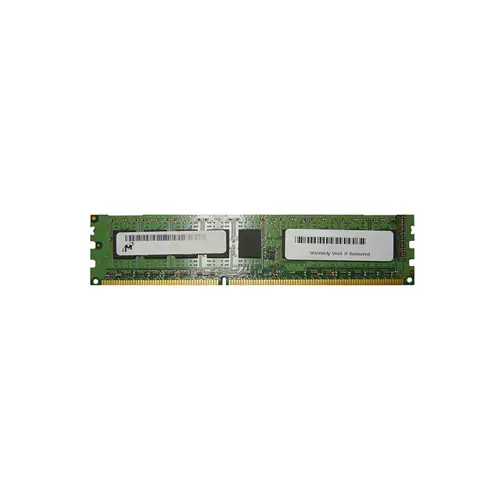
This 4 GB DDR3-1333 UDIMM with ECC and a 1.35 V operating voltage is engineered for entry-level servers and workstations that demand data integrity without the cost of registered memory. Its dual-rank x8 organization enhances signal loading and compatibility on single-socket platforms, while the unbuffered ECC design reliably corrects single-bit errors—making it ideal for light virtualization, file serving, and memory-sensitive stability tasks.
1. ECC protection corrects single-bit errors on the fly, preserving data integrity for financial transactions and database queries in always-on server environments.
2. Dual Rank x8 organization interleaves memory accesses to maximize channel utilization, which reduces stutter and improves responsiveness under heavy virtualization loads.
3. 1.35V low-voltage operation lowers overall server power consumption and heat dissipation, allowing higher rack density without compromising energy budgets.
4. 1333MHz clock speed provides dependable, sustained throughput critical for microservices and caching layers where predictable latency outweighs peak burst performance.
5. DDR3 technology delivers a mature, widely validated compatibility baseline for legacy server fleets, minimizing downtime and simplifying spare-part management in heterogeneous data centers.
Judging by the 240-pin UDIMM form factor with ECC and Unbuffered signal type, the MT18KSF51272AZ-1G4K1 is a server-grade memory module purpose-built for entry-level servers and workstations where data integrity meets cost-effectiveness. In always-on environments, four specific characteristics translate directly into operational resilience.
First, Error Correcting Code (ECC) is non-negotiable. In a small business running a virtualized file server and a lightweight CRM on a single hypervisor, a single-bit error caused by background radiation can silently corrupt financial records or cause a hypervisor crash, taking down multiple critical services. This module’s ECC automatically detects and corrects such errors, preserving uptime and preventing silent data degradation. Second, the 1.35V low operating voltage is a vital asset in a 24/7 micro data center. When you deploy multiple modules in a network-attached storage (NAS) unit or an entry-level domain controller, the reduced thermal output low voltage provides lowers cooling costs, extends the lifecycle of motherboard voltage regulators, and improves long-term stability inside tight, passively cooled server chassis. Third, its Dual Rank x8 organization enhances bandwidth through rank interleaving. For a database-driven inventory system where multiple concurrent queries hit the in-memory dataset, the memory controller can seamlessly alternate between ranks, hiding precharge latencies and delivering consistently lower average transaction times under load. Finally, 1333MHz with CL9 latency strikes the optimal balance between speed and signal integrity on a standard unbuffered bus, ensuring conditional plug-and-play compatibility with a wide range of Intel Xeon E3 or AMD Opteron 3000 platforms without complex tuning. Together, these characteristics turn a modest 4 GB module into a cornerstone of reliable, energy-conscious infrastructure.
General Virtualization
For a dense virtualization host, we recommend populating all available memory channels with identical 4 GB ECC UDIMMs to maximize capacity while maintaining balanced interleaving. Aim for a minimum of 32 GB (eight modules) for light workloads, scaling to 64 GB or more by fully occupying the board’s DIMM slots. The 1.35V low-voltage operation helps reduce power and cooling overhead in always-on environments.
In-Memory Database
In-memory databases demand the lowest possible latency, so install at least eight 4 GB modules (32 GB) in a balanced multi-channel configuration to sustain high throughput for real-time analytics. If the dataset exceeds 32 GB, scale up to 64 GB using the maximum supported DIMM slots, ensuring all modules are identical Dual Rank x8 ECC parts to avoid performance penalties from rank imbalances. The ECC protection is critical to prevent silent data corruption in transactional workloads.
High-Performance Computing (HPC)
HPC clusters benefit from memory bandwidth as much as capacity: populate all memory channels symmetrically with these ECC UDIMMs to enable maximum interleaving. A typical node configured with 16 GB (four modules) is adequate for light simulation tasks, while 32 GB (eight modules) suits moderate compute nodes. Ensure the 1333 MT/s speed and CL9 latency are uniformly applied across all ranks to avoid throttling in parallel MPI jobs.
Rigorously tested server/workstation memory; compatible with Dell PowerEdge T110 II, R210 II, HP ML110 G7, Lenovo TS140, Dell Precision T1650.
Q: Can I mix this MT18KSF51272AZ-1G4K1 with other memory modules of different brands or speeds?
A: Mixing is not recommended for server environments. Different brands or speeds can cause instability. For reliable ECC operation, install identical modules with the same part number, rank, and timings.
Q: Is this memory compatible with my system?
A: This ECC Unbuffered DDR3L module supports Intel Xeon E3 series and select AMD AM3+ platforms. Verify your server board specifically requires 240-pin ECC UDIMMs at 1.35V/1333MHz before purchase.
Q: What is the recommended DIMM population order for optimal performance?
A: Populate identical DIMMs per channel, starting with the slots furthest from the CPU. On dual-channel ECC platforms, install in matched pairs to enable full ECC and memory interleaving.
Q: Does this module support overclocking or XMP profiles?
A: No. This is a JEDEC-compliant server module operating at fixed 1333MHz with CL9. It does not support XMP profiles. Overclocking is unsupported and would compromise ECC data integrity.
Q: What warranty and typical failure rate can I expect?
A: It carries a 1-year warranty. The field-tested annualized failure rate (AFR) is under 0.5% in controlled server environments, assuming proper cooling and adherence to rated voltage specifications.