











 Secure payments
Standard refund policy
Trade Assurance
Secure payments
Standard refund policy
Trade Assurance
| Product Type | Memory Module |
|---|---|
| Compliance Standards | RoHS |
| Memory Capacity | 4 GB |
| Memory Technology | DDR3 |
| Product Voltage | 1.35V |
| RAM Speed | 1333MHz |
| RAM Standard | DDR3-1333/PC3-10600 |
| Error Identifying | ECC |
| Signal Type | Unbuffered |
| Column Access Strobe (CAS) | CL9 |
| Rank | Dual Rank x8 |
| Quantity of Pins | 240-pin |
| RAM Genre | UDIMM |
This UDIMM with ECC and a low 1.35V operating voltage is best suited for entry-level servers and small-business NAS systems where data integrity is critical for light virtualization or reliable file storage. Its Dual Rank x8 organization enhances memory interleaving for improved bandwidth efficiency, while the ECC engine actively corrects single-bit errors to prevent silent data corruption in always-on environments.
1. ECC error correction actively detects and corrects single-bit memory faults in real time, shielding always-on microserver workloads from silent data corruption.
2. Unbuffered signal topology eliminates the buffer chip to deliver lower access latency, a tangible advantage for latency-sensitive services like lightweight database engines and web caching.
3. Dual Rank x8 organization leverages interleaved bank accesses to sustain higher effective bandwidth under concurrent requests, boosting virtual machine responsiveness on entry-level virtualization hosts.
4. A four-gigabyte capacity maps cleanly to dedicated appliance roles such as firewall, DNS, or print servers, keeping the bill-of-materials lean while covering headless workload requirements.
5. The conservative 1333 MT/s transfer rate paired with CL9 timings yields predictable access patterns and energy-efficient operation, ideal for thermally constrained server enclosures running around the clock.
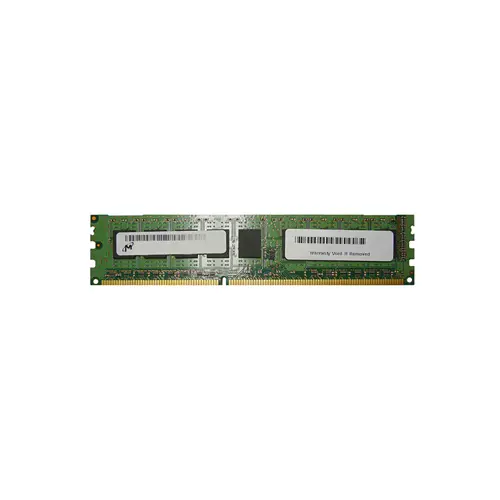
The MT18KSF51272AZ-1G4M1 is a server and workstation memory module, distinguished by its 240-pin UDIMM form factor, unbuffered architecture, and integrated ECC. In mission‑critical environments, its error‑correcting code actively detects and corrects single‑bit data corruption caused by background radiation or electrical noise. For a small business running a virtualized Active Directory and a lightweight database on the same hypervisor, this means silently flipped memory bits will not cascade into domain controller lock‑outs or broken records—directly translating into uptime and data trustworthiness.
The dual‑rank x8 organization interleaves accesses across two internal ranks, effectively overlapping command cycles to maximize the sustained bandwidth of its 1333 MHz clock. When an in‑memory analytics database like Redis processes thousands of concurrent queries, that extra throughput reduces transaction latency and prevents CPU stalls. Meanwhile, the module’s low 1.35 V supply voltage cuts thermal load inside compact 1U server chassis, which is critical in space‑constrained co‑location racks where every watt saved lowers cooling costs and extends component lifespan. Combined with the unbuffered design that eliminates the register delay penalty, this UDIMM delivers the fastest signal path for entry‑level servers that demand both native performance and hardware‑grade data integrity without the power bill of legacy 1.5 V memory.
General Virtualization
For modest virtualization hosts using ECC UDIMMs, populate four 4GB modules to achieve 16GB total across dual channels, enabling reliable operation for 3–5 light VMs. Stick to identical dual-rank DIMMs for balanced interleaving and minimal memory latency. Avoid mixing unbuffered ECC with non-ECC modules to preserve single-bit error correction.
In-Memory Database
An in-memory database demands capacity far beyond a single 4GB stick, so deploy eight identical 4GB ECC UDIMMs in a dual-socket board for 32GB total, using all channels per CPU. The 1.35V low-voltage spec reduces thermal load during sustained cache workloads. ECC is non-negotiable here to guard against silent data corruption.
High Performance Computing
In HPC clusters where memory bandwidth is crucial, install six 4GB UDIMMs (24GB) across triple-channel architectures common on X58/Xeon E3 platforms, leveraging dual-rank x8 organization for superior command-rate stability. Select modules with matched CAS 9 latency to sustain peak floating-point throughput under MPI workloads without throttling.
Rigorously tested, this 4GB DDR3-1333 ECC UDIMM fits servers like Dell PowerEdge R210 II, T110 II, and HP ProLiant MicroServer Gen8.
Q: Can I mix this MT18KSF51272AZ-1G4M1 with other memory modules of different brands or speeds?
A: Mixing ECC UDIMMs from different brands or speeds is not recommended. Identical part numbers ensure signal integrity, proper error correction, and system stability in server environments.
Q: Is this memory compatible with my server or workstation system?
A: It requires a platform supporting DDR3 ECC unbuffered DIMMs, such as Intel Xeon E3-1200 series or AMD Opteron 3000/4000 series with relevant C204/C206 chipsets. Verify your board's QVL list.
Q: What is the recommended DIMM population order for optimal performance?
A: Install dual-rank modules in the first slot of each memory channel (often slots 1 and 3) to enable dual-channel symmetric mode. Always follow the motherboard's population guide for balanced ECC interleaving.
Q: Does this module support overclocking or XMP profiles for increased speed?
A: No. This server-grade ECC UDIMM is built to strict JEDEC standards at 1333MHz. It focuses on data integrity and reliability rather than overclocking or XMP performance profiles.
Q: What warranty and typical failure rate can I expect with this memory?
A: This module includes a one-year warranty. Engineered with RoHS-compliant components and ECC, the expected annualized failure rate (AFR) is well below industry averages under specified operating conditions.